Featured Post

WELCOME TO RUSSELL ARBEN FOX'S HOME PAGE

If you're a student looking for syllabi, click the "Academic Home Page" link on your right, and start there.

Showing posts with label Populism. Show all posts

Wednesday, August 03, 2022

Seven Theses on Kansas, "Popularism," and Value Them Both

Well, my predictions from yesterday were wrong (mostly; I was still right about Kris Kobach getting the Republican Attorney General nomination). And while the image I used yesterday to reflect the diversity of the No campaign here in Wichita didn't unintentionally predict the final state-wide vote totals (59% voted No, not 75%), the fact is it was a lot closer than I or any other serious political observer here in Kansas that I'm aware of actually believed was possible. So what more is there to say.

Well, a few things, anyway:

1) Let me repeat what I just wrote: nobody I am aware of who as at all seriously engaged in following these campaigns--and I've talked to people at the Kansas Reflector, at Vox, at Newsweek, at ABC News and KAKE News locally, and many more places about all this--was predicting that in an August primary election, in a strongly Republican state, would result in a win for abortion rights by 10 points, much less nearly 20 points. As the very first election to take place anywhere in America after the overturning of Roe v. Wade and the ending of a national constitutional guarantee of at least limited access to abortion services, the size of the Value Them Both amendment's defeat is bound to create a lot of political noise.

2) Political noise...but maybe not immediate political changes. Political parties are mighty beasts, and different factions or interest groups that have put in years of work and money and organizational strategy in shaping their platforms, and thereby socializing and contributing to the further self-sorting of voters who look at those parties and platforms, aren't going to want to see them make an about-face after just one election. Here in Kansas, I would expect that Governor Kelly will express gratitude for the results, and then proceed to run her re-election campaign in with the same wonky focus on Medicaid expansion and other nuts-and-bolts issues that she's always preferred; similarly, I bet that Derek Schmidt will prefer to say as little as possible about the failed amendment, and run the same "Governor Kelly serves the radical left in Washington DC" ads that he's team has no doubt long since prepped, only with references to abortion very much cut back.

3) Why? Because Schmidt will know, as will leaders of the GOP's current super-majority in Topeka, that there is simply no honest way to parse these numbers without acknowledging that there were a good number of Republicans--including at least a small-but-nonetheless-meaningful slice of Kobach-supporting, low-propensity, normally-November-voting-only, self-identifying conservative Republicans!--who voted against the amendment. The majority of the Republicans in Topeka come from safe enough seats not to worry about alienating those Republicans who wandered off the anti-abortion reservation this particular election...but there are at least a few who will worry about them, and Schmidt, who needs to hold on to votes in the same urban counties which Kelly won in 2018, will worry about them as well.

4) So I suspect that the short-term consequences of this vote won't be especially visible. It's the medium-term consequences, the post-November 2022 consequences, which could potentially put some real force behind all the chatter which Value Them Both's defeat is generating. I could be wrong, of course; my track record suggests I probably will be. Maybe the Kansas GOP will immediately throw all their efforts behind voting to unseat state supreme court justices in November, and immediately start talking about taking another shot at amending the constitution, this time grudgingly including language about how the Kansas constitution does guarantee that there cannot be a total, no-exceptions-for-rape-or-incest-or-medical-emergency abortion ban. But I doubt it; rather, I think they're going to want to wait to see how this vote is reflected in other votes nationally, and how the overall abortion discourse continues to evolve.

5) After all, in the meantime there is probably going to be a small, perhaps invisible, but almost certainly nonetheless viscous, fracture within the Kansas GOP to deal with, all while the gubernatorial election is going on. Because there will be Republicans--the small-government, business-oriented, libertarian-inclined, individualistic Republicans from rural Kansas, the pragmatic folks that, before Brownback and Trump would have been considered the backbone of the party--that will have serious questions for why their party essentially out-sourced themselves to Kansas Catholic archdioceses for this election, and why they ended up (by driving all the cultural conservatives to the August voting booth) saddling themselves with a three-time loser like Kris Kobach as their attorney general candidate. That fracture doesn't exist in isolation, of course; the divide between the numerous micro-factions that make up the much-declined (but not extinct) moderate bloc of Republican voters and the even more numerous micro-factions that make up the dominant (but not completely unobstructed) conservative, Trumpist bloc of Republicans, has been a feature of Kansas politics for decades, and this internal fight will be folded into it. Will it push the party towards a new balance? Dion Lefler, who has watched Kansas politics as closely as anyone I know, thinks it might; we need to wait and see.

6) As we wait for the medium- and long-term consequences of a strongly Republican state voting in a way that actually reflects the existing polling data here in the state, as opposed to being led by party allegiance to support the much more extreme positions adopted by minority anti-abortion factions in their parties, to play themselves out, one note about "popularism." While there are many ways to make use of this wonky idea which has emerged among Democratic activists over the past couple of years, the basic idea is that Democrats hurt themselves when they allow their party to become associated with liberal or progressive or radical or socialist ideas that don't poll well, even if their purported consequences are ones voters clamor for. The question, as my old friend Damon Linker posed months ago, is whether the insights of popularism--that is, building campaigns around those ideas which poll well with ordinary voters, keeping the question of whether or not they are truly empowering or "populist" insofar as the interests of ordinary people are concerned as a secondary concern ("normie politics," as Freddie deBoer put it)--apply to Republicans as well. Noting the extreme abortion bans popping up through legislative action throughout the country in the wake of Roe's overturning, Damon wondered if Republicans are "governed by the principle that there are and can be no negative electoral consequences from moving too far to the antiliberal right on cultural issues." If so, then the defeat of Value Them Both might be seen as sign that some Republicans had had enough, or at least were content with what they had (abortion is already quite heavily regulated in Kansas), and didn't want to see the status quo disrupted, even if that meant challenging their own party's priorities in this primary election.

7) Finally, if nothing else, let's enjoy a couple of news cycles where people wonder how on earth an anti-abortion referendum could have lost in Kansas. The context is totally different, but I can’t help, as I look at the incredulity around me, but remember an exchange during the debate over the non-discrimination ordinance adopted here in Wichita by the city council last year. City ordinances to explicitly list and defend the rights of LGBTQ citizens had been pushed by many groups throughout Kansas for years, and Mayor Brandon Whipple made supporting such a priority. It passed by a 6-1 vote, but not before much argument on the council, some of it contentious, and two marathon open city council meetings that went on for hours, with dozens of people showing up to elaborate about how an NDO was an attack on religious freedom. At one of those meetings, a woman showed up and looked at the council (which ultimately, after many delays, voted for the ordinance by 6-1), shook her head, and said, in essence, “this isn’t the Kansas way, this isn’t the Wichita way, I don’t know who you people think you’re representing.” When she saw Mayor Whipple roll his eyes, she zeroed in on him, observing that her grandchildren deserved to grow up in a Christian world, "not Brandon Whipple’s world." I’ve never heard the conviction held by that shrinking-but-still powerful segment of Kansas voters that true “Kansas values” can’t possibly include abortion rights, LGBTQ protections, etc., expressed so pithily. Until today, that is.

Friday, December 24, 2021

The Place (and Place-ness) of Occupy, Ten Years On

[Cross-posted to Front Porch Republic]

Before 2021 comes to a close, let's remember the many tributes, found in many year-end wrap-ups written just about exactly ten years ago (including one of my own), to the tens of thousands of people across our country, and the tens of millions of people around the world, who stood up in 2011, and fought for their local communities, and strove to reclaim their cultural strength against oppressive elites. I am, of course, talking about Occupy.

Obviously, not many people talked about Occupy--whether we mean Occupy Wall Street or any of its other many incarnations--that way, either at the time or since, whether they be those who were directly involved or those who merely cheered them or castigated them from the sidelines. With their their class-based talk of the "99%" challenging the "1%," and their attacks on everything from oppressive student loans to growing wage gaps to spiraling health care costs, it was easy to assume that Occupy--in the United States at least--reflected the complaints of underemployed college grads with progressive politics, and nothing more. True, some people recognized that its radicalism was broader, more cultural and communal, than that--Jedidiah Purdy, for one, argued that OWS provided conservative as well as liberal, socialist, and anarchic lessons for us all, one of which ("It is sometimes necessary and appropriate to appeal to...[the] sentimental ties that join individuals in group") I think sums up what happened in Zuccoti Park in New York City from September to November of 2011 as well as anything written about it since. What, after all, held together the people drawn to those protests, and inspired them to built those makeshift communities, more than the stories and testimonies which those suffering through the Great Recession stood up to share?

Most, however, look back upon the Occupy movement as a failure, a perhaps inevitable and in any case an embarrassing one. The essayist Freddie deBoer recently summed up the results of Occupy pithily, claiming that, given the apparent absence of attacks upon the power of capital in progressive circles today (I say "apparent" because deBoer--a wonderful writer but not, I think, at his best here--appears to base his judgment perhaps too much on that which he sees posted to Facebook, Twitter, and Instagram), one must conclude that OWS's failure is "almost complete." Even those deeply sympathetic to Occupy Wall Street's general aims--specifically, challenging the financial and social power of the 1%--see it as having been a "leaderless, ultimately structureless collection of people," unfortunately reflecting the tendency of those on the left to engage in "mindless repetition" and talk in circles in an "outwardly incomprehensible loop." Those inclined to rant about the undeniably jargony woke-speech of many of those concerned with social justice today can easily connect the dots.

But such connections would miss the real point of Occupy, I think, and the real reason its messy provocations and demands have nonetheless continued to reverberate and recur within American discourse, shaping the way many of us think about economic equality and its disruptive effects. That lesson is contained less in what the protesters said, much less how they said, and rather in what they did: they occupied. Meaning that their argument about the oppressive power over our lives, our family finances, our economic plans, and our communities' fiscal integrity which the 1% wields was literally grounded in a claim to a space. A public space, wherein human beings can and should be able to democratically, deliberately, determine the risks and rewards of their collective choices. An inhabited space, wherein those who make their homes and contribute to their cultures and simply live can act with the sort of freedom that not being subject to what Thomas Jefferson derisively called (in a recreation of a historically unsubstantiated but intellectually truthful dinner conversation) the "moneyed interest" and "New York stock-jobbers" allows. A space wherein one can insist that the laws of the market (especially as mastered by those whose wealth and advantages enable them to) are not, as Wendell Berry has insisted, "inevitable." To claim such a space, and to occupy it in the face of the (elitely developed) rules which claim that the people, gathered together, simply cannot, should not, must not, act or organize or vote in certain ways, is and has been central to the arguments against finance capitalism which millions concerned about preserving their places and their choices in this world have made ever since the Industrial Revolution, if not earlier.

The centrality of occupying a space was key to the 19th-century Populist movement, for example, though it was rarely articulated as such. After all, the whole point of organizing at community granges in Kansas, Nebraska, Oklahoma, Colorado, Iowa, and Texas to challenge the power of the railroads was exactly because this alliance of farmers and ranchers and homesteaders wanted to defend the communities and the ways of life which had developed in those places, communities and ways of life that were being driven to ruin by manipulative railroad shipping rates and punitive lending and mortgage practices. They wanted their families and their children's families to be able endure in place, and they knew that collectively fighting on behalf of the integrity of their places, rather than giving in to an individualizing acceptance of the undemocratic, unaccountable, why-don't-you-just-sell-out-and-invest-in-stocks-instead-marketplace, was their only option. Such a fight would be inconceivable without a sense of place-ness. The better observers realized this parallel at the time, seeing in Occupy Wall Street in 2011 a model for a twenty-first-century, "open-source populism," with the places where we stand and build lives for ourselves being much more inclusive and interdependent than was the case in the 1890s or 1930s, but nonetheless playing the same conceptual role of pointing us towards that which we want to conserve in the face of the atomizing effects of concentrated capital. While the ideologies and trajectories followed by other instances of populist occupation--including everything from the Capitol Hill Autonomous Zone in Seattle to the water protectors at Standing Rock to the Little Mountain Cohousing village in Vancouver to the Solidarity House Cooperative in Laramie--their commonalities remain: people inhabit places, and so fighting on behalf of the democratic treatment of people must, or at least should, incorporate a defense of a place, whether literal or metaphorical or both.

This is what Occupy Wall Street did: it made its rejection of financial rules visible and present in a particular location, and proceeded to speak and act and protest against all the ways in which economic oppression disrupts the freedom of people in their places by making that location into a human space--complete with publications and libraries and all sorts of other things which humans do. Still, the embodiment of a defense of the ability of people to freely build and securely maintain their neighborhoods, communities, and ways of life--in other words, their places--in the actual establishment of a place itself, however audacious and authentic and influential such an action may be, doesn't lend itself to specific, programmatic plans of political action, any more than the neighborhood or community which anyone reading this lives in itself manifests a ready-made set of talking points or calls for legislation. That's just not the way human spaces work. And so, of course, in terms of a direct legislative and organizational consequences, Occupy comes up short.

It was perhaps this utopian populist element of Occupy--the insistence that in these places, these people possess the sovereign power (or at least ought to) to determine for themselves how to live--that made it less than entirely admirable to some leftist and localists who either opposed it or thought it silly and inconsequential. For Michael Walzer, the long-time editor of Dissent and one of the most perceptive and respected voices on the American left, the Occupy movement was "heartening" but nonetheless primitive; the point of such movements, in his view, is to establish not a place but rather "a presence on the actual ground of democratic politics--where parties are organized and elections fought." The aim that is, according to him, is not to occupy any real or conceptual territory, but to win that territory over to one's side, which means specifically "to force a political party to adopt [one's] program." (The fact that Walzer was, at best, only grumpily tolerant of the enthusiasm which greeted Bernie Sanders's own Jeffersonian and populist form of democratic socialism is, perhaps, revealing here.) Obviously, there is much truth here. Walzer, like just about everyone else deeply committed to a point a view in our democratic society--whether it be anti-tax libertarianism or democratic socialism or Christian integralism--wants to see that view itself established as a matter of law and policy and culture, and not merely as a organizing premise for families or neighborhoods or churches to make use of. This is, of course, a desire complicated by the realities of federalism and the many different, subsidiarian ways in which identities are articulated and authority distributed in our country, to say nothing of others. But it is also complicated by Walzer's own deep belief in the necessity of starting with local, particular places.

Geoffrey Kurtz, a political theorist and scholar of Walzer's thought, has written essays which explore this dynamic indirectly. While never mentioning Occupy Wall Street or Walzer's comments upon it, Kurtz observes that Walzer's ideas have long exhibited, to a sometimes greater and sometimes lesser degree, a tension regarding the experience of belonging. He agrees with other scholars that Walzer's political philosophy is one which takes seriously the proposition that human beings construct and dwell within "moral worlds that contain the resources necessary for their improvement," meaning that visions of more egalitarian, more fair, more free and just arrangements of the power otherwise claimed by the economic elite should not be top-down, all-or-nothing impositions. Rather, Walzer's is a "decentralized democratic socialism," strongly opposed to the administrative state, and thus one which "conveys the possibility of a socialist politics that does not worship progress and innovation." But why then would Walzer not be an enthusiast for similar municipalist experiments around the world, for what his own journal labeled "experimental utopias," which OWS was clearly an early, and perhaps incoherent, but nonetheless fully intentional example of?

Kurtz provides no direct answer--but he does suggest that Walzer is perhaps dispositionally "uninterested in understanding the core of that which he wants to conserve." In an unpublished paper of his, Kurtz digs even deeper into Walzer's oeuvre, insightfully pointing out the ways in which Walzer, a secular Jew, nonetheless implicitly acknowledges that "the mutual recognition of persons depends on a mystery," one that Walzer himself is disinclined to explore or see fully committed to by any of the hypothetical socialist citizens he invokes, all while admitting that those mysteries of belief and identification and attachment "can be the moral basis for a political commitment in the sense that it orients and sustains those who recognize it." While this is admittedly a large interpretive leap, I think that Kurtz can help us understand why it is, then, that even some of those whose particular socialist politics ought to align them strongly with the sentimental and local and communal form which Occupy's protest against economic exploitation took, saw it nonetheless as an impressive yet fundamentally childish step, rather than a model to be embraced. To put it crudely, and probably a little unfairly, but perhaps nonetheless accurately: such thinkers probably aren't believers…while holding up a sign, sitting at a lunch counter, sticking a flower in a gun, setting up a tent, and occupying a space in the face state and corporate power is an act of utopian belief and faith. A belief, to go back to Berry's insight above, that something may not be--and should not be accepted as being--an economic, and therefore social, inevitability.

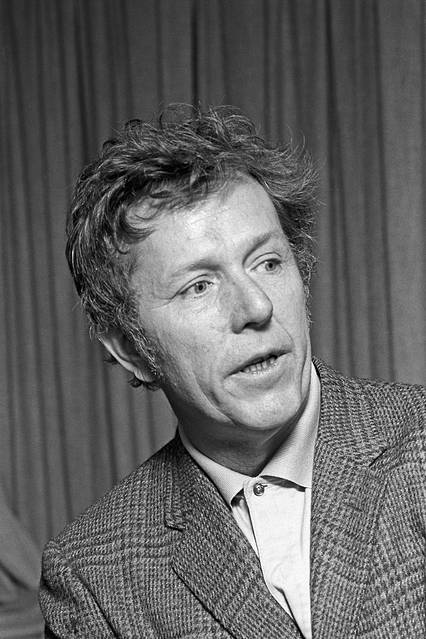
In reference to the aforementioned "experimental utopias," perhaps the best comparison with Walzer's--perhaps limited but still clearly wise--approach to conceiving of a more egalitarian politics is the arguments of Murray Bookchin. The contributions of Bookchin and Walzer (left and right in this photo) occupy very different corners of the radical democratic quadrant of American thought, despite many similarities--their concern for pluralism, their respect for communities, and their suspicion of efforts to take the struggle against capitalism out of the hands of ordinary people. Bookchin, who would have been 100 years old this year, was of a different generation and orientation than Walzer. Whereas the latter made his mark primarily in the post-Vietnam era of Ronald Reagan, fighting within the Democratic party for what the founder of the Democratic Socialists of America, Michael Harrington, called "the left wing of the possible," the former's fights on behalf of what he came to call "social ecology" and "communalism" were fought outside of either of the dominant political parties in America, both of which were transforming throughout the 1960s and 1970s, as the individualist, environmentalist, and technological waves which washed away the statist, post-WWII New Deal consensus began to emerge. Fundamentally, though, the key difference may simply be that Walzer, in the wake of those waves, has long insisted that taking the energy they unleashed and using them to build political agendas and structures is the only radical politics worthy of the name. Anything other than that, however deeply felt and expressed, is mere play-acting.

That warning should never be entirely dismissed by those who believe another world is possible; as any reader of the Epistle of James can tell you, belief needs organization and structure to bring possibilities about. But that belief, that confidence in anarchic actions and democratic demands and communal alternatives, must come first. And moreover, as Doug Henwood observes in his own conflicted-yet-deeply-appreciative recollections of OWS, anarchic actions, properly understood, do (or at least can) have a structure to them, and need not be nearly so disconnected by constant discussion from concrete action as Occupy and other utopian experiments have stereotypically been seen to be. Bookchin's insights into how people can truly, freely--while still methodically!--make the places they occupy into transformative spaces is one that needs to be remembered by localists and radicals and everyone who cares about the common good today, 10 years on. As one activist put it, invoking Bookchin's faith in ecologically conscious communities which reject the supply chains of global capital, the legacy of Occupy Wall Street was "something that touches our deepest spiritual yearning," in a very un-Walzerian sense; "its practice says: 'We will no longer live in hatred and competition. We will live in love and community.'" In our deeply divided current moment, is there any better model to carry into our (hopefully) increasingly local-community-focused, (hopefully) increasingly egalitarian, (hopefully) increasingly small-d democratic future? I think not.

Tuesday, March 09, 2021

Century II, Home Rule, and the Problem (and Appeal) of States Pushing Cities Around

[Cross-posted to Wichita Story]

On Sunday the Wichita Eagle ran two guest editorials--one by me on how state governments push cities around, and one by my friend John Todd on the effort by him and others to get the state to require cities to hold a public referendum before historic buildings like Century II could be torn down. Both essays are essentially about "home rule," though neither ever use that phrase. Let me try to expand on that idea here.

"Home rule" refers to the principle of municipal governments being allowed the ability to fully govern their own residents. Under our constitutional system, the national government and the state governments are assumed to have some degree of sovereignty; no such assumption necessarily holds counties and cities, however. While some have made the democratic argument that any self-identifying and politically recognized community should possess distinct governing authority--a claim with real historical, legal, and philosophical grounding--generally in the United States the opposite has been the case. Counties are understood as administrative arms of the state, and cities, as codified in a principle called "Dillon's Rule," as seen as entirely dependent creations, with "no inherent right of self-government which is beyond the legislative control of the state."

While the legislative record claims that Kansas, after the adoption of the Home Rule Amendment to the state constitution in 1960, has "stood Dillon's Rule on its head," in practice this has clearly not been the case, especially not in recent years. We here in Wichita, the largest stand-alone city in the whole state, know this well. In 2014, the city of Wichita fought in vain a state law overturning local gun control ordinances, thus passing along to cities like our own increased insurance costs as they could no longer legally limit concealed carry in public buildings like courthouses and libraries. The very next year, the state of Kansas sued Wichita to stop from us from following through on a minor local marijuana decriminalization referendum, obliging the city to continue to accept the costs of enforcing invasive drug laws that, on the basis of the referendum, have limited popular support. The tendency of our state government to minimize or outright dismiss local governmental concerns isn't limited to Wichita, of course. For example, the state allows the residents of 101 Kansas counties to choose their own election officials--but when it comes to counties with a significant urban population, such as you see in Kansas City, Overland Park, Topeka, and of course Wichita, the state government insists on making those appointments themselves.

In the jargon of governance, this is often known as "preemption"--the act of a state government taking away options that might be democratically determined by the people who live in and wish to govern themselves locally. It's an issue that is having a bit of moment right now. Governing magazine ran a long piece about how common state preemption of local authority has become over the course of the pandemic, and Strong Towns used it as a basis of their weekly podcast. Of course, the story of the Texas state government going bananas at the prospect of the city of Austin reforming their own police department (which, of course, the city of Austin pays for), has gotten a lot of attention, but don't count Kansas out; as of last month, the Kansas state senate debated a bill that would profoundly limit cities’ ability to explore sustainable energy alternatives to natural gas. It may not go anywhere–but considering the Kansas state government's track record (note how the state is currently considering forcing local counties, to which they gave explicit responsibility of managing and enforcing health restrictions during the pandemic, to bear the total, and devastating, cost of those mandates), I wouldn't be surprised to hear it being sent to governor's desk anyway.

So what do all of these issues pertaining to the limits on the power of local people to govern themselves through municipal or county bodies have to do with the argument over Century II? Because, in that particular case, both sides are, in essence, claiming "home rule" for themselves--though only those opposed to the proposed public referendum requirement are saying so specifically. In fact, Amanda Stanley, a lawyer working for the Kansas League of Municipalities, when arguing against the proposal during a legislative committee hearing in Topeka, called the idea of the state of Kansas requiring that the local populace be allowed to vote one way or another on the fate of historic buildings "the antithesis of home rule." 

That claim does make sense--but only if you set aside the general principle of local, democratic governance, and you think in terms of the institutions which such governance gives rise to. In the case of Wichita, what it has given rise to is a council-manager form of government, with a city manager and a professional staff in control of the details of the city's budget and general policies, and a city council, led (though only formally) by a mayor, which gives approval to and, in certain circumstances, initiates, stops, or gives correction to those policy directions. For those who spoke on behalf of the city in Topeka (including two members of the city council, Republican Bryan Frye and Democrat Brandon Johnson), "home rule" means "rule by the government of the city of Wichita."

Which, of course, we have, for all the reasons listed above, precious little of, whatever the formal proclamations of the Kansas state constitution. It seems reasonable to city leaders, whose hands are already tied in so many ways, to not have the tied any further by yet another state mandate. But this would be a state mandate connected to local democratic action, would it not? Local voters deciding on whether or not a proposal which involves the destruction of a beloved (by some, anyway) old building should go forward--that's not the same as the earlier examples of preemption, is it?

It clearly isn't, and that's part of the problem here: knowing exactly where real democratic empowerment lies. In some ways, those who spoke for the city really tipped their hand in an anti-democratic direction; when they testified in Topeka that the voters of Wichita (or wherever) lack sufficient training or experience “to make rational choices regarding the maintenance of such buildings,” the condescension is so thick you could cut it with a knife. But are they wrong? Not necessarily; part of the whole reason we have a representative systems of government is because it has become accepted as more or less obvious that, when societies (whether we're talking about cities or countries) become large and complex enough, mass democratic politics--government by plebiscite, in other words--becomes a risky project, particularly when complicated and long-term problems demand resolution. Not that direct democratic resolutions will always be wrong; the anti-populist terror most Americans are schooled in regarding the "tyranny of the majority" is too often a tool to make certain that the poor never fundamentally trouble those in power. But nonetheless, the institutions of representative government serve a valuable civic purpose, balancing distinct needs and forcing compromises over contentious issues. Those who take on the difficult, often thankless task for trying to organize, serve, and lead our city through our institutions can't be blamed for seeing public referendums like this as an additional complication of their jobs.

Maybe the problem, then, is their jobs themselves. Because, as I noted above, the institutions of our city government actually do not, for the most part, have the kind of power and responsibility which would enable them to balance distinct needs and force compromises. On the contrary, too often issues are laid out to them by the city staff in ways which foreclose any truly fundamental political arguments over priorities, with the members of the city council, including our mayor, rarely being able to enlist the kind of democratic support for any particular matter facing the city so as to challenge the broad determinations which the city manager's office has already made. What this means, in practice, is that historically in the city of Wichita, the only voices which have regularly tended to emerge so as to influence the direction of city policy are those already friendly to construction, development, the expansion of the city's built environment--the "growth machine," in other words. And after watching our city council either embrace or at least acquiesce to such growth-friendly (though hardly necessarily sustainable) calculations when it came to our baseball stadium, and fearing the same pattern being followed when it comes to the whole Wichita Riverfront, it makes sense for concern citizens of Wichita to want to make an end-run around these institutions, and appeal directly to the state in the name of their (potentially) populist and localist project.

Still, it's a risky proposition. In the aforementioned Strong Towns podcast, Charles Marohn, the founder of Strong Towns, looks at a situation in California today, where you see something comparatively rare--while usually it is Republican-dominated state legislatures preempting cities which tend more Democratic, in California is it a Democratic-dominated state government preempting the options available to cities. In California, a state-wide--but certainly not universal throughout California's cities--consensus about the problems with single-family zoning has emerged. This is an issue dear to ST's heart: privileging single-family zoning artificially imposes a suburban model upon development which is bad for the environment, bad for social and physical health, bad for housing costs, and most of all, very bad for the fiscal liabilities which cities must carry. Every city ought to severely limit single-family zoning! (To its very small but still real credit, the city of Wichita's Places for People plan may at least begin to introduce an escape from these commonly locked-in zoning requirements.)

But if every city in California ought to limit single-family zoning...should the state of California therefore mandate that the cities of California limit single-family zoning? Or since the costs of development, the liabilities of paying for streets and sewers, and, yes, the lure of construction jobs and population growth are all matters particular to cities, should decisions about zoning remain with them? Chuck Marohn admits--beginning at around 11:30 in the podcast--that as much as he's convinced that this is policy is the right one to follow, he's doubtful of the wisdom of states actually preempting local zoning decisions. In his view, the ideal of subsidiarity--of determining the most appropriate level for making decisions, and giving to that level the power and authority to make the decisions accordingly--while lacking in efficiency, is far better for real democratic legitimacy. Hence, rather than appealing to the state, even in the name of something which would enable and empower local democratic concerns, organize politically on the city level, and make the needed changes there. For all the reasons he mentions, I have to say I agree.

And so we come back to the city of Wichita, a city that--almost uniquely among all American cities of its size and situation--maintains a manager-council form of government, with a nominally (but of course not actually) non-partisan and part-time (exhaustively so, as any councilmember will admit) city council that is both too small and too under-staffed to effectively and democratically articulate and represent and fight and compromise over the divided desires of its citizens. Should the efforts of Save Century II, rather than appealing to the already much-abused preemptive proclivities of our state government, be focused on organizing around, campaigning for or against, and otherwise working with and seeking influence over the institutions of Wichita's city government? Yes, they should; that's the best local democracy that we have available. But given the deep structural problems and limitations of our city government as currently constituted (where what ought to be a straightforward discussion of ethics can get derailed by the supposedly horrendous possibility that the mayor has brought "big city politics" into the council!), do I blame them for seeing our city government as a possibly unreliable institution, perhaps incapable of holding to whatever a majority of voters may charge them to do, and instead seeking a state-level run-around? I have to admit: I don't blame them one bit.

Monday, December 28, 2020

Some Possibly Helpful Thoughts on Localism, Populism, and Proximity During a Pandemic

[Cross-posted to Front Porch Republic]

The departure of Donald Trump from the White House [crosses fingers] will assuredly not mean the departure of Trumpism from American life. The collection of grifters, paranoiacs, and devout (and, I think, devoutly misinformed) Christians who embraced Trump as the salvation of our broken liberal capitalist state may or may not stick with the man himself (or rather with the narcissistic tweetstorms that will no doubt continuously flow from his mansion in Florida), but the populist discontent which he channeled, the sense of technological alienation, socio-economic frustration, and constitutional disregard many justifiably feel in relation to our ever-increasingly unequal, undemocratic, and elite-driven country--that, I'm certain, we're stuck with. That can been as a threat requiring constant condemnation--or maybe, instead, we can dig into this discontent, find its constructive elements, relocate them, and use them to build a different, more local and less easily abused political foundation.

Of course, figuring out how to disentangle Trump from ideas embraced by, at the very least, hundreds of thousands of voters, is no simple matter. Populism--which, borrowing from The Oxford Handbook of Populism, I'll define minimally as "an ideology that posits a struggle between the will of the common people and a conspiring elite," and thus is, among other things, "a normative response to perceived crises of democratic legitimacy--is an alluring idol, the promise (one which many consider democratically dangerous) of making political connections with the imagined masses who feel alienated from or resentful towards those who wield social power within the dysfunctional mass democracies of today. I say "imagined" masses not because I reject the possibility of such alienation and resentment operating on a nation-wide scale; rather, I call it imagined because the populist articulations we see around us, whether expressed as a positive or a negative, are almost inevitably couched in a statist, collective context--and the pioneering work of Benedict Anderson decades ago has made it impossible, I think, for serious people to speak casually of national communities and their political expressions through states without recognizing their fundamentally "imaginary" quality, as things constructed through acts of affective identification and imagination.

Scholars who recognize this imaginary element in the politics of the contemporary democratic nation-state are often quick to suggest alternative stories which the inhabitants of such states could, or should, tell themselves, so as to short-circuit the lure of populist stories that, in the view of many of them, invariably cast the fight between the “common people” and the “conspiring elite” in dangerously ethnic or exclusionary terms. Their goal is to find a way to cast the affective identification and imagination at work in liberal capitalist states into the civic realm: hence, “civic nationalism” or “constitutional patriontism.” This effort, while it has had great influence in the scholarship on national identity over the past 30 years, has seemed less than wholly convincing as populist narratives have revived over the same period. Rogers Smith, while sharing the fear of these scholars regarding the threat to liberal democracy which populist narratives present, suggests that any political story which fundamentally rests on “pledging allegiance to an abstract creed” is doomed to struggle.

Instead, Smith argues that those stories which will lastingly engage the affective imagination of a people are the ones which focus on “a shared endeavor that participants can see as expressive of their identities and interests as well as their ideas.” This is not a denial of the constitutive role which acts of political imagination will invariably involve, but it suggests that such affective expressions need not be either “mechanistic” (which suggest unchanging laws or identities) or “teleological organicist” (which suggest an inevitable evolution towards a destiny or end-state); a people can also see itself constituted through “contextual accounts” which derive themselves from mapping “how the interactions of different units in [society] foster change in those units and in the society as a whole.”

Given Smith’s appreciation of the constitutive function which a story about the contextual interactions of different parts of aspects of a social group can serve for the group itself--an appreciation he deepens even further when he associates the best kind of national stories with “reticulation”: that is, they will “weave networks” that “transform jumbles of differences into more orderly and attractive arrangements that generally have more utility and durability”--it is unfortunate that he never seriously considers any group besides the nation state. After all, his talk of contextual accounts of a jumble of different subgroups and distinct social units being woven into a network which constitutes an appreciation of the whole has an obvious analog in a very important, though clearly not national, form of imagined community: the city. Consider the applicability of Smith’s considerations to Jane Jacob’s justly famous description of the “sidewalk ballet” of a thriving city in The Death and Life of Great American Cities: 

Under the seeming disorder of the old city, wherever the old city is working successfully, is a marvelous order for maintaining the safety of the streets and the freedom of the city. It is a complex order. Its essence is intricacy of sidewalk use, bringing with it a constant succession of eyes. This order is all composed of movement and change, and although it is life, not art, we may fancifully call it the art form of the city and liken it to the dance--not to a simple-minded precision dance with everyone kicking up at the same time, twirling in unison and bowing off en masse, but to an intricate ballet in which the individual dancers and ensembles all have distinctive parts which miraculously reinforce each other and compose an orderly whole. The ballet of the good city sidewalk never repeats itself from place to place, and in any one place is always replete with new improvisations. 

That Smith does not recognize this obvious parallel is perhaps a matter of convenience; while he allows that our globalized and interconnected world allows for a cacophony of potential political stories, he sees “narratives of nation-states” as possessing a “simplicity, clarity, and authority” which “proponents of rival senses of political identity often can manage only with great difficulty.” Or it is possible that he sees that convenience as reflecting something natural and inevitable. William Galston, relying in part on the political theorist Pierre Manent, makes this point multiple times in his own recent attack on populist narratives; it is essential, he writes, to make a civic case for the pluralist and democratic nation-state, because only a government that is incorporated by national bodies can have the scale of representation to make genuinely “legitimate decisions about laws and rules,” and only a national body can incorporate enough resources to generate the sort of wealth that can reward the very human characteristic of “ceaseless effort and ingenuity in the service of material improvement.” Democracy at our present moment, according to this argument, requires a liberal capitalist nation-state, and since such states create elites, and elites can be depicted as threatening the common people by populist demagogues, the great task of theorists of democracy, in Galston’s and Smith’s minds at least, is to call for the sorts of stories and public policies that will prevent the populist narratives which are parasitic upon such states from gaining any political ground.

My concern, at this point, should be obvious: if the fundamental problem with populism--and the efforts which some theorists go to either counter or re-orient its appeal as a constitutive narrative of affective imagination--is the complicated fact of its appeal to the feelings of powerlessness and longings for popular control which exist in the contemporary nation-state, then what about focusing on the constitutive, people-building power of other, less statist scales of belonging? Of course, so long as our national governing bodies wield sovereign power, and our major media organs remain committed to casting every debate into terms of what effect said debate will have on the use or abuse of state power, any such alternative will face many practical obstacles. But those obstacles may not be insurmountable.

One particular way in which localism has taken on theoretical forms which potentially carry with them real possibilities for constituting a sense of popular identity is the family of ideas which are sometimes referred to as the “new municipalism” or “radical municipalism.” Heavily indebted to the “libertarian municipalism” of Murray Bookchin, but expressed in light of a more locally interconnected understanding of participatory democracy than his did, it is an attempt to think more seriously about what a politically empowered egalitarian commons would look like in a localized urban context. That such models can be productively imagined and politically built upon in relatively rural contexts is an understanding as old as Thomas Jefferson’s proposed ward system or Alexis de Tocqueville’s idealization of the egalitarian town meetings of 19th-century America. The parallels between those associational forms and those spoken of by the Populists of late 19th-century America are strong--but considering how poorly the Populists fared in America's urban centers, that would only seem to further suggest the incompatibility between populist formations and the urban life most American citizens live.

Yet perhaps the distinguishing feature that municipalist narratives could offer, one which borders on the populist articulation of a defense of the common people and yet does not get hung up on inevitably statist definitions of citizenship and claims to a sovereign people--definitions which, in the 19th century, became entangled with an anti-urbanism and an anti-immigrant ethnic sentiment, echoes of which continue to Trump’s so-called “populism” today--is their rigorous focus on the most basic phenomenological fact of urban life: bodies in proximity to each other (which is exactly the same central reality to Jacob’s sidewalk ballet). As Bertie Russell observed:

[The] municipalist movements have found themselves building on a unique potential of the urban--proximity. In its simplest forms, we can understand the quality of proximity the observation that...the local level is the place the space where shifts and changes can truly be transformative in terms of impacting people’s lives....[Their] initiatives are harnessing the potential of the urban scale through adopting a politics of proximity, the concrete bringing together of bodies (rather than of citizens, who already come with a [state-defined] territory) in the activation of municipalist political processes that have the capacity to produce new political subjectivities....[We] should understand the politics of proximity as attending to those forces that pull us together, as opposed to those forces that push us apart. Whilst contemporary urbanization is characterized by the ever-increasing massification of bodies...this same urbanization is driven by dynamics that pull us ever further apart. Perhaps it is precisely because of this contradiction that the municipality has been adopted as a key site through which a politics of proximity can be pursued. 

While the theoreticians of municipalism have thus far, to my knowledge, not thought to connect populist stories about constitutive identification (or their more civic equivalents) with the urban “subjectivities” that they see as emerging through the politicalization of the proximate bringing together and shifting and changing of human bodies, the parallels are, I think, obvious. The focus on the needs of human bodies, on organizing to maintain their proximate patterns of movement and change, or resisting those socio-economic forces which pull people apart, inducing alienation in the place of togetherness--that all can fit within a populist framework. Remember that Smith argued that the best stories of identification must incorporate some degree of “reticulation,” some respect for the pluralistic “patterns among the elements that constitute a larger whole.” In rural or suburban environments, it may correctly be the fact that the distance between bodies requires a narrative of affective and imaginary identification on a national scale, since locally there isn’t sufficient shifting and changing to prevent the craving for such stories to land upon exclusive, ethnic ones. But in cities? The requisite reticulation which the constituting story needs to making human plurality into a part of one’s imagined community, rather than an obstacle to it, will be as obvious as the foot traffic on the sidewalk outside one’s front door (or at least potentially could be, anyway).

Margaret Kohn's work on the "urban commonwealth" provides a specific example of putting this kind of imagined subjectivity--a non-statist, urban sense of the common people united against those who would alienate and privatize them from one another--to direct political work. Kohn refers to the theoretical construct she explores as “solidarism,” but at one point in her analysis the populist parallel is made explicit. Using the urban uprisings of a decade ago--Occupy Wall Street being the best known in the United States, but with parallels all around the world--as her model, she suggests that life in cities today is increasingly teaching more and more people to rethink how they see themselves as bodies which occupy public, democratically articulated spaces. In association with that particular urban education, Kohn postulates a greater awareness of how it is that those spaces, and the means by which they are "common" to those who live and move and change within them–speaking here of the roads and parks and playgrounds and markets through which healthy urban activity is expressed--are separated from them, thus making them, presumably, something that people can feel no politically identifying affection for.

Enabling this awareness are the operations of, in Kohn’s words, "two very different understandings of the term 'public.'" The first she calls the "sovereigntist model, which identifies the public with the state," and the second the "populist model, which sees the public as a force which emerges outside of state institutions in order to challenge policies and publicize issues that do not make it onto the government’s agenda.” Predictably, the sovereigntist model requires a regulative state in order for the urbanites to find identification through their actions in their spaces: “A public space is one that is owned, authorized, or regulated by the state.” Whereas the populist model defends the contentious interaction of persons, with their always shifting associations, as a necessary component of persuasion; it justifies “the public as a force that emerges outside of state institutions in order to challenge policies and publicize issues that do not make it onto the government’s agenda.” In short, Kohn is pointing to a kind of populist imaginary which comes from the same space as the subjectivities which radical municipalism invokes: finding oneself constituted as a community through the practice of “extralegal” action, putting bodies into public space “as a way of ensuring that the law does not protect the interests of the elite at the expense of the common people."

Obviously, talk of the people being able to exercise political force in regards to public places "outside of state institutions" is terrifying to those who consider state-enforced property rights to be sacrosanct. Such urban and local populist formulations do not necessarily take a clear position on the place of private property (Kohn herself doesn't, recognizing that the idea of "social rights" or the "right to the city" are far from fully developed), but again, the key point is not contesting every particular argument being made as part of this intellectual shift. Rather, the point is taking up the discontent which issues in the whole drive to politically express oneself through in connection with one's collectively self-articulated people and place, and explore the possibilities of the shift itself.

It is my belief--and, with a little creative re-interpretation, perhaps a belief which aligns with the theoretical work done by the theorists and activists mentioned here--that populism, the popular engagement of people against elites, can be made relevant to political formulations outside of national imaginaries. And if the rhetoric of populism really can be theoretically articulated as a local and urban matter, then perhaps exclusive national narratives, whatever their effectiveness, could also be understood as invoking a language which is parasitic upon the embodied place where populist feeling mostly actually resides. To be certain, it is ridiculously unlikely that a conceptual exploration like this one could be persuasive enough to be even just a small part of making incoherent any further Trumpist and state-dependent abuse of the valid populist sentiments out there. But given how likely it is that our national pre-occupations will allow bad actors like our soon-to-be-former president to continue to turn legitimate frustrations with the elite disregard of our  proximate (and, for most of us, urban) places in nationalist, exclusivist directions, any rhetorical and intellectual resistance, however small, is worth doing.

Monday, December 21, 2020

Why The Cult of Smart is a Book for Every Parent in 2020 (Whether Anarcho-Socialist or Not)

[Cross-posted to Front Porch Republic]

This past summer a book was published, with little fanfare, that made what was, in retrospect, an argument that millions of middle-class, public-schooling parents everywhere--my wife and I included--desperately needed to hear. The argument was, in essence: don't worry about your kids and the inconsistent online education they are likely receiving thanks to the pandemic; just remember that while teachers matter a great deal, and the information which teachers have to impart to our children matters as well, the actual structure of the "schooling" received by students really doesn't matter much at all, or at least not in the way most successful members of our society have come to believe.

That's an unfair and reductive description of Frederik deBoer's fine (if somewhat overlong and scattered) The Cult of Smart: How Our Broken Education System Perpetuates Social Injustice, but it's not fundamentally inaccurate. The primary target of deBoer's book is the American educational meritocracy and those who, because they benefit most from it, are among the last to see its harms, and thus who most frequently push hard against both common sense and scientific data in their efforts to keep it working. But in surveying all that aforementioned data, and explaining how it reveals the very small role that certain types of formal education--however expensive or expert--ultimately play in expanding minds and developing talents, deBoer's attack on meritocratic elites also serves as a consolation to parents and caregivers worried about what their children, and students all across America, may be missing out on. As he writes at the end of his chapter on school quality--following paragraphs of delightfully vicious swipes at Harvard, Yale, and the Gates Foundation--even when we synthesize data from "more than a hundred studies over a 15-year period" looking at the "benefits of...afterschool programs, behavioral interventions, computer-assisted teaching, and more," the results are undeniable: "most things didn't work." He concludes that "[t]his is not an argument that school does not matter" (he notes, for example, the limited yet real impact that small group tutoring can have); rather, "it is instead a question of how school matters" (pp. 120-121). Hence the succor that can be found in The Cult of Smart: if online learning often seems to consist, at least in part, of far too many poorly delivered, incoherently received make-work assignments--and as a college professor myself, I assure you: I am entirely familiar with the pressures which have led struggling instructors around the world to arrive at these far from engaging assignments!--then rest easy; if you're still taking the time to help your kids out around the dinner table, then you're already doing the thing that matters most to their education anyway.

It is unfortunate that "doing homework at the dinner table" is so commonly--however inaccurately--coded as "conservative"; I promise you (again, speaking from personal experience) that left-leaning parents make use of such family schooling traditions just as much of right-leaning ones do. Still, perhaps that coding was inevitable. All through last year, it was solely conservative media outlets which gave deBoer's book any attention; reviews of the book--all of which praised different parts of his argument, if not the whole thing--appeared in National Review, the Wall Street Journal, Business Insider, and the Washington Examiner. It's possible that deBoer--a self-described revolutionary socialist, and a writer who has an equal reputation for thoughtfulness and contrariness--takes some pleasure from being ignored or misunderstood by his own ideological compatriots, but missing his provocative claims is a loss for the American left. It's also possible that, on some deep, inarticulate level, these conservative outlets thought deBoer's book was worth engaging with because the reviewers recognized in it some parallel with Ivan Illich's anarchist classic Deschooling Society, which they learned about from some hippies that sneaked into a home-schooling conference they attended once. In all likelihood, though, none of the above applies; rather, the more likely answer is that the media outlets which took the book seriously were those who like running features that challenge, as they see it, the aims of public education, and the media outlets which dislike challenging the those premises didn't. (In the interests of full disclosure, let it be known that earlier versions of this review were submitted by me to Dissent, Jacobin, and The Nation, all without success--which may be a reflection of the quality of my writing, but I suspect there is more to it than that.

The one extensive exception to this (and boy, is it ever extensive) came from Nathan J. Robinson of the very left-leaning Current Affairs, who wrote a massive, purposefully exhausting response to The Cult of Smart, claiming in essence that it is correct both that the right has looked positively upon the book and that the left has ignored it, since deBoer's arguments, according to Robinson, embrace the same racist assumptions which Richard Herrnstein and Charles Murray infamously wove into their arguments over a quarter-century ago in The Bell Curve, only repurposing their old genetic judgments about the heritability of intelligence for anti-meritocratic ends. Robinson’s overlong effort to bury his earlier, pre-publication enthusiasm for deBoer’s book is, I think, almost entirely mistaken. The Cult of Smart, despite its flaws, does have something distinct to contribute to the development of a socialist vision of education--and, in that such a vision exists in opposition to that which is presumed by our liberal meritocratic bureaucracies, to a localist, even anarchist, vision of education as well. While it is fair to push back against some of the ideas which deBoer’s consideration of cognitive science leads him to, his is absolutely a left (maybe left conservative?) argument, and not a repackaging of Herrnstein and Murray. The challenges which cognitive psychology and neuroscience have already posed to numerous fields--education in particular--will not go away any time soon; leftists and anarchists and localists of all stripes, so long as they accept that education is a public good, need an appropriate framework to develop the sorts of answers to those challenges which will advance their ideals. DeBoer’s book, whatever its limitations, is an excellent place to start doing so, granting it a value far beyond simply reminding parents like my wife and I not to worry too much about what their daughters may have missed out on as their teachers struggled to make physical education, forensics, and culinary arts classes work online.

DeBoer’s primary two-part thesis is simple. First, he asserts that the role which genetic differences play in any given person’s cognitive ability and academic inclinations, while not determinative in any final sense--as deBoer writes in his introduction, “the relationship between genes and behavioral traits is neither perfect nor fixed; environment does matter, to a varying degree, and there are interventions that can ameliorate some of the impact of genes” (p. 23), a caveat which Robinson seems to have missed entirely--ought to accepted as a matter of policy. But second, he notes that as much as we may causally acknowledge the ordinary reality of these differences, the “cult of smart” prevents us from fully accepting these differences for what they are. Instead, we find ourselves institutionally driven to maximize access to the meritocracy of contemporary life, telling ourselves that education--assuming the opportunity for such can somehow, someday, finally be fully guaranteed to all--will be the great equalizer. But as any educator who looks at the data honestly can tell you, that is always, at best, a partial truth. What deBoer sees, not unreasonably, as the denial of this fact simply infuriates him: “The Cult of Smart, for the people who excel within it, is more than a political platform or a vision of success. It is a totalizing ideology that colors everything they buy, say, and do” (p. 32).

All of the debates about educational outcomes which deBoer introduces in the early chapters are controversial, and his approach to them is often uneven. Still, deBoer’s slaying of various cows sacred to the education establishment in America is kind of a delight. It’s hard to deny that progressive efforts to make schools both more effective and more egalitarian have often relied upon data which only masks how much the results of America’s unequally funded education system often simply entrench income inequality. Similarly, it is clear that many articulations of equality of opportunity implicitly posit students as “blank slates,” ready to compete, which only increases the pressures on both students and teachers to come up with evidence to prove to legislators and donors the supposedly transformative outcomes of learning. As much as more than few philosophical liberals--of both progressive and conservative varieties--may be loath to admit it, our reluctance to be honest about differences in natural academic talent (in contrast to our uncomplicated acceptance of most differences in natural athletic or artistic talent, which are generally seen as obvious) does seem to be a contributor to our constant expensive experiments with school quality, test scores, teacher accountability, and more, giving us along the way such arguable misfires as No Child Left Behind, Common Core, and various other “ed-tech boondoggles,” in deBoer’s wonderful phrase.

It is the book's middle which gets to the meat of the argument, however: the “heritability of academic ability,” and consequently the very real possibility that “the range of the possible in the classroom is dramatically smaller than conventionally assumed....[with a] large portion of the variation in academic outcomes...remain[ing] permanently out of the hands of schools and teachers” (p. 121). Robinson sees this claim as a criminal reduction of the always unknown potential lurking in the relationship between students and their environment, or even students and their past selves. But even if deBoer’s examples aren’t always as careful as they could be, his presentation of the science around them is succinct and clear. His efficient summary of numerous studies in behavioral genetics, as well as critiques of those studies, leads to the carefully stated conclusion that “the impact of genetic ancestry on human behavioral traits seems indisputable” (p. 137). Despite his penchant for picking fights, deBoer is uncharacteristically sympathetic to the challenge which this information puts to those who have fought so long for what they generally accepted as the true "ideal" of public education (simplistically put, that literally any student can achieve literally anything they put their mind to) but neither does that understanding cause him to pull back:

It’s understandable...that many progressive people have decided to wash their hands of the topic of genetics and intelligence altogether. Understandable, but disturbing. Disturbing because by avoiding these subjects, good people have essentially ceded the conversation to bad....I believe that we can engage in the fight against bigotry in all forms while acknowledging the overwhelming evidence that intelligence, like all cognitive traits, is significantly influenced by genetic parentage. In fact, we need to do to so....[W]e need to separate a belief in claims about individual genetic difference from claims about group genetic differences. Through grappling with the data, we can craft better arguments against those who would misuse it to advance their racist and sexist agendas. Or we can ignore the data, dismiss the subject entirely, cede the field to the worst people imaginable, and suffer the consequences (pp. 140-141).

What, in deBoer’s view, are those better arguments? Central to them is a recognition of how the meritocracy, and its roots in a libertarian reading of the equality of opportunity, should have no place is any actually democratic public school system. DeBoer makes good use of John Rawls’s concept of the “veil of ignorance” as a tool for intellectually justifying the creation of a social contract--and, for that matter, a public school system--where we shape circumstances without any cognizance of our natural assets, abilities, or intelligence. As a socialist, though, he goes beyond Rawls’s assumption that a redistributive principle can ameliorate the differences which will nonetheless result from the purely opportunistic (and thus invariably luck-influenced) choices in our resulting lives, and instead suggests that our insights into cognitive differences should point us away from the glorification of equality of opportunity entirely. In the educational sphere especially, “opportunity” is often tied to specific academic measurements, which different people with different genetic traits, insofar as deBoer's argument points, can probably never realistically give full and equal consent to. Consequently, the aim of education should instead be to accommodate the widest possible range of dispositions among students. The goal should be empowerment and plurality, rather than equality and uniformity.

That many educators already know this, and have leaned hard in its direction in the midst of the pandemic-related disruptions experienced in many of the (perhaps sometimes too restrictive) patterns which govern much public school teaching, is important to emphasize. And it is something parents like myself have needed to hold onto as well: the idea that the ability of kids is variable, as is the number of paths open to them, and that such variability will not be much changed by however much schooling itself changes (or, sometimes, simply fails). While any number of civic goods or socializing experiences might be more tied to one particular form of public education or another, whatever empowering academic potential which schooling itself has almost certainly is not. 

These realizations and experiences do not on their own, however, amount to an alternative--a leftist, localist, or anarcho-socialist alternative--to deBoer's "equality of opportunity" canard. While I think deBoer is correct that it is a misunderstanding of classic Marxist thought to enshrine “equality” as a central socialist goal, he doesn’t do enough in the book’s final chapters to really develop what alternatives to it would involve. This is unfortunate. DeBoer’s exploration of diverse reforms (including the intriguing suggestion that compulsory schooling end and children be allowed to drop out of school after age 12--something which more that a few parents dealing with pandemic-related school closings probably think they've already experienced!), as part of his drive to undermine the Cult of Smart and “save us from our smart-kids-take-all economy” (p. 227), are thoughtful but hardly systematic. By failing to more consistently consider the character of a truly socialist and pluralistic education model, and instead engaging in yet another attack on charter schools (as well as a passing swipe at the anti-communism of Michael Harrington and the Democratic Socialists of America), deBoer doesn’t provide a theoretical structure to support his conclusion: that the aim to “achieve [academic] equality of any meaningful kind is to deny our nature,” while using education to recognize that “we have fundamentally different abilities and talents...is the first step in [our] liberation” (p. 239).

Here, deBoer's arguments can be fruitfully compared with a similarly radical attack on our educational meritocracy from two decades ago, one which lacks deBoer's insight into cognitive research (and his accidental pandemic relevance!), but which shares his radical passions. In 2000, Michael W. Apple, a well-known Marxist educator and scholar, published Educating the “Right” Way: Markets, Standards, God, and Inequality (a second edition came out in 2006). It was a furious broadside against what he called “conservative modernization,” which philosophically was a misnomer, since what he was attacking was the neoliberal meritocracy, not anything actually conservative, properly speaking. But whatever the best label for the interest groups and educational entrepreneurs and reformers who crowded around the Bush I and Clinton administrations, Apple saw them all as blaming the lack of educational accomplishment in American public education on the supposedly stifling uniformity and secularity of the schools themselves. Their proposed solutions, as he saw them, involved undermining both teachers unions and the traditional (and, from our perspective today, distinctly non-high-tech) standards-enforcing bureaucracies which those unions had complicated opinions about, and replacing both with various market-based and localizable educational options (charter schools, public school vouchers, religious schools, home schooling, etc.) which would use cultural and economic competition (serviced by centralized corporate interests, to be sure) to generate excellence.

Needless to say, Apple found all of this appalling. But he also recognized that the ideas contained within this movement connected with the hopes and fears of many parents. To counter that connection, a new and "truly public school ideal" needed to adopt “a somewhat more populist set of impulses,” including “tactical alliances” with distinct religious, linguistic, and cultural groups, such as might be best served by properly constructed--that is, genuinely community-based, as opposed to corporately astroturfed--charter schools, or whatever else might best enable educators to respect “the cultures, histories, and experiences of these students and their parents and local communities.” The point being that, in confronting what he saw as a profound threat to the democratic possibilities of public education in America, Apple's socialist suggestions made room for difference and proceeded to think about how to make available to all something that needed to be shaped differently for all. (Educating the “Right” Way, pp. 100, 224-226, 228-229).

Apple's arguments are two-decades old, but the concepts they reflect--like the mature thought of Michael Harrington's anti-bureaucratic decentralist socialism, in fact--are relevant to the arguments which deBoer engages. Harrington, like many other socialist theorists, came to acknowledge that a truly democratic socialization of the economy--and, it seems reasonable to assume, of public education as well--would be the exact opposite of the totalizing meritocracy which we have today and which deBoer rightly condemns. Instead, it would partake of something almost republican in the civic sense: that is, distinct and at least partly autarkic communities of learning, work, leisure, and political participation. DeBoer touches on one aspect of this idea briefly, when he insightfully points out that the progressive reliance upon decreasing social mobility in America to attack income inequality is actually an implicit licensing of the disruption and meritocratic sorting--in other words, the “mobility”--which generates so much inequality in the first place (p. 156). But his insight that mobility (moving to find the best school district! competing to hire the best teachers!) is at best orthogonal, if not in some ways actually in opposition, to a genuinely egalitarian educational environment, is never connected to the larger theoretical question of a model that sustains people in all their various different creations of the good life in the places they are. Given deBoer’s rejection of any form of the charter school idea which Apple saw as potentially a component in a populist front against supposedly-free-but-actually-corporatized educational “reforms” (assuming that such charters could be designed around a difficult balance of non-discrimination and real local pluralism, rather than around fake promises of efficient, competition-driven results), it would at least have been good to see deBoer present other alternatives for building a truly differentiated public schooling movement--like the formal enlistment of home schooling, or attaching educational institutions to local guilds of apprenticeships, perhaps. (Something for those 12-year-olds who, having learned the basics of reading and writing, dropped out!)

I don't want to condemn deBoer’s book for failing to flesh out all its own theoretical parameters and implications. The Cult of Smart is deeply entrenched in most modern systems of public education around the world, and the increasingly clear reality of cognitive and genetic differences between different human beings poses not just a practical challenge to educators committed to giving everyone an idealistically equal opportunity to prove their merit, but also a painfully sharp one to some liberals whose membership in the Cult makes them want to deny this reality entirely, since it threatens the usual justifications of the meritocracy which gave them the positions they enjoy. By forcing his readers to recognize the Cult for what it is, and why neuroscience and behavioral genetics should be opportunities for critics of the meritocracy--whether from a socialist or a localist or yet some other ideological direction--to make the case for an education that empowers rather than one which vainly strives to homogenize, deBoer has performed an important service. And, not incidentally, as 2020 draws to a close, he has given parents and caregivers obsessing over what their students may be missing out on something different to worry about. As an educator myself, I want to do the best I can in terms of teaching my students. But it's helpful, as I close the books on the fall 2020 semester, to be reminded, as this book does implicitly, of something that every teacher and parent ought to remember as well: that basically, more often than not, the kids, in all their variety and abilities and interests, are, and likely always will be, pretty much all right.