Featured Post

WELCOME TO RUSSELL ARBEN FOX'S HOME PAGE

If you're a student looking for syllabi, click the "Academic Home Page" link on your right, and start there.

Showing posts with label Parties. Show all posts

Thursday, June 04, 2026

A Follow-Up on Christian Influence in Kansas (Democratic Edition)

[An expansion upon my latest Insight Kansas column, with the help of an image from The Active Age]

Two months ago, I wrote a column (which I later expanded upon) which addressed, among other things, on how Kansas Christians (which over two-thirds of the population of the Sunflower State identify as) have changed how they make use of their influence as citizens. Obviously the historical develop I was addressing had many causes—technological, socio-economic, and more—but still, it struck me just how many Christians, when they thought about the public-facing aspects of their faith, once regularly aimed to lift up Kansas society to the moral level they held to be scripturally mandated, whether in the form of prohibitions upon alcohol or Sunday closing laws or the abolition of slavery or women’s suffrage or so much more. Today, with a few notable exceptions—mostly pertaining to abortion, LGBTQ issues, and other matters involving personal sexual identity and behavior—the focus is more about providing financial support or legal protection to individuals, families, or businesses that affirm particular Christian standards, and less about presenting their moral message as relevant to social life itself.

One problem with that essay, though, was that as it moved from Kansas’s Carrie Nation past into the present, it came to focus entirely upon Kansas Christians organizing on behalf of and arguing for or against issues and policies that map almost solely onto the interests of the Republican party. In some ways, that’s predictable; for decades, the public language of Christianity (particularly Protestant Christianity, which for a variety of reasons has long been the dominant religious faction here in Kansas) has been owned by the Republican party. But nonetheless, there are still plenty of religious believers in Kansas—especially if you look at Black congregations, or other multi-ethnic Christian churches and groups who aren’t part of the powerful and mostly White evangelical subgroup—who approach the question of how to engage in public life with a focus on collective causes that are more typically associated with Democrats. Some attention needs to be paid to them as well, so this month, for reasons I explain below, I wanted to do so.

Over the past five years, multiple church-based organizations have sprouted up throughout Kansas, sometimes standing on their own and sometimes joining with others that have had a long history within their local communities. Together, these groups could be seen as Kansas instantiations of a national revival of the religious left (which there is evidence for, but which has also been falsely predicted much too often in the past), giving new voice to groups of believers who feel a need to, first, drill down on specific public policy problems, and second, pressure city and county officials to recognize the problems that have been identified and respond to the solutions which these groups recommend. In this, they’ve been making a real, unglamourous difference in many communities across the state.

Some of groups—all of which are multi-faith, but within which Protestant Christian congregations (Methodists in particular) invariably provide the largest number of supporters—include Topeka JUMP (Justice Unity and Ministry Project) in Shawnee County, MORE2 (Metro Organization for Racial and Economic Equity) in KCK and KCMO, Churches United for Justice in Wyandotte County, the Good Faith Network in Johnson County, and the organization I know best, Justice Together in Sedgwick County. I’ve written on the latter organization multiple times before, and I’m proud to be a supporter of their work. But all of these organizations, representing tens of thousands of believers in the Bible’s messages about inclusion, charity, compassion, and justice, have pushed for the creation of municipal IDs (which help homeless individuals begin to rebuild their lives by applying for jobs and aid), for setting up affordable housing funds (which helps bring downward pressure on home costs in genera), for holding corrupt city officials accountable for their crimes (which helps increase trust in government and thus makes more legitimate collective efforts to aid those suffering from abuse and poverty), for creating additional services for those struggling with mental health or facing gun violence, and much more.

Have they been successful in all their work? Not remotely. For example Justice Together, after much internal discussion, elected to throw their weight behind an ill-conceived (but still, in my opinion, defensible) sales tax proposal in Wichita, entirely because of the funding it would have guaranteed to anti-homelessness and affordable housing programs, a decision that ended with egg on their (and my, and many others’) faces. But that hasn’t dissuaded them. Here in Wichita, at a recent town hall on the city’s 2027 budget, Justice Together brought out over 130 people to press their case for the importance of trying once again to secure through the ballot a stable, enduring source of funding for affordable housing and homelessness support, as well as other issues. As Justice Together co-president (and old friend of mine) Rabbi Andrew Pepperstone said at the start of the meeting: “We will not avoid this crisis; we will not stop; we will not be silent.” The turnout was so large the meeting had to be moved to the main city council chambers, and the power of their voice (and vote) was acknowledged throughout the evening.

To some, of course, the efforts of these organizations, and the numbers of faithful Christians supporting these progressive causes, is easily dismissed. In their mind, Christian engagement in politics remains the natural property of conservatives, and they point to how some progressives across Kansas have reacted with hostility to the entrance of Methodist minister Adam Hamilton into the race to be the Democratic challenger to Senator Roger Marshall as evidence for their presumptions. That hostility is mostly online and isn’t terribly loud, in my judgment, but it would be foolish to pretend that it isn’t real. In a low-turnout primary election, it might even be enough to sink Hamilton’s chances with the Democratic electorate (despite some of those same voters supporting churches engaged in the social justice work mentioned above).

At an event where Hamilton met with local voters in Wichita last night, I was impressed with how forthright he was regarding this particular challenge. For decades, Biblical language has been publicly owned (at least among White voters and those soliciting their support) by folks on the conservative side of the aisle; Democrats have spent decades articulating secular self-justifications, and sometimes some outright defiance, in response. Given all that, there is bound to be some members of the Democratic primary electorate who will insist that no minister, and certainly no person who—as is obviously appropriate when one works in a pastoral context, as Hamilton has for more than 30 years—approaches some of those same “matters involving personal sexual identity and behavior” with a recognition of and respect for the “tensions” which surround them (he shared a story about his own family history which, in another context, would have sounded like a set-up for an anti-abortion rights argument, except he turned it around into a case for supporting reproductive rights) will ever win their vote. How can someone like Hamilton reach them? Certainly not by downplaying his Christian approach to political questions; he knows that would be impossible, in the same way that organizations like Justice Together understand that eschewing Biblical arguments when they make their case simply undermines the whole point of their existence. The ways in which those inspired by the progressive or egalitarian aspects of the Christian message express themselves publicly have to reckon with pluralism in a way that wasn’t the case decades ago. That’s a complication, to be sure, but also one that aligns the character of the society we live in today—and that, perhaps, is an advantage, however small.

In any case, the history of Kansas shows us that Christian priorities were once as likely to be expressed by Democrats as by Republicans in this state. While that, obviously, has changed a lot over the years, it’s not like the language of faith as an important motivator for collective change ever entirely disappeared from the small liberal corners of Kansas. Expressing it today can’t be something done in same manner as decades past, but this election season, it’s heartening to see a variety of individuals and organizations looking for new ways to keep that expressive process going. I hope they succeed.

Monday, November 04, 2024

Some Thoughts on the Republican Donald Trump, and All the Other Republicans, Mormon or Otherwise, I Know (and Sometimes Love)

[Note: this is a long and very party-centric set of musings for the day before the presidential election ends and the real electoral and legal chaos begins. For many, that’s a turnoff. But I’m both a scholar of American politics as well as a politics nerd, so that’s what you get. Read on, if you feel so inclined. And yes, this an expansion/revision of a piece published by Insight Kansas, in The Wichita Eagle and elsewhere, over a week ago. Cross-posted to By Common Consent.]

For a great many people—though not, I think, quite as many as some people suppose—in America over the past eight years or so, the problem of Donald Trump and the Republican party is entirely straightforward. Trump is an awful person, who represents awful things—as my fellow Kansas writer Joel Mathis summarized it on Saturday, his whole approach to representative politics has always involved divisiveness, cruelty, and threats of (and sometimes actual) violence--and so anyone who supports him, and any party he is part of, must be, by definition, awful, full stop.

Both personally and professionally, I have a hard time imagining how anyone with a lick of political sense could fail to recognize how potentially counter-productive doubling-down on that attitude is—to say nothing of how arguably un-Christian it is for those of us who take the command to love one’s enemies seriously, and who therefore should be very conscious of the costs to our ability to draw a line between our opinions and electoral divisiveness, cruelty, and possible violence, when it comes to labeling any other human being or group of human beings by definition “awful” (or “evil,” or “garbage,” or “scum,” or "demonic," or “deplorable,” or whatever you prefer). I’m not denying that it’s hard to avoid that doubling-down; civil discourse, maintaining a full-throated defense of one’s beliefs while showing love and respect to others, is really hard when basic civic norms seem to have collapsed. But still, I think that is what both democratic citizenship and Christian discipleship call on us to do. The fact that many smart and good people I know, who appear to me in all other areas of their lives to sincerely affirm both of those aforementioned principles, apparently do in fact double-down on all-or-nothing anger nonetheless, just shows that it’s my imagination that’s lacking. 

Do I think Trump is an awful human being? Yes, absolutely; my opinion of him—“personally corrupt, administratively irresponsible, stupidly (and often gleefully) divisive, and politically destructive”—hasn’t changed in the past four years. Do I think that everyone that supports Trump is therefore also awful? No, because “supports” is a broad term, one which technically includes everyone from Stephen Miller, a convicted felon and an unrepentant racist immigrant-basher, and my mother, a wonderful 79-year-old woman whom I love dearly. I mean, they both voted for Trump, so QED, right?

There is a cohort of the politically awoke and online—though again, I am convinced, by both the data on split-ticket voting and personal observation, that the polarizing “Big Sort” of American voters into two rival tribes hasn’t eliminated cross-party familial and social relations nearly to the extent some believe—who might well insist that, whatever the manifold differences between my mom and Stephen Miller, in the present environment they belong in the same category. I can understand that formulation, in the same way I can understand—and even defend as coherent—that formulating of political opinions which leads people to become single-issue voters: that literally nothing else matters except where a candidate stands on stopping abortion, or where a candidate stands on ending the war in Gaza, etc. But however coherent it may be to conclude that if X is awful—a fascist, perhaps, or even, in Trump’s maddeningly nonsensical claim, a “Marxist, communist, fascist, socialist”—then everyone who does something so extreme as to cast a vote in favor of X must therefore be fully baked into X’s awfulness, no matter what they claim, it remains, I am convinced, a deeply unhelpful and, frankly, immature thing to believe.

 [Note: in terms of Trump himself, I continue to think “fascist-adjacent” remains the best label. He isn’t the only authoritarian-wanna-be to have occupied the White House or tried to do so, but the cult of personality, exclusion, and resentment which his rise has lent dominance to within an major political party is, I fear, quite arguably unique in our history (Huey Long, maybe? or Theodore Bilbo?), and deserves to be noted, and feared, as such.]

So, a little pedantic social psychology here. Human beings, both singly and in groups, always act in ways that can be assessed on multiple planes of judgment: historical, religious, strategic, aesthetic, and more. To ignore those different planes—which usually means ignoring all the sorts of things you can know about a person that you’ve actually spent face-to-face, real-world time with, someone you’ve listened to and lived alongside, and instead just focusing on random statements forwarded on social media—is to do something intensely reductive, and therefore almost certainly something that fails to take your fellow human beings seriously, in the way that I think the fundamentals of Christianity, to say nothing of the basic premises of any belief in democracy, particularly of the participatory sort, necessitates.

True, the too-often evil vicissitudes of political life sometimes necessitate reductive, immediate distinctions; you can’t save someone from a lynch mob if you insist upon deliberating as to whether or not extra-judicial mob action might be necessary in any given circumstance. But casting a vote simply isn’t the direct equivalent of that, because absent a voter explicitly affirming such, I just don’t see how someone can meaningfully—in the sense of providing evidence which proves a particular conclusion—discover in the casting of a ballot the same intentionality as swinging a rope over a branch. Passionately insisting on the contrary, that actually every vote fully incorporates the most extreme intentions that anyone can historically connect to said vote, only suggests that one must believe we’re at the point where the electoral agency expressed by actual voters no longer matters—that the incorrect yet sincerely believed intentions of my mother and every other Trump-supporting Republican I know is wholly irrelevant. And if that’s the case, why are you worrying about votes at all? Best of luck with your revolution, I guess. (Though I hope you’ll choose to retreat and form an intentional commune rather than engage in armed revolt, because the record of the latter is atrocious and while the former is often inspiring.)

My mom’s vote for Trump (she believes he’ll keep America out of foreign wars) doesn’t surprise me. She’s a life-long American Mormon, and American Mormons who were born in the 1940s and committed themselves to the socially conservative family model that mostly took over American Mormon culture during the 20th century, particularly after World War II (the Old Right-style anti-communist paranoia of Mormon leader Ezra Taft Benson being the key factor here), were pretty consistent supporters of the Republican party, and that has only very recently slowly begun to change. My father was a life-long Republican too, and while I want to believe that he would have been like a number of other Mormon Republicans I know—my wife’s parents, some of my brothers, a couple of my oldest friends in my local Mormon congregation here in Wichita, to say nothing of Mitt Romney, the most famous Mormon Never Trumper of them all—and recognized the awfulness of Trump and voted against him accordingly, I actually suspect that he would have stuck with the GOP until the bitter end. Socializing one’s voting history, religious beliefs, and regional environment together can do that, sometimes.

This is the sort of thing that leads some to insist on the terribleness of party politics and partisanship in general; in particular, in the case of my religious tribe, it leads some of those of us who want to nudge the great bulk of the Republican-voting Mormon faithful in a properly anti-Trump direction (especially if they live in Arizona!), to double-down instead on the curious statement the Mormon church leadership made in 2023: that in addition to encouraging members of the Church of Jesus Christ of Latter-day Saints (the official name of my church) to be active citizens and affirming the church’s official neutrality—positions they emphasize every year—the church leadership insisted that “members should…vote for those [candidates] who have demonstrated integrity, compassion, and service to others, regardless of party affiliation. Merely voting a straight ticket or voting based on ‘tradition’ without careful study of candidates and their positions on important issues is a threat to democracy.”

In the same way that I can recognize as coherent (even if stupid) single-issue voting, I can recognize that straight-ticket voting, just supporting every Republican or Democrat down the line, can seem a coherent response to certain conditions—like, for example, party having been so fully captured by single cause or candidate that attempting to stop that party on every level seems like the only reasonable way to express one’s discontent. But thankfully, ticket-splitting is something that, in this moment of intense polarization, is very much an active variable in trying to understand the shape of the 2024 elections. That’s true even here in Kansas, where the historical dominance of the Republican party—there is very close to 2 registered Republican voters for every 1 registered Democrat here in the Sunflower State--exceeds the levels of the Mormon corridor.

A month ago, I spoke at the Dole Institute at the University of Kansas about “The Ticket-Splitting Voter.” (You can watch the whole thing here.) One of the other speakers at the event was Stephanie Sharp, a Republican who served three terms in the Kansas House, who is one of the prime movers behind Women 4 U.S., a national organization of self-identifying conservative women determined to work against Trump’s return to the White House. Meeting and talking with her put me in mind of Mormon Women for Ethical Government—an officially non-partisan body that does not engage in any political recruitment, to be sure, but it’s impossible to read their recent defenses of the election system and condemnations of any refusal to accept election results as anything except a rebuke of Trump, what with his constant lies about the 2020 elections and his preparations to lie some more starting this week. MWEG’s membership obviously includes many Democratic and unaffiliated voters, but given its grounding in American Mormonism, and the fact that it got off the ground essentially as a direct response to Trump election in 2016, the sense in which it, like Sharp’s group, and like dozens of other groups like it, all aim to connect with Republican women turned off by Trumpist Republican leaders whose message of protecting women comes off as condescending is hard to deny. Hence, the essential split-ticket voter of the 2024 election: the Republican woman who supports conservative candidates down the line, because that’s what she believes, but votes for Harris at the top of the ticket, because what he represents takes their party in a direction they don’t want it to go. There won’t be remotely as many such split-ticket voters as there will be women—or men, for that matter—who vote a straight-party line, but there may be enough of them to make a difference.

Parties have always included within them various factions, and party leaders—whose primary aim is to win elections, of course—will always be incentivized to paper over those divisions, insisting that their party is a “big tent” which can handle dissent over various issues. But dissent over the party’s own presidential candidate? The Bernie Sanders faction of the Democratic party, despite its grievances, made its peace with and grudgingly supported both Hilary Clinton and Joe Biden, and it seems likely the same will go for Kamala Harris. Yet the complete absence of anti-Trump Republicans of real national prominence from the current GOP campaign, from the 2012 Republican nominee for president Mitt Romney to Trump’s own vice president Mike Pence, as well as multiple important Republican voices essentially washing their hands of the GOP, all suggests an even deeper problem on the Republican side.

Even here in Kansas, with its Republican dominance, Trump is commanding only 48% support in the polls, far less than the 56% he won in both 2016 and 2020. The final numbers when all the ballots are counted will almost certainly be above that—I don’t know anyone who thinks there is even the remotest chance Trump could fail to win Kansas. (Ditto for Utah, where Trump’s approval rating stands at a low but still solid 54%.) But the Republican party is facing a real problem here as well as nationally, whether or not it is a problem that will be manifest in the next Tuesday’s results. It’s a problem evident in the decision of a close friend of mine here in Wichita, a deeply conservative man who has voted Republican his whole life, and has basically no political agreement with any of the policies and proposals of the Democratic party, and yet is going to vote, however symbolically, Harris—because of the January 6 riot at the Capitol which Trump abetted, because he is convinced that Trump is going to allow Putin to do whatever he wants in Eastern Europe, because of his personal corruption and disrespect for the rules of the office, and much more. How can a party present itself as representing his preferences, and at the same time that of another friend of mine, a man who—much more typically for Kansas Republican voters—has gone full MAGA, and is convinced that not only did Trump win in 2020 but also that every action he took or winked at in the wake of that election, including the violence of January 6, was entirely justified?

Some Republicans are responding to this divide by denouncing Trump, like Stephanie has, and organizing to help stop his re-election—but that’s exceptionally rare. More common, among those at least willing to speak are, are Republicans like Steven Howe, a current member of the Kansas House, who back in January condemned Trump’s “deceit and lies” and plead with his own party to turn away from their support for the former president, but then came back around to his party and fell in line when November loomed. And then there is U.S. Senator Jerry Moran, the only one of the Republicans Kansans have elected to Congress who has declined to endorse Trump for president. While he’s never condemned Trump directly either, this is a man who, if you’ve paid attention to his careful speeches over the years, clearly has little respect for the nominal leader of his own party. Again, there is basically no chance any of this electorally significant in either my state, in the same way the pleas of well-connected Mormons in Utah will have basically zero chance of moving the great mass of Republican voters in the Beehive state. But it simply underscores a partisan difficulty that will have to be addressed, one way or another.

Parties have endured in American politics because there is no better way to respond to the incentives of our political and electoral system than by organizing into groups which reflect particular interests by promoting particular candidates. The fact that those parties, once their candidates are elected, are going to work to entrench their influence by fully socializing themselves into the institutional and ideological structures through which those who voted for those candidates operate, is simply a by-product of the logic of our constitutional system itself. I’m fully on board with imagining alternatives to that system—but in the shorter term, the reality of cross-party voting, and the potential rise of fusion voting, might be the only routes available to making parties, which at one time genuinely did, however indirectly, manage to reflect and moderate and promote the best versions of the preferences of those who voted for them, do so again.

Of course, in my view, the even shorter-short term solution to the partisan dilemma both posed by and facing (to whatever degree the leaders of the party are willing to admit it) the Republican party is the defeat of Donald Trump. Which, across this country, hundreds of thousands (and potentially even more) of registered GOP voters will contribute to—but many millions more, including my mother, and most of the members of my Mormon congregation, and much of my family and most of my friends and neighbors here in Kansas, won’t. That’s okay. Frustrating, depressing, potentially frightening, but okay, and I mean that—I’m convinced that if Trump becomes president as a result of either outright Electoral College votes or whatever legal and electoral chaos will almost certainly erupt in less than 48 hours, the country will stumble forward (though whether the legitimacy of our constitutional democracy will remains to be seen).

But will the Republican party? Will those stymied Republicans return to the GOP, or join the Democrats, or push for some other yet unforeseen party or party-like formation? I don’t know. But I suspect that any Republican--particularly those of the Mormon persuasion, given that the party re-alignment this division may potentially give rise to could well, given the processes of socialization, impact religious and cultural assumptions which play major roles in one’s church affiliation and much more—who thinks the era of Re-Elected-Trump, or Post-Trump, will be an easy, or easier, one to navigate are probably in for a surprise. (Hopefully whatever surprise the first of those possibilities might pose for the United States won’t be a whole lot worse.)

Friday, February 17, 2023

Two Steps Forward, One Step Back for Kansas Republicans

[This is a somewhat expanded version of an editorial which recently appeared in The Wichita Eagle and elsewhere.] 

Last weekend Mike Brown, a former Johnson County commissioner and a failed primary candidate for GOP Secretary of State Scott Schwab’s job, and someone who has expressed sympathy on multiple occasions for former President Trump’s lies regarding the 2020 election results, was chosen to be the new chairperson of the Kansas Republican party. This is a frustrating result for those local Republicans--and I know they're out there; I know several myself--who keep hoping to separate election conspiracies from their party’s substantive platform, an effort that, of late, one could argue that was, all things considered, going pretty well.

It's easy for the terminally online to forget, but it needs to be remembered that for a great many ordinary citizens, including a significant minority of Republicans, the claims of voter fraud and rigged elections promoted by Trump, culminating in the attack on the Capitol on January 6, 2021, had always made little sense, a feeling that has only grown more pronounced outside the hot-houses of conservative websites (and, unfortunately, Republican leadership caucuses, but even there many Republicans are silently trying to extricate themselves). This drift has become even more pronounced as time has gone by; recent polls show that election denialism declined by more than half between the elections of 2020 and 2022, and overall only a third of those not already caught up in conspiracy theorizing say they find such paranoia understandable. In short, continuing to obsess and nitpick over super-close elections has increasingly come to seem to most Americans as pointless, dangerous, and strange.

Kansas, however, has its own long and separate history with Republican electoral paranoia. Long before Trump started ranting about how he was robbed—and started harassing GOP officials and his own vice-president to get them to support his lost cause—we had Kris Kobach, who for years as Secretary of State made claims about illegal voting he was never able to prove, and demanded prosecutorial power to enforce voter restrictions which were thrown out as unconstitutional. Meaning that Kansas Republicans, including the ordinary rank-and-file ones, have long seen hysteria over election security overshadow their other priorities, which is why the failed (but still very close!) efforts to derail Kobach in his race for attorney general had significant Republican support.

Still, looking across the country, particularly at defeated, Trump-endorsed, non-existent voter-fraud-obsessed Republican candidates in Arizona and elsewhere, many Kansas Republicans probably had reason to feel hopeful for the direction of the state party. Despite the closeness of his loss to Governor Kelly, Derek Schmidt left the stage without recriminations (same thing for Kobach, who not only made no criticism of his squeaker of a win but also spoke only of his conservative agenda, and said nothing about contesting the governor's equally narrow win). Schwab won re-election handily in the midst of national under-performance by other local Republicans, all while insisting the Kansas elections were secure and reliable. Perhaps they were shaking off the preoccupations of their former national leader?

Many are, no doubt. Unfortunately, some Kansas Republicans are still obsessed with the idea that ballot drop-boxes or mail-in ballots allow nefarious actors to skew or falsify election results. And now, they have a state party chair on their side.

When running against Schwab in the Secretary of State GOP primary, Brown mocked his opponent for refusing to claim the same voter-hunting power Kobach had previously abused, insisted that all ballot drop-boxes should be banned, and implied that Schwab was at fault for not investigating outlandish, unsubstantiated claims about ballot-dumping and more. As party chair, he obviously won’t be involved in setting priorities for the Secretary of State, much less shaping legislation. Nonetheless, his narrow, 88-90 vote triumph among state party leaders—powered mostly by conservative Republicans in the 3rd District, frustrated by seeing their message increasingly rejected by moderates in the Kansas City area and the resulting “purple creep” that, among other things, kept Representative Sharice Davids in office, despite a Republican gerrymander explicitly designed to get rid of her in 2022—is surely frustrating to those Kansas Republicans who are hoping to move their party out of Trump’s shadow.

Of course, Trump may well be back at the top of the national GOP ticket come 2024, so perhaps the state Republican is just getting ready to fall in line. But for those many Republicans who recognize—even if they keep their views quiet—how hopeless and dangerous adhering that line is, the Brown’s selection likely strikes them as an unfortunate stop backwards, while others try to push ahead.

Wednesday, November 02, 2022

Wondering About a (Highly Unlikely, But Not Inconceiveable) Local Wave

At the Great Plains Political Science Association annual conference held last weekend at Wichita State University, four political observers--three of them Insight Kansas contributors--were asked to make their predictions for next week’s elections. All four said they believed Sharice Davids would win re-election in the Third Congressional District; three out of the four said they believed Governor Laura Kelly would defeat Derek Schmidt and be re-elected; and two out of the four said they believed Chris Mann would defeat Kris Kobach and be elected Kansas’s attorney general. But further down the ballot, and pretty much everywhere else besides, maybe, the 3rd District and Kansas's northeast corner? The agreement was near unanimous (and in line with the latest public opinion analysis): November 8 will likely be a red wave, terrible night for the Democrats.

“Near unanimous,” of course, means at least one voice of dissent. The dissenter was me.

Am I totally confident in my belief that Kansas, come November 8, may provide national Democrats with some tiny, consoling blue ripples during an otherwise rough night (which, on the macro level, I agree it will be)? Not remotely. So why bother saying so, when the usual political science variables—a midterm election during the first term of an unpopular President at a time of high inflation—point towards a Democratic bloodbath?

Maybe it’s just contrariness. Or maybe it’s the lesson of two elections. Or maybe, once again, it's the yard signs.

The first election I’m thinking is the one we just had: the August primary vote on the “Value Them Both” amendment. That the size of the victory enjoyed by abortion-rights supporters has been much commented on—but more relevant here is just how much of a surprise it was.There had never really been a vote like that one before: a straight-up, yes-or-no vote regarding the right to at least minimal abortion services. Frankly, no one really had any data to work with. Reasonable guesses could be made on the basis of demographics or party affiliation—but no serious observer could have guessed that the amendment would lose by nearly 20 points (I certainly didn't). 

The 2016 election of Donald Trump similarly took a huge number of people by surprise—but in that case, the surprise wasn’t because of the lack of data, but because so many people (myself included) didn’t take seriously all the relevant information—the unpopularity of Hillary Clinton, the shifts in white voting patterns in upper Midwestern states, etc.—which pointed to the real chance that Trump could win. It seemed to so many of us just so unlikely and bizarre that we discounted it. 

So we come to the Kansas 2022 elections, where we’re not in the same situation as before the August amendment vote. In fact, thanks to that vote, the Kansas Speaks survey, and some other data points, we know a fair amount, particularly about high levels of voter engagement among Democratic-leaning groups, and the early numbers which suggest that engagement may be continuing into the week of the election. We also know that Kelly’s approval numbers are pretty good, and that abortion, along with Medicaid expansion and medical marijuana legalization, are motivating many voters--presumably in a Democratic direction.

But are they motivating enough voters to entirely overcome the huge, historical advantages which Republicans enjoy in Kansas? Or all the other already-mentioned disadvantages weighing down Democrats this year? Probably not. 

But in this election I don’t want to discount the data out there, however limited it may be. Yes, the election fundamentals and the polling (as flawed as much of it may be) suggest fairly comprehensive Republican gains, both across the nation and here in Kansas as well. Nonetheless, I believe there really is a chance that not only will we see some top of the ballot Democrats winning in this state, but also see enough Democrats holding on to or flipping state houses races—perhaps in Manhattan, Shawnee, Emporia, Hays, Hutchinson, or even here in thoroughly polarized Wichita—such that the Republican super-majority in Topeka could actually be lost, bizarre as that may sound in the wake the Republican redistricting of state and congressional legislative districts earlier this year.
(I admit that I added Wichita to that list out of simple self-interested curiosity. I'm looking at Representative Dan Hawkins, my neighborhood's representative in the state house, and the House Majority Leader--a pretty powerful figure in the Kansas legislature. Yet in light of what I've written before about Wichita slowly turning purple, if not blue, we've seen Hawkins's percentages consistently decline in this strongly Republican area through the election cycles since the last redistricting, from 70% down to 60%. And against that you have some local Democratic urgency, an urgency I see with his opponent Mike McCorkle--learn all about him here--whose team is managing to place yard signs simply everywhere around our little part of Wichita, meaning that he is either better funded than past local Democrats, or has a better team knocking doors and placing signs than candidates of the past, or just plain has more voters out there willing to show public support for him. Add it all up, and I wonder if Hawkins might actually be brought down to 50% of the vote this time. Or, dare I say it...maybe even a smidge lower?)

Again, I’m not remotely confident about any of this. All the macro level stuff I mentioned above remains true--and frankly, the smart money is to always bet on what the macro trends say. But after 2016 and 2022, I’m not so confident as to discount the possibility of the truly unlikely happening either. I mean, what's the worst that can happen--I get it all wrong? I've eaten crow before, I can do it again.

Monday, September 19, 2022

Biden's "Soul of the Nation" Speech, Take 2

[This is a rewritten version of a post of mine from two weeks ago, which this morning appears on the website Current. My thanks to Eric Miller for editing and focusing my ramblings down, kind of in the way I hoped to do for Biden's necessary but definitely-not-first-rate speech.]

President Biden never used the word fascism in his “Soul of the Nation” speech in Philadelphia on September 1. But considering the outrage many supporters of Donald Trump expressed at the speech, particularly focusing on its (poorly chosen) staging and imagery, perhaps he might as well have. At a fundraiser he had already expressed his opinion that “the entire philosophy” motivating Trump and those Biden called “MAGA Republicans” is “like semi-fascism,” and considering the way Trump’s cult of personality operates, that label, as John Fea recently pointed out, makes a certain amount of sense. As for those who denounced the speech as divisive and confused (some of them saying so even before the speech was actually given), they likely would have responded that way no matter what terminology Biden had used to describe the authoritarian threat posed by Trump and his followers.

My own guess is that Biden avoided formally using the word “fascism” because of the recent short seminar he convened to discuss threats to democracy, which no doubt included many reminders of the complex crosscurrents in American history. But given the unfortunately rambling nature of Biden’s speech, the suspicion of some of Biden’s opponents that he simply forgot to use an f-word he clearly believes applies to them is plausible. 

What isn’t plausible, though, is dismissing Biden’s specific accusations, whatever label they did or did not invoke, as logically incoherent. On the contrary, they build upon each other well.

Biden made three key claims: (1) “MAGA Republicans do not respect the Constitution.” (2) “They do not believe in the rule of law.” (3) “They do not recognize the will of the people.” 

Given the social media-induced ignorance of our moment, the substantive accuracy of the events and actions to which these claims refer could be endlessly contested. And it’s true that Biden’s unnecessarily partisan praise for various Democratic legislative priorities probably incentivized such contestation. Still, in terms of political theory, his claims fit together well. They effectively situate Biden’s own position regarding these threats to our democracy. 

First, consider the matter of “respecting the Constitution.” Biden’s critics are quick to turn this accusation against him, most recently for his constitutionally debatable student loan forgiveness order, insisting that Biden’s actions show a presumptuous level of Constitutional disregard. In response, one can point to the anti-democratic stance Trump and his supporters regularly took when asserting that while president Trump could legitimately claim near-total executive authority. 

But maybe it’s best to back up a pace or two and pose another question: What does it mean to “respect” the Constitution, anyway? 

It can’t simply mean adhering to its specific text. In his 1816 letter to Samuel Kercheval, Thomas Jefferson himself mocked those who “look at Constitutions with sanctimonious reverence, and deem them, like the ark of the covenant, too sacred to be touched.” Jefferson suggested instead that “laws and institutions must go hand in hand with the progress of the human mind.” In today’s words, that might be called a “living” or a “progressive” understanding of the Constitution. Presumably the overwhelming majority of MAGA Republicans would denounce such a position, while many in President Biden’s party would embrace it. But if you accept that interpretations of the Constitution can and should change, what are the grounds for a charge of disrespect?

Thinkers like Sheldon Wolin provide some guidance here. Wolin saw government constitutions in what might be called “performative” terms, as repositories of the democratic tension between, on the one hand, a contractual basis for the ordering of the people who live in a particular place and have some kind of imagined community with each other (i.e., a demos), and, on the other, the practices, rituals, and norms that appropriately embody the operational details of that contract. This means that our understanding of what counts as an acceptable constitutional performance—from issuing executive orders to accepting the certification of Electoral College votes—is not necessarily identical with the legal specifics of the contract itself. Which is why saying that something is “legal but unconstitutional”—or the reverse—is not at all incoherent. It also is why getting hung up on fine constitutional distinctions when confronted with a chief executive and party leader whose performance is explicitly contemptuous of the law is missing the forest for the trees.

Far from “believing in the rule of law,” consider how cavalier Trump has always been about following the rules. This is not just clearly evidenced by his entire career as a liar and a grifter but has been explicitly demonstrated most recently by everything the FBI has compiled about his theft of classified documents, which is just the latest controversy du jour for him. It’s true that cynicism about the fungibility of the law once lawyers get involved is hard to avoid. But that frustration should not be allowed to mask the Nixon-level “when the president does it, it is not illegal” hubris that was on display throughout the Trump administration and that—with Trump’s talk of pardoning insurrectionists and presidential reinstatement—he continues to traffic in. Biden’s claims were, if anything, not emphatic enough in calling out the MAGA Republican core. To actually not think that today, post-January 6, a portion of the Trumpist Republican party has become accepting of a degree of outright criminality, as Representative Liz Cheney and other (not nearly enough) Republicans have warned, defies comprehension. One can take issue with the pathologies that an over-reliance on the law produces and yet not drink so much “own-the-libs” Kool-Aid as to forget that the admittedly bourgeois, procedural ends the law often serves—in this case, the smooth transfer of power—are extremely valuable and worth preserving.

Obviously election laws are key here, which is where “recognizing the will of the people” comes in. Yes, the Electoral College, both in its original design and its subsequent jerry-rigging over the centuries, is a frustrating mess, and certainly not anything that can be said to represent the people’s will, at least not since aristocratic notions of a republican common good, vouchsafed by local state-appointed elites, were surpassed by the democratic appeal of pluralistic party politics in the first decades of the nineteenth century. But nonetheless, given the Electoral College’s current place in America’s electoral system, citizens with any respect for the representative process—something Trump, with his frivolous lawsuits and harassing post-election phone calls to election officials and state governors, purposefully tried to suppress—should be obliged to acknowledge the political checks and balances that have been woven, however imperfectly, into its procedures. In January 2021, 147 Republicans did not, to their shame; that many apparently feel the same today is reason enough for Biden’s speech. 

You don’t need a carefully constructed definition of fascism with an accompanying media campaign to follow the thread of Biden’s accusations against Donald Trump and his most deluded followers. There have always been, and always will be, those who take issue with aspects of America’s still imperfect representative democracy from a variety of ideological directions. But a movement of millions challenging the legitimacy of American elections in such Constitutionally disrespectful, legally dismissive, and democratically destructive ways is something that, thankfully, we have not often had to face. We are facing it now. However stumblingly President Biden sometimes makes his points, he’s not wrong at all.

Friday, August 19, 2022

A Random Thought on Mikey Kaus

A few days ago Robert Farley, of Lawyers, Guns & Money, posted the latest entry in his wonderful "Oral History of the Blogosphere" project, this one focusing on the once-notorious (indeed, widely loathed on the liberal/left/progressive side of the blogosphere), but now mostly-just-grumbled-over journalist and blogger, Mickey Kaus. It's actually a pretty great conversation, if you're into remembering or rethinking what people were arguing about online and why and how they did it, circa 20001-2010. For me, besides enjoying it as I have enjoyed every previous entry in this series (really, if you're a blogger or ever thought you could be one you should listen to them all), it made me reflect on the enduring relevance of a particular ideological niche, however tiny or incoherent it may seem.

I never thought, and still don't think, the loathing of Kaus was mostly due to the controversial positions he took on the dominant political news items in America in the 1990s and 2000s: welfare reform, criminal justice, immigration, the Iraq War, etc. Rather, I think he was loathed because he insisted--to the minds of the aforementioned liberal/left/progressive pundit class, infuriatingly so--that he was taking those positions as a sincere, if appropriately evolved, New Deal Democrat. In a way, I think Kaus occupies the same much-condemned rhetorical space as Ralph Nader: he's someone who is seen as a betrayer, someone who talks the talk of liberal justice and then engages in public actions and intervenes in public debates that seem, to most liberals and leftists and progressives, to entirely contrary to how the liberal political world actually works.

The first minutes of the conversation with Kaus touched upon the legacy of Charles Peters and the magazine he founded, Washington Monthly, which tutored legions of journalists (including Kaus) in a vision of activist government grounded, as Paul Glastris, Washington Monthly's long-time editor, put it, in "the communitarian patriotic liberalism of Peters’s New Deal youth." There are, out there amid the sprawling, multifaceted coalition that constitutes the Democratic Party, lines of reflection upon the achievements of the New Deal, both scholarly and activist, which seriously downplay the ethical and civic part of that triumph of positive liberalism and egalitarianism. According to those arguments, the greatest achievement of the New Deal was that it laid the foundation for erecting social democratic institutions in America, for which many are still fighting for: to make health care a human right, to make higher education available to all, to put workers in charge of the economy, etc. As a democratic socialist myself, I agree with those lines of argument! But I'm also a sometime left conservative, a wanna-be civic republican, and a fan of both Christopher Lasch and the Point Huron Statement, and thus find myself agreeing with Peters as well. The leadership of the post-New Deal, and particularly the post-civil rights movement, Democratic Party really did focus mostly on achieving liberal justice through building ever-more effective (and ever-larger) redistributive institutions and practices. The way that focus partly (but not entirely unintentionally) combined a very un-New Dealish individualism with outright bureaucratic statism, and allowed a entirely new kind of meritocracy to flourish in liberal circles, thus taking the focus off the cultural and communal aspects of what a genuinely egalitarian and just society must involve...well, that's the critical space which Kaus occupied. Entirely coherently? In a philosophically rigorous way? Open-mindedly, kindly, and without self-indulgent contrarian snark? Not at all; in many ways, Kaus's voice was a profoundly flawed vehicle for this critical perspective on post-Cold War liberalism in America. But to my mind, at least, he was a vehicle for it all the same.

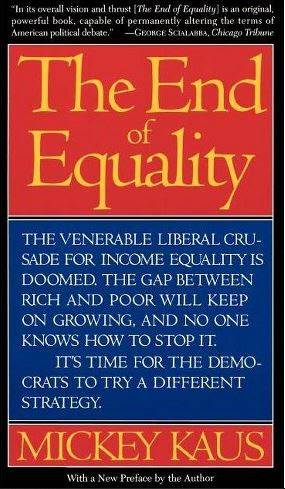
My primary evidence for this is a wonderful book that he wrote, The End of Equality. The book never got the respect it deserved, I think, partly because of the weird moment it arrived (right at the beginning of the Clinton administration; but was the book arguing against what Clinton was doing, or supporting it, or both?), and partly because Kaus's subsequent career--intransigently defending some of the worst aspects of Clinton's welfare reform, obsessing about family breakdown even as income inequality skyrocketed, etc.--retrospectively made the book's insistence that "Money Liberalism" was a non-starter and that "Civic Liberalism" was the way to go seem like Kaus was auditioning George W. Bush's "compassionate conservatism" a decade before it nominally (though never actually) arrived. All those criticisms are fair. But I still use selections from the book in my Political Ideologies classes on occasion, because I find so much of it refreshingly clear and free of cant. He is frank about his conviction that most of those with socialist aspirations have been unwilling to recognize the incompatibility of "fraternity, community, and idealism" with the lack of "material prosperity" that only rapacious capitalism seems to provide (p. 11); he is genuinely eloquent in asserting that differing levels of health care don't actually matter to the egalitarian legitimacy of society so much as "that everyone wait in the same waiting rooms" (p. 93); and he is downright prescient in warning that, if the goal of the Democratic party continued to be tweaking the tax code in some Rawlsian way so as to make it fairer and increase the size of welfare checks but in the meantime said nothing about the lack of community-feeling and solidarity in America, the end result will a general hardening of whatever egalitarian spirit the revolutions of the 1930s and the 1960s may have left us with:

Americans may be social egalitarians today. But give the affluent two more decades to revile the underclass and avoid the cities as if they were a dangerous foreign country, two decades to isolate their "gifted" children from their supposed inferiors, two decades of "symbolic analysis" and assortative mating, and we might wake up to discover that Americans aren't such egalitarians at all any more. Then politics would be really dispiriting (p. 180).

That paragraph can be picked apart and even partly undermined in multiple ways (that large numbers of younger and mostly liberal-learning people, including young families, started returning to America's cities throughout the 2000s is the most obvious rejoinder, but not the only one). But I read it, and I see the once at least moderately liberal suburbs, filled with college-educated, white-collar-job-holding, mostly well-off Americans, voting for Trump across large parts of America. Dispiriting indeed.

Anyway, this is just something that occurred to me, when Robert unintentionally invited Kaus back into my mind. So I thank him for that.

Wednesday, August 03, 2022

Seven Theses on Kansas, "Popularism," and Value Them Both

Well, my predictions from yesterday were wrong (mostly; I was still right about Kris Kobach getting the Republican Attorney General nomination). And while the image I used yesterday to reflect the diversity of the No campaign here in Wichita didn't unintentionally predict the final state-wide vote totals (59% voted No, not 75%), the fact is it was a lot closer than I or any other serious political observer here in Kansas that I'm aware of actually believed was possible. So what more is there to say.

Well, a few things, anyway:

1) Let me repeat what I just wrote: nobody I am aware of who as at all seriously engaged in following these campaigns--and I've talked to people at the Kansas Reflector, at Vox, at Newsweek, at ABC News and KAKE News locally, and many more places about all this--was predicting that in an August primary election, in a strongly Republican state, would result in a win for abortion rights by 10 points, much less nearly 20 points. As the very first election to take place anywhere in America after the overturning of Roe v. Wade and the ending of a national constitutional guarantee of at least limited access to abortion services, the size of the Value Them Both amendment's defeat is bound to create a lot of political noise.

2) Political noise...but maybe not immediate political changes. Political parties are mighty beasts, and different factions or interest groups that have put in years of work and money and organizational strategy in shaping their platforms, and thereby socializing and contributing to the further self-sorting of voters who look at those parties and platforms, aren't going to want to see them make an about-face after just one election. Here in Kansas, I would expect that Governor Kelly will express gratitude for the results, and then proceed to run her re-election campaign in with the same wonky focus on Medicaid expansion and other nuts-and-bolts issues that she's always preferred; similarly, I bet that Derek Schmidt will prefer to say as little as possible about the failed amendment, and run the same "Governor Kelly serves the radical left in Washington DC" ads that he's team has no doubt long since prepped, only with references to abortion very much cut back.

3) Why? Because Schmidt will know, as will leaders of the GOP's current super-majority in Topeka, that there is simply no honest way to parse these numbers without acknowledging that there were a good number of Republicans--including at least a small-but-nonetheless-meaningful slice of Kobach-supporting, low-propensity, normally-November-voting-only, self-identifying conservative Republicans!--who voted against the amendment. The majority of the Republicans in Topeka come from safe enough seats not to worry about alienating those Republicans who wandered off the anti-abortion reservation this particular election...but there are at least a few who will worry about them, and Schmidt, who needs to hold on to votes in the same urban counties which Kelly won in 2018, will worry about them as well.

4) So I suspect that the short-term consequences of this vote won't be especially visible. It's the medium-term consequences, the post-November 2022 consequences, which could potentially put some real force behind all the chatter which Value Them Both's defeat is generating. I could be wrong, of course; my track record suggests I probably will be. Maybe the Kansas GOP will immediately throw all their efforts behind voting to unseat state supreme court justices in November, and immediately start talking about taking another shot at amending the constitution, this time grudgingly including language about how the Kansas constitution does guarantee that there cannot be a total, no-exceptions-for-rape-or-incest-or-medical-emergency abortion ban. But I doubt it; rather, I think they're going to want to wait to see how this vote is reflected in other votes nationally, and how the overall abortion discourse continues to evolve.

5) After all, in the meantime there is probably going to be a small, perhaps invisible, but almost certainly nonetheless viscous, fracture within the Kansas GOP to deal with, all while the gubernatorial election is going on. Because there will be Republicans--the small-government, business-oriented, libertarian-inclined, individualistic Republicans from rural Kansas, the pragmatic folks that, before Brownback and Trump would have been considered the backbone of the party--that will have serious questions for why their party essentially out-sourced themselves to Kansas Catholic archdioceses for this election, and why they ended up (by driving all the cultural conservatives to the August voting booth) saddling themselves with a three-time loser like Kris Kobach as their attorney general candidate. That fracture doesn't exist in isolation, of course; the divide between the numerous micro-factions that make up the much-declined (but not extinct) moderate bloc of Republican voters and the even more numerous micro-factions that make up the dominant (but not completely unobstructed) conservative, Trumpist bloc of Republicans, has been a feature of Kansas politics for decades, and this internal fight will be folded into it. Will it push the party towards a new balance? Dion Lefler, who has watched Kansas politics as closely as anyone I know, thinks it might; we need to wait and see.

6) As we wait for the medium- and long-term consequences of a strongly Republican state voting in a way that actually reflects the existing polling data here in the state, as opposed to being led by party allegiance to support the much more extreme positions adopted by minority anti-abortion factions in their parties, to play themselves out, one note about "popularism." While there are many ways to make use of this wonky idea which has emerged among Democratic activists over the past couple of years, the basic idea is that Democrats hurt themselves when they allow their party to become associated with liberal or progressive or radical or socialist ideas that don't poll well, even if their purported consequences are ones voters clamor for. The question, as my old friend Damon Linker posed months ago, is whether the insights of popularism--that is, building campaigns around those ideas which poll well with ordinary voters, keeping the question of whether or not they are truly empowering or "populist" insofar as the interests of ordinary people are concerned as a secondary concern ("normie politics," as Freddie deBoer put it)--apply to Republicans as well. Noting the extreme abortion bans popping up through legislative action throughout the country in the wake of Roe's overturning, Damon wondered if Republicans are "governed by the principle that there are and can be no negative electoral consequences from moving too far to the antiliberal right on cultural issues." If so, then the defeat of Value Them Both might be seen as sign that some Republicans had had enough, or at least were content with what they had (abortion is already quite heavily regulated in Kansas), and didn't want to see the status quo disrupted, even if that meant challenging their own party's priorities in this primary election.

7) Finally, if nothing else, let's enjoy a couple of news cycles where people wonder how on earth an anti-abortion referendum could have lost in Kansas. The context is totally different, but I can’t help, as I look at the incredulity around me, but remember an exchange during the debate over the non-discrimination ordinance adopted here in Wichita by the city council last year. City ordinances to explicitly list and defend the rights of LGBTQ citizens had been pushed by many groups throughout Kansas for years, and Mayor Brandon Whipple made supporting such a priority. It passed by a 6-1 vote, but not before much argument on the council, some of it contentious, and two marathon open city council meetings that went on for hours, with dozens of people showing up to elaborate about how an NDO was an attack on religious freedom. At one of those meetings, a woman showed up and looked at the council (which ultimately, after many delays, voted for the ordinance by 6-1), shook her head, and said, in essence, “this isn’t the Kansas way, this isn’t the Wichita way, I don’t know who you people think you’re representing.” When she saw Mayor Whipple roll his eyes, she zeroed in on him, observing that her grandchildren deserved to grow up in a Christian world, "not Brandon Whipple’s world." I’ve never heard the conviction held by that shrinking-but-still powerful segment of Kansas voters that true “Kansas values” can’t possibly include abortion rights, LGBTQ protections, etc., expressed so pithily. Until today, that is.

Friday, April 29, 2022

Three Reasons Why Evan McMullin Might Not be Greg Orman

[This is an expanded, more contexualized version of a piece which appeared in The Salt Lake Tribune this weekend.]

What does Evan McMullin's independent race for the U.S. Senate in Utah in 2022 have to do with Greg Orman's independent race for the U.S. Senate in Kansas in 2014? Hopefully, not much.

This past weekend, the Utah Democratic party--or rather, the delegates in attendance at their election-year convention--decided (by a vote of 57% to 43%) to not nominate Kael Weston, their own presumptive candidate for the upcoming Senate race against Mike Lee, and instead to throw the support of the party behind independent senatorial candidate and famed Never-Trumper Republican and former independent presidential candidate McMullin. Why? Because it's Utah in 2022, and unless someone who can win a large number of Republican votes runs against Mike Lee, his re-election is basically assured. Hence, in choosing to support a candidate who isn't a member of their party and who obviously rejects a significant portion of the Utah Democratic party platform, Utah's Democratic party leadership are charting a surprising path, one that Jennifer Rubin praised in The Washington Post as an attempt to build a "cross-partisan, cross-ideological alliance to defeat MAGA authoritarians who put Trump above country and their ideology above democracy," and thus provide a "model for democratic triage" going forward.

The thing is, this has happened before, as the tiny handful of political observers who care about both Kansas and Utah well know. In 2014, Kansas, which hasn't elected a non-Republican to one of its U.S. Senate seats since 1932 (compare that to Utah, which elected a Democrat to the Senate as recently as 1970!), had a choice between Pat Roberts, an utterly predictable and unexciting Republican who had lived and served in Washington DC since 1981 (he listed a house owned by a Kansas supporter as his home address, so as to qualify as a Kansas resident; he defended himself by saying he sleeps in its easy chair at least a couple of times every year), and Greg Orman, a charismatic, mostly self-made millionaire and political independent. Orman was Robert's sole opponent because Chad Taylor, a district attorney from Shawnee County who had been nominated by the Kansas Democratic party, withdrew from the race in September with the full support of the party leadership, which proceeded to fight a legal battle against the Roberts team to keep Taylor's name off the ballot (they succeeded).

Why did they go through all this? Because the polls showed that Roberts, who never exactly set his own party on fire anyway, was vulnerable...but only if there wasn't a spoiler in the race. And in this case, the spoiler was judged by many to be not, as is usually assumed to be the case, the independent interloper, but rather the candidate from a major political party. Which is essentially the same decision made by Utah Democratic leaders a few days ago. 

So the electoral apparatus of the minority party in these two strongly Republican states essentially shut down, all in the name of increasing the likelihood of defeating the incumbent. Was Orman's effort in Kansas in 2014 a harbinger for what will happen in Utah this year? Utah Democrats presumably would hope not; Orman ended up losing to Roberts by 53% to 42%, with a Libertarian candidate capturing most of the remaining 5%. Those numbers are basically identical to the loss which Democrat Barbara Bollier--after running easily the best funded and organized state-wide campaign which any Democratic senatorial candidate had run in Kansas in decades--suffered in 2020 to Republican Roger Marshall. So maybe the attempt to lure Republicans away from their regular voting patterns by putting forward an independent instead of a Democrat is pointless? Probably, for all sorts of reasons baked into the demographics and socialization which characterizes our extremely polarized political present. But only "probably." Herewith, five reasons why the move by Utah Democrats to defeat Lee by supporting McMullin this November might play out differently than did the effort by Kansas to defeat Roberts by supporting Orman eight years ago.

1) 2022 isn't 2014, Mike Lee isn't Pat Roberts, and Utah isn't Kansas  

Senate races were certainly just as nationalized in 2014 as they are today, and during that election cycle Tea Party protests and anti-Obama paranoia was very much part of the national discourse shaping how voters--politically voters inclined to vote Republican, which in Kansas out-number those inclined to vote Democrat by two-to-one--thought about control of the U.S. Senate. Still, the Trump years, and especially the attack on the Capitol by Trump supporters on January 6, 2021, have absolutely focused and ramped up extremes even further, forcing open rhetorical options that simply weren't present or politically available in the Roberts-Orman race (for example, McMullin's accusation that Lee must account for his "brazen treachery" can't be entirely dismissed as ideological grandstanding). And Mike Lee's transformation from Trump critic to willing supporter of his efforts to stay in office beyond his loss in the 2020 election paints a target on his chest which Roberts, a perfectly hackish (or, more nicely, dutiful) piece of Republican furniture, never carried. Finally, Utah Republican voters aren't identical to Kansas Republican voters; while the end results are pretty similar, Utah's Republicans are more somewhat more likely--due to differences in education levels, religious culture, and party history--to be motivated by ideology than by historical party identification itself...which means that if McMullin can come up with a good intellectual argument to support the moderately conservative no-long-officially-a-Republican rather than the strongly conservative Republican in the race, it may work--at least for a few Utah voters, and that may be all that matters.

2) Evan McMullin isn't Greg Orman

Speaking of McMullin and Orman themselves, the odds might seem even worse for the earnest independent from Utah. He lacks Orman's charisma, Orman's money, or Orman's social connections. However, those personal qualities fade in importance when one looks at the larger political pictures of these two states and two moments in time. Orman was, essentially, a business-friendly, socially moderate Democrat trying to avoid being tagged as a Democrat (thanks to then-Vice President Joe Biden, he failed) in a state where Democrats are in a perpetual minority. That's not an implausible strategy; Kansas has historically elected Democrats to state-wide offices (like our current governor, Laura Kelly), when the Republicans can be painted as too extreme, too culturally obsessed, and not fiscally responsible enough. But when it comes to campaigns for federal office, that locally effective strategy ran straight into national polarization. McMullin won't have that problem; he is a fiscal and cultural conservative (though not as conservative as Lee), and until 2016, had the party label to prove it. That's not to say Lee won't be able to turn our national ideological and partisan divides against him; he absolutely will, going after McMullin on LGBTQ issues, abortion issues, and more, all so as to force him to antagonize Utah's few, long-suffering liberals, or reveal himself as someone who may sometimes be sympathetic to the Democratic position in Congress, thus antagonizing Utah Republicans who may dislike Lee's defense of Trump but maybe not enough to be ready to actually vote across party lines, or both. Still, that's a tightrope which traverses Utah's actually existing Republican landscape, unlike Orman's tightrope, which imagined the existence in Kansas of large numbers of moderate Republicans or independents which, when it comes to national elections, mostly aren't there.

3) Greg Orman didn't have Ben McAdams

Orman was--and I would presume still is--one of those very rare (though they almost invariably believe themselves to be part of a huge hidden mass, just waiting to be revealed) genuine independents in matters of politics. Usually financially secure, well-educated, fairly secular, and deeply pragmatic, they tend to feel that, gosh darn it, if people could just get past the partisanship and quit listening to the rhetoric and just focus instead on what works, they'd discover that actually there are common-sense solutions to all our problems out there. The sort of people who are infuriated by the admittedly often mind-numbingly stupid political positioning and split-the-difference compromising which small-d democratic politics--particularly ever since the rise of mass democracy in the 19th century--requires. Such independents are almost invariably anti-party; they want to communicate with their fellow frustrated independents directly. Orman is a true believer in this gospel; he wrote a whole book about it (it's naive, in my opinion, but not bad!).

None of this describes McMullin, and the evidence for that is the support which his play for the Utah Democratic party's endorsement received from Ben McAdams, former mayor of Salt Lake County, former one-term Representative, and a leading figure in the Utah Democratic party. McAdams, like any successful Democrat in Utah (like any successful Democrat in Kansas), is socially moderate and when it comes to taxes and government programs, often sounds like a Republican. But his commitment to his party is strong--which is exactly which made his personal endorsement of McMullin's independent run against Lee (risking his own standing among longtime supporters and donors), and his push to get his party to decline to put anyone on the ballot and unite behind McMullin against Lee instead, so valuable. This isn't an independent running against the party system; rather, this is an independent candidate twisting the existing party system, with help from people like McAdams on the inside, to make it possible for Utah voters to have a choice regarding something--Lee's commitment to Trump's lies--which, unlike so many other divisive policies, a large number of Utah Republicans and Democrats both appear to care about.

For some political observers, this kind of cross-party fusion--which also means, in effect, a splitting up of the national Democratic party, which some state parties going in significantly different directions--is one of the few ways forward for Democrats in the face of massive political polarization and structural obstacles. Democrats as "Democrats" don't have a chance in state-wide elections in Utah, the reasoning goes: so, given the stakes many see in Mike Lee's continued presence in the U.S. Senate, why shouldn't Utah Democrats try running a Republican instead? It might work, if only because this wouldn't involve working against long-established voting patterns; rather, it would be attempting to work alongside them (though in a perverse way). Noah Millman praised this kind of thinking in The Week--though he later followed it up with a warning: "For his campaign to be viable, though, McMullin needs to be clear that he is not promising to caucus with the Democrats, that he would, in fact, prefer to caucus with the Republicans, but that he has conditions for caucusing that, in theory, either party could meet. If he doesn’t do that, and if Lee can effectively accuse him of being a Democrat in all but name, then I doubt he stands much of a chance."

Whether he has a chance against Lee's organization, Lee's money, Lee's support from former President (or, according to some Republicans, President-in-Exile) Donald Trump, and the powerful infrastructure of the Utah Republican party remains to be seen. But Utah's 2022 senate race will be, at the very least, quite different from Kansas's 2014 race. In the latter case, the Kansas Democrats made way for a very Democratic-sounding Independent, who wanted to be free of party labels, to run against the Republican incumbent; in the former, the Utah Democrats made way for a Republican, who will accept any party support he can get, to run unimpeded against another Republican. A pretty original move, that.