Featured Post

WELCOME TO RUSSELL ARBEN FOX'S HOME PAGE

If you're a student looking for syllabi, click the "Academic Home Page" link on your right, and start there.

Showing posts with label Blog Stuff. Show all posts

Tuesday, August 13, 2024

20 Years of In Medias Res

Remember this image? Of course you do. Everyone does. Especially those of us who had already been blogging for years (in my case, five of them) by the time it appeared in February 2008.

Like millions of other American bloggers, I'd been reading blogs--though I don't recall if I called them that--for years (all through graduate school in the late 1990s, specifically) before the Iraq War tipped me over into actually publishing one myself. It's easy to reconstruct my blogging career, such as it is, partly in reference to the content of my writing way back then; I've done it before, and the details haven't changed, though obviously my assessment of it all has. Talk about being wrong! All those posts during my first month of blogging, in March of 2003--"liberal internationalism," "the Anglosphere," Blair, Bush, blah, blah, blah. There are intellectual elements to the way I was drawn into tentative but nonetheless undeniable support of America's utterly unwarranted and overwhelmingly ruinous invasion of Iraq that I can, and sometimes still do, reconstruct into a more theoretically nuanced and therefore defensible political posture towards nationality and sovereignty and all the rest, but that doesn't excuse being wrong about the question of the moment. And it wasn't the only time, for certain; over the past two decades of blogging, I've had to eat crow over stuff as momentous as same-sex marriage, stuff as unimportant as Deathly Hallows, and lots of stuff in between. But this is getting me into talking about content, which I didn't want to do. Rather, I feel like I should say something about why I'm still typing away, however rarely these days, on this here blog--yes, still using Blogger!--because maybe that will say something that I need to hear myself say about where I stand and where I'm going, looking forward towards the last third of my life.

That sounds terribly pretentious, I suppose (also not a new thing for me). But I'm 55, and I've been wondering on and off all summer what sort of aims and intentions should shape the remaining 15 or 20--or less, or more--intellectually and professionally productive years I have left. And just as the the medium is the message, I suppose to one degree or another, the platform is the person--or the publicly thinking and writing persona, at least.

When I started that first blog in March 2003, I was less than two years out of graduate school and still had aspirations to publish my dissertation as a book; I was going to the sort of political theorist who thought and wrote heavily about the sort of issues and ideas--identity, recognition, revelation, community, language, truth--that the German Romantic and Counter-Enlightenment traditions, and the particular sort of communitarianism which I saw deeply indebted to it, put front and center. Hence the name of my first blog: "Wäldchen vom Philosophenweg," a phrase of my own invention (though heavily indebted to Johann Gottfried Herder's Kritische Wälder) that basically meant something like "the twisted, wooded path through philosophy." Yes, it was terrible. And by the summer of 2004, I knew that. By then I also knew that the way I'd leaned hard into thinking about global politics in light of all the aforementioned issues and ideas was, while not worthless by any means, part and parcel to how I'd convinced myself of something that was very, very wrong. So I had this idea: I needed to back away from my heady, grad-school-inspired approach to framing what I saw as my own intellectual contributions to online discourse, and get more humble. (My inability to follow through on my plans to turn my dissertation into a book was pretty humbling too.) I spelled out some of this in my final post on that old blog, and then 20 years ago today, on August 13, 2004, I started this baby, In Medias Res, "in the midst of things," complete with a tagline stolen from a comment my dissertation advisor once made on one of my papers, with two posts: one, a reflection about my life at the time as a visiting assistant professor at Arkansas State University (a position I'd hold for one more year, before the most stressful year of my professional life, which ended with my surprising job offer here at Friends University), and two, a celebration of Melissa's and my 11th wedding anniversary (31st this year!). And, well, here I still am.

Over the past two decades I've thought dozens of times--as the position of blogging in the media ecosystems around us radically changed, as the technology our homes and my offices upgraded, and, I think most importantly, as smart phones undermined, sucked up, and/or re-wired nearly all of the discursive habits that had made the blogsophere a thing in the first place--of dumping IMR. Or revamping it through Wordpress, or moving it to Reclaim Hosting, or any number of other strategies. After moving here to Wichita, KS, and beginning teaching at Friends, and landing on the idea of taking my intellectual interests in community and turning that towards a consideration of the urban and rural divide, and of the politics and economy and physical environment of urban communities of a middling size--like Wichita--I continued to experiment. Once I launched a different blog, then later a substack (now called Wichita and the Mittelpolitan; you can read my justification for that effort here) to replace that second blog. I moved posts from In Medias Res over to the first one and then later to the second one, all in the hopes of eventually finding, through the architecture of how I was arranging and thereby thinking about my own engagements with both my scholarly interests as well as the constant flow of information all around me, some way to make my contributions more constructive (and maybe even write a book!). It hasn't happened yet, and now I wonder if it ever will. 

And would that be so bad? In the grand scheme things--especially since I, thankfully, landed at an institution that prioritizes teaching and different types of service, both to the school and to the community, over pure research (though of course we're supposed to be doing that as well)--maybe not. And yet, I haven't taken down the substack, have I? Nor this blog. So apparently I still have some sort of aspiration to keep my thinking and writing, if not truly organized and intentional, than it least occupying a space, and possessing a direction. I may not understand myself and my own limited grasping of the world as the hacking through of philosophical thickets any longer, but I do still believe, or at least aspire to believe, that in the midst of things, some constructive pattern can be drawn out. Ideally by me! But, maybe not? I'm not sure. Melissa always says that over the past 20 years on this blog, I've written hundreds of thousands of words; a large portion of that has been about family and local politics and pop music and philosophical tributes and movies and geek culture, true, but surely at least some of it could be shaped into some kind of genuine scholarly work, right? Sometimes I can see a way to do that; other times I can't. But as long as I think there might be some value to all these ruminations, whether or not that value manifests in the form of some goal I can aim to make the final third (more more) of my professional add up to, I figure it's a good thing I never got rid of In Medias Res and all that has spun off from it. Being thrown into the midst of things means finding some kind of stability in the midst of the flow; maybe this blog, whether I use it much or not, and however my thinking about that use has changed (and will likely continue to change) over time, has been mine. And given my unwillingness to pull the trigger after two decades, presumably will remain so until Blogger goes bankrupt (knock on wood!).

My primary guide--and sometimes primary goad--throughout all of this has been the wonderfully meandering musings of Alan Jacobs, a scholar I've never met in person, but whom I've read productively and sometimes engaged with for over 15 years. He not only planted the seed which inspired my original--more than a decade old!--vision of engaging with what I later named "mittelpolitan" places, but his whole, always evolving, always self-reflecting, presence on the internet--his main blog, his micro-blog, his Buy Me a Coffee community--continually inspires (as well as intimidates) me. I've never been, and likely never will be, either disciplined enough or productive enough--or just plain write quickly enough--to make habitual any of the practices which I see his own experimentation as pointing out options for, but I love imagining finding some version of them in my own online writing nonetheless. He recently commented:

[A] blog is an ideal venue for what I want to do, which is preservation and transmission...[even though] a blog is probably the least cool way to communicate with people. It doesn’t have old-school cred or state-of-the-art shine; it falls into a kind of uncanny valley. To be a blogger is sort of like being that Japanese guy who makes paintings with Excel. But that suits me.

Suits me too. (And, if you're one of the, I suppose, 14 occasional readers of this blog, maybe you as well!)

Friday, August 19, 2022

A Random Thought on Mikey Kaus

A few days ago Robert Farley, of Lawyers, Guns & Money, posted the latest entry in his wonderful "Oral History of the Blogosphere" project, this one focusing on the once-notorious (indeed, widely loathed on the liberal/left/progressive side of the blogosphere), but now mostly-just-grumbled-over journalist and blogger, Mickey Kaus. It's actually a pretty great conversation, if you're into remembering or rethinking what people were arguing about online and why and how they did it, circa 20001-2010. For me, besides enjoying it as I have enjoyed every previous entry in this series (really, if you're a blogger or ever thought you could be one you should listen to them all), it made me reflect on the enduring relevance of a particular ideological niche, however tiny or incoherent it may seem.

I never thought, and still don't think, the loathing of Kaus was mostly due to the controversial positions he took on the dominant political news items in America in the 1990s and 2000s: welfare reform, criminal justice, immigration, the Iraq War, etc. Rather, I think he was loathed because he insisted--to the minds of the aforementioned liberal/left/progressive pundit class, infuriatingly so--that he was taking those positions as a sincere, if appropriately evolved, New Deal Democrat. In a way, I think Kaus occupies the same much-condemned rhetorical space as Ralph Nader: he's someone who is seen as a betrayer, someone who talks the talk of liberal justice and then engages in public actions and intervenes in public debates that seem, to most liberals and leftists and progressives, to entirely contrary to how the liberal political world actually works.

The first minutes of the conversation with Kaus touched upon the legacy of Charles Peters and the magazine he founded, Washington Monthly, which tutored legions of journalists (including Kaus) in a vision of activist government grounded, as Paul Glastris, Washington Monthly's long-time editor, put it, in "the communitarian patriotic liberalism of Peters’s New Deal youth." There are, out there amid the sprawling, multifaceted coalition that constitutes the Democratic Party, lines of reflection upon the achievements of the New Deal, both scholarly and activist, which seriously downplay the ethical and civic part of that triumph of positive liberalism and egalitarianism. According to those arguments, the greatest achievement of the New Deal was that it laid the foundation for erecting social democratic institutions in America, for which many are still fighting for: to make health care a human right, to make higher education available to all, to put workers in charge of the economy, etc. As a democratic socialist myself, I agree with those lines of argument! But I'm also a sometime left conservative, a wanna-be civic republican, and a fan of both Christopher Lasch and the Point Huron Statement, and thus find myself agreeing with Peters as well. The leadership of the post-New Deal, and particularly the post-civil rights movement, Democratic Party really did focus mostly on achieving liberal justice through building ever-more effective (and ever-larger) redistributive institutions and practices. The way that focus partly (but not entirely unintentionally) combined a very un-New Dealish individualism with outright bureaucratic statism, and allowed a entirely new kind of meritocracy to flourish in liberal circles, thus taking the focus off the cultural and communal aspects of what a genuinely egalitarian and just society must involve...well, that's the critical space which Kaus occupied. Entirely coherently? In a philosophically rigorous way? Open-mindedly, kindly, and without self-indulgent contrarian snark? Not at all; in many ways, Kaus's voice was a profoundly flawed vehicle for this critical perspective on post-Cold War liberalism in America. But to my mind, at least, he was a vehicle for it all the same.

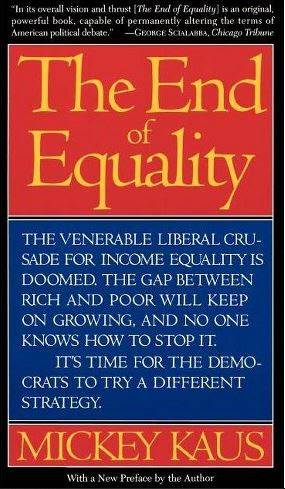
My primary evidence for this is a wonderful book that he wrote, The End of Equality. The book never got the respect it deserved, I think, partly because of the weird moment it arrived (right at the beginning of the Clinton administration; but was the book arguing against what Clinton was doing, or supporting it, or both?), and partly because Kaus's subsequent career--intransigently defending some of the worst aspects of Clinton's welfare reform, obsessing about family breakdown even as income inequality skyrocketed, etc.--retrospectively made the book's insistence that "Money Liberalism" was a non-starter and that "Civic Liberalism" was the way to go seem like Kaus was auditioning George W. Bush's "compassionate conservatism" a decade before it nominally (though never actually) arrived. All those criticisms are fair. But I still use selections from the book in my Political Ideologies classes on occasion, because I find so much of it refreshingly clear and free of cant. He is frank about his conviction that most of those with socialist aspirations have been unwilling to recognize the incompatibility of "fraternity, community, and idealism" with the lack of "material prosperity" that only rapacious capitalism seems to provide (p. 11); he is genuinely eloquent in asserting that differing levels of health care don't actually matter to the egalitarian legitimacy of society so much as "that everyone wait in the same waiting rooms" (p. 93); and he is downright prescient in warning that, if the goal of the Democratic party continued to be tweaking the tax code in some Rawlsian way so as to make it fairer and increase the size of welfare checks but in the meantime said nothing about the lack of community-feeling and solidarity in America, the end result will a general hardening of whatever egalitarian spirit the revolutions of the 1930s and the 1960s may have left us with:

Americans may be social egalitarians today. But give the affluent two more decades to revile the underclass and avoid the cities as if they were a dangerous foreign country, two decades to isolate their "gifted" children from their supposed inferiors, two decades of "symbolic analysis" and assortative mating, and we might wake up to discover that Americans aren't such egalitarians at all any more. Then politics would be really dispiriting (p. 180).

That paragraph can be picked apart and even partly undermined in multiple ways (that large numbers of younger and mostly liberal-learning people, including young families, started returning to America's cities throughout the 2000s is the most obvious rejoinder, but not the only one). But I read it, and I see the once at least moderately liberal suburbs, filled with college-educated, white-collar-job-holding, mostly well-off Americans, voting for Trump across large parts of America. Dispiriting indeed.

Anyway, this is just something that occurred to me, when Robert unintentionally invited Kaus back into my mind. So I thank him for that.

Tuesday, December 11, 2018

The Worst Christmas Specials Ever. Still.

Exactly ten years ago I shared this wonderful relic of the Olde Days of the Blogosphere, by John Scalzi. It was old then, and it's even older now. Still make me laugh, though. Maybe it will you too.

An Algonquin Round Table Christmas (1927)
Alexander Woolcott, Franklin Pierce Adams, George Kaufman, Robert Benchley and Dorothy Parker were the stars of this 1927 NBC Red radio network special, one of the earliest Christmas specials ever performed. Unfortunately the principals, lured to the table for an unusual evening gathering by the promise of free drinks and pirogies, appeared unaware they were live and on the air, avoiding witty seasonal banter to concentrate on trashing absent Round Tabler Edna Ferber’s latest novel, Mother Knows Best, and complaining, in progressively drunken fashion, about their lack of sex lives. Seasonal material of a sort finally appears in the 23rd minute when Dorothy Parker, already on her fifth drink, can be heard to remark, “one more of these and I’ll be sliding down Santa’s chimney.” The feed was cut shortly thereafter. NBC Red’s 1928 holiday special “Christmas with the Fitzgeralds” was similarly unsuccessful.

The Mercury Theater of the Air Presents the Assassination of Saint Nicholas (1939)
Listeners of radio’s Columbia Broadcasting System who tuned in to hear a Christmas Eve rendition of Charles Dickens’ A Christmas Carol were shocked when they heard what appeared to be a newscast from the north pole, reporting that Santa’s Workshop had been overrun in a blitzkrieg by Finnish proxies of the Nazi German government. The newscast, a hoax created by 20-something wunderkind Orson Wells as a seasonal allegory about the spread of Fascism in Europe, was so successful that few listeners stayed to listen until the end, when St. Nick emerged from the smoking ruins of his workshop to deliver a rousing call to action against the authoritarian tide and to urge peace on Earth, good will toward men and expound on the joys of a hot cup of Mercury Theater of Air’s sponsor Campbell’s soup. Instead, tens of thousands of New York City children mobbed the Macy’s Department Store on 34th, long presumed to be Santa’s New York embassy, and sang Christmas carols in wee, sobbing tones. Only a midnight appearance of New York mayor Fiorello LaGuardia in full Santa getup quelled the agitated tykes. Welles, now a hunted man on the Eastern seaboard, decamped for Hollywood shortly thereafter.

Ayn Rand’s A Selfish Christmas (1951)
In this hour-long radio drama, Santa struggles with the increasing demands of providing gifts for millions of spoiled, ungrateful brats across the world, until a single elf, in the engineering department of his workshop, convinces Santa to go on strike. The special ends with the entropic collapse of the civilization of takers and the spectacle of children trudging across the bitterly cold, dark tundra to offer Santa cash for his services, acknowledging at last that his genius makes the gifts — and therefore Christmas — possible. Prior to broadcast, Mutual Broadcast System executives raised objections to the radio play, noting that 56 minutes of the hour-long broadcast went to a philosophical manifesto by the elf and of the four remaining minutes, three went to a love scene between Santa and the cold, practical Mrs. Claus that was rendered into radio through the use of grunts and the shattering of several dozen whiskey tumblers. In later letters, Rand sneeringly described these executives as “anti-life.”
The Lost Star Trek Christmas Episode: “A Most Illogical Holiday” (1968)
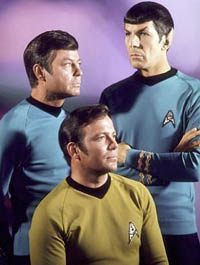
Mr. Spock, with his pointy ears, is hailed as a messiah on a wintry world where elves toil for a mysterious master, revealed to be Santa just prior to the first commercial break. Santa, enraged, kills Ensign Jones and attacks the Enterprise in his sleigh. As Scotty works to keep the power flowing to the shields, Kirk and Bones infiltrate Santa’s headquarters. With the help of the comely and lonely Mrs. Claus, Kirk is led to the heart of the workshop, where he learns the truth: Santa is himself a pawn to a master computer, whose initial program is based on an ancient book of children’s Christmas tales. Kirk engages the master computer in a battle of wits, demanding the computer explain how it is physically possible for Santa to deliver gifts to all the children in the universe in a single night. The master computer, confronted with this computational anomaly, self-destructs; Santa, freed from mental enslavement, releases the elves and begins a new, democratic society. Back on the ship, Bones and Spock bicker about the meaning of Christmas, an argument which ends when Scotty appears on the bridge with egg nog made with Romulan Ale.

Filmed during the series’ run, this episode was never shown on network television and was offered in syndication only once, in 1975. Star Trek fans hint the episode was later personally destroyed by Gene Roddenberry. Rumor suggests Harlan Ellison may have written the original script; asked about the episode at 1978’s IgunaCon II science fiction convention, however, Ellison described the episode as “a quiescently glistening cherem of pus.”

Bob & Carol & Ted & Santa (1973)
This ABC Christmas special featured Santa as a happy-go-lucky swinger who comically wades into the marital bed of two neurotic 70s couples, and also the music of the Carpenters. It was screened for television critics but shelved by the network when the critics, assembled at ABC’s New York offices, rose as one to strangle the producers at the post-viewing interview. Joel Siegel would later write, “When Santa did his striptease for Carol while Karen Carpenter sang ‘Top of the World’ and peered through an open window, we all looked at each other and knew that we television critics, of all people, had been called upon to defend Western Civilization. We dared not fail.”

A Muppet Christmas with Zbigniew Brzezinski (1978)
A year before their rather more successful Christmas pairing with John Denver, the Muppets joined Carter Administration National Security Advisor Brezezinski for an evening of fun, song, and anticommunist rhetoric. While those who remember the show recall the pairing of Brzezinki and Miss Piggy for a duet of “Winter Wonderland” as winsomely enchanting, the scenes where the NSA head explains the true meaning of Christmas to an assemblage of Muppets dressed as Afghan mujahideen was incongruous and disturbing even then. Washington rumor, unsupported by any Carter administration member, suggests that President Carter had this Christmas special on a repeating loop while he drafted his infamous “Malaise” speech.

The Village People in Can’t Stop the Christmas Music — On Ice! (1980)
Undeterred by the miserable flop of the movie Can’t Stop the Music!, last place television network NBC aired this special, in which music group the Village People mobilize to save Christmas after Santa Claus (Paul Lynde) experiences a hernia. Thus follows several musical sequences — on ice! — where the Village People move Santa’s Workshop to Christopher Street, enlist their friends to become elves with an adapted version of their hit “In The Navy,” and draft film co-star Bruce Jenner to become the new Santa in a sequence which involves stripping the 1976 gold medal decathlon winner to his shorts, shaving and oiling his chest, and outfitting him in fur-trimmed red briefs and crimson leathers to a disco version of “Come O Ye Faithful.” Peggy Fleming, Shields and Yarnell and Lorna Luft co-star.
Interestingly, there is no reliable data regarding the ratings for this show, as the Nielsen diaries for this week were accidentally consumed by fire. Show producers estimate that one in ten Americans tuned in to at least part of the show, but more conservative estimates place the audience at no more than two or three percent, tops.

A Canadian Christmas with David Cronenberg (1986)
Faced with Canadian content requirements but no new programming, the Canadian Broadcasting Company turned to Canadian director David Cronenberg, hot off his success with Scanners and The Fly, to fill the seasonal gap. In this 90-minute event, Santa (Michael Ironside) makes an emergency landing in the Northwest Territories, where he is exposed to a previously unknown virus after being attacked by a violent moose. The virus causes Santa to develop both a large, tooth-bearing orifice in his belly and a lustful hunger for human flesh, which he sates by graphically devouring Canadian celebrities Bryan Adams, Dan Ackroyd and Gordie Howe on national television. Music by Neil Young.

Noam Chomsky: Deconstructing Christmas (1998)
This PBS/WGBH special featured linguist and social commentator Chomsky sitting at a desk, explaining how the development of the commercial Christmas season directly relates to the loss of individual freedoms in the United States and the subjugation of indigenous people in southeast Asia. Despite a rave review by Z magazine, musical guest Zach de la Rocha and the concession by Chomsky to wear a seasonal hat for a younger demographic appeal, this is known to be the least requested Christmas special ever made.

Christmas with the Nuge (2002)
Spurred by the success of The Osbournes on sister network MTV, cable network VH1 contracted zany hard rocker Ted Nugent to help create a “reality” Christmas special. Nugent responded with a special that features the Motor City Madman bowhunting, and then making jerky from, four calling birds, three French hens, two turtle doves, and a partridge in a pear tree, all specially flown in to Nugent’s Michigan compound for the occasion. In the second half of the hour-long special, Nugent heckles vegetarian Night Ranger/Damn Yankees bassist Jack Blades into consuming three strips of dove jerky. Fearing the inevitable PETA protest, and boycotts from Moby and Pam Anderson, VH1 never aired the special, which is available solely by special order at the Nuge Store on TedNugent.com.

Thursday, December 11, 2014

The Ten Least Successful Christmas Specials of All Time

Has it really been exactly six years since I last shared this, one of the greatest holiday creations of All Internet History? Apparently so! Well, fine, here it is again, an oldie-but-goodie from John Scalzi, who wrote it ages ago (like a whole decade ago, or even earlier). In times past I saw it regularly on the internets (that itself is an old in-joke, everyone, remember?), but it's been a while, and something this good shouldn't stay buried forever. Enjoy.


An Algonquin Round Table Christmas (1927)
Alexander Woolcott, Franklin Pierce Adams, George Kaufman, Robert Benchley and Dorothy Parker were the stars of this 1927 NBC Red radio network special, one of the earliest Christmas specials ever performed. Unfortunately the principals, lured to the table for an unusual evening gathering by the promise of free drinks and pirogies, appeared unaware they were live and on the air, avoiding witty seasonal banter to concentrate on trashing absent Round Tabler Edna Ferber’s latest novel, Mother Knows Best, and complaining, in progressively drunken fashion, about their lack of sex lives. Seasonal material of a sort finally appears in the 23rd minute when Dorothy Parker, already on her fifth drink, can be heard to remark, “one more of these and I’ll be sliding down Santa’s chimney.” The feed was cut shortly thereafter. NBC Red’s 1928 holiday special “Christmas with the Fitzgeralds” was similarly unsuccessful.

The Mercury Theater of the Air Presents the Assassination of Saint Nicholas (1939)
Listeners of radio’s Columbia Broadcasting System who tuned in to hear a Christmas Eve rendition of Charles Dickens’ A Christmas Carol were shocked when they heard what appeared to be a newscast from the north pole, reporting that Santa’s Workshop had been overrun in a blitzkrieg by Finnish proxies of the Nazi German government. The newscast, a hoax created by 20-something wunderkind Orson Wells as a seasonal allegory about the spread of fascism in Europe, was so successful that few listeners stayed to listen until the end, when St. Nick emerged from the smoking ruins of his workshop to deliver a rousing call to action against the authoritarian tide and to urge peace on Earth, good will toward men, and expound on the joys of a hot cup of Mercury Theater of Air’s sponsor Campbell’s soup. Instead, tens of thousands of New York City children mobbed the Macy’s Department Store on 34th, long presumed to be Santa’s New York embassy, and sang Christmas carols in wee, sobbing tones. Only a midnight appearance of New York mayor Fiorello LaGuardia in full Santa getup quelled the agitated tykes. Welles, now a hunted man on the Eastern seaboard, decamped for Hollywood shortly thereafter.

Ayn Rand’s A Selfish Christmas (1951)
In this hour-long radio drama, Santa struggles with the increasing demands of providing gifts for millions of spoiled, ungrateful brats across the world, until a single elf, in the engineering department of his workshop, convinces Santa to go on strike. The special ends with the entropic collapse of the civilization of takers and the spectacle of children trudging across the bitterly cold, dark tundra to offer Santa cash for his services, acknowledging at last that his genius makes the gifts--and therefore Christmas--possible. Prior to broadcast, Mutual Broadcast System executives raised objections to the radio play, noting that 56 minutes of the hour-long broadcast went to a philosophical manifesto by the elf and of the four remaining minutes, three went to a love scene between Santa and the cold, practical Mrs. Claus that was rendered into radio through the use of grunts and the shattering of several dozen whiskey tumblers. In later letters, Rand sneeringly described these executives as “anti-life.”

The Lost Star Trek Christmas Episode: “A Most Illogical Holiday” (1968)
Mr. Spock, with his pointy ears, is hailed as a messiah on a wintry world where elves toil for a mysterious master, revealed to be Santa just prior to the first commercial break. Santa, enraged, kills Ensign Jones and attacks the Enterprise in his sleigh. As Scotty works to keep the power flowing to the shields, Kirk and Bones infiltrate Santa’s headquarters. With the help of the comely and lonely Mrs. Claus, Kirk is led to the heart of the workshop, where he learns the truth: Santa is himself a pawn to a master computer, whose initial program is based on an ancient book of children’s Christmas tales. Kirk engages the master computer in a battle of wits, demanding the computer explain how it is physically possible for Santa to deliver gifts to all the children in the universe in a single night. The master computer, confronted with this computational anomaly, self-destructs; Santa, freed from mental enslavement, releases the elves and begins a new, democratic society. Back on the ship, Bones and Spock bicker about the meaning of Christmas, an argument which ends when Scotty appears on the bridge with egg nog made with Romulan Ale.

Filmed during the series’ run, this episode was never shown on network television and was offered in syndication only once, in 1975. Star Trek fans hint the episode was later personally destroyed by Gene Roddenberry. Rumor suggests Harlan Ellison may have written the original script; asked about the episode at 1978’s IgunaCon II science fiction convention, however, Ellison described the episode as “a quiescently glistening cherem of pus.”

Bob & Carol & Ted & Santa (1973)
This ABC Christmas special featured Santa as a happy-go-lucky swinger who comically wades into the marital bed of two neurotic 70s couples, and also the music of the Carpenters. It was screened for television critics but shelved by the network when the critics, assembled at ABC’s New York offices, rose as one to strangle the producers at the post-viewing interview. Joel Siegel would later write, “When Santa did his striptease for Carol while Karen Carpenter sang ‘Top of the World’ and peered through an open window, we all looked at each other and knew that we television critics, of all people, had been called upon to defend Western Civilization. We dared not fail.”

A Muppet Christmas with Zbigniew Brzezinski (1978)
A year before their rather more successful Christmas pairing with John Denver, the Muppets joined Carter Administration National Security Advisor Brezezinski for an evening of fun, song, and anticommunist rhetoric. While those who remember the show recall the pairing of Brzezinki and Miss Piggy for a duet of “Winter Wonderland” as winsomely enchanting, the scenes where the NSA head explains the true meaning of Christmas to an assemblage of Muppets dressed as Afghan mujahideen was incongruous and disturbing even then. Washington rumor, unsupported by any Carter administration member, suggests that President Carter had this Christmas special on a repeating loop while he drafted his infamous “Malaise” speech.

The Village People in Can’t Stop the Christmas Music--On Ice! (1980)
Undeterred by the miserable flop of the movie Can’t Stop the Music!, last place television network NBC aired this special, in which music group the Village People mobilize to save Christmas after Santa Claus (Paul Lynde) experiences a hernia. Thus follows several musical sequences--on ice!--where the Village People move Santa’s Workshop to Christopher Street, enlist their friends to become elves with an adapted version of their hit “In The Navy,” and draft film co-star Bruce Jenner to become the new Santa in a sequence which involves stripping the 1976 gold medal decathlon winner to his shorts, shaving and oiling his chest, and outfitting him in fur-trimmed red briefs and crimson leathers to a disco version of “Come O Ye Faithful.” Peggy Fleming, Shields and Yarnell, and Lorna Luft co-star.

Interestingly, there is no reliable data regarding the ratings for this show, as the Nielsen diaries for this week were accidentally consumed by fire. Show producers estimate that one in ten Americans tuned in to at least part of the show, but more conservative estimates place the audience at no more than two or three percent, tops.

A Canadian Christmas with David Cronenberg (1986)
Faced with Canadian content requirements but no new programming, the Canadian Broadcasting Company turned to Canadian director David Cronenberg, hot off his success with Scanners and The Fly, to fill the seasonal gap. In this 90-minute event, Santa (Michael Ironside) makes an emergency landing in the Northwest Territories, where he is exposed to a previously unknown virus after being attacked by a violent moose. The virus causes Santa to develop both a large, tooth-bearing orifice in his belly and a lustful hunger for human flesh, which he sates by graphically devouring Canadian celebrities Bryan Adams, Dan Ackroyd, and Gordie Howe on national television. Music by Neil Young.

Noam Chomsky: Deconstructing Christmas (1998)
This PBS/WGBH special featured linguist and social commentator Chomsky sitting at a desk, explaining how the development of the commercial Christmas season directly relates to the loss of individual freedoms in the United States and the subjugation of indigenous people in southeast Asia. Despite a rave review by Z magazine, musical guest Zach de la Rocha, and the concession by Chomsky to wear a seasonal hat for a younger demographic appeal, this is known to be the least requested Christmas special ever made.

Christmas with the Nuge (2002)
Spurred by the success of The Osbournes on sister network MTV, cable network VH1 contracted zany hard rocker Ted Nugent to help create a “reality” Christmas special. Nugent responded with a special that features the Motor City Madman bowhunting, and then making jerky from, four calling birds, three French hens, two turtle doves, and a partridge in a pear tree, all specially flown in to Nugent’s Michigan compound for the occasion. In the second half of the hour-long special, Nugent heckles vegetarian Night Ranger/Damn Yankees bassist Jack Blades into consuming three strips of dove jerky. Fearing the inevitable PETA protest, and boycotts from Moby and Pam Anderson, VH1 never aired the special, which is available solely by special order at the Nuge Store on TedNugent.com.

I swear, something like ten years on, that line about "the shattering of several dozen whiskey tumblers" still cracks me up.

Monday, October 07, 2013

Sefdom in Equestria, the Libertarian Manifesto of the Millennial Generation

This has apparently been bouncing around the internets for a while, and thus is probably fake, but I don't care. I've only just seen it, and it's a revelation. Now I know what I need to use as the key text for my next Topics of Political Theory course.


Thursday, September 05, 2013

Films for Teaching International Relations

This is a well-worn topic, but still, as I'm teaching International Relations this fall for the first time in a couple of years, I figured I needed to update my list. So take a look, both fellow academics and film buffs, and tell me--out of all these movies which I am allowing students of mine to watch and write a short response to in connection with themes of international relations, which ones are tired or weird or overused or don't work, and which ones have I scandalously forgot? (And if you're going to say, "Hey, you stole a lot of this list years ago from Daniel Drezner and Stephen Walt and Fred Kaplan"--well, okay, you're right: I did. Um...sorry?)

Apocalypse Now (1979)
Argo (2012)
Army of Shadows (1969)
The Battle of Algiers (1966)
Black Hawk Down (2001)
Breaker Morant (1979)
Burn! (1970)
The Bridge on the River Kwai (1957)
Charlie Wilson’s War (2007)
Clear and Present Danger (1994)
Conspiracy (2001)
The Day of the Jackal (1973)
Dr. Strangelove, Or: How I Learned to Stop Worrying and Love the Bomb (1964)
Fail-Safe (1964)
Good Bye Lenin! (2004)
Hotel Rwanda (2005)
In the Loop (2009)
Judgment at Nuremberg (1961)
The Last King of Scotland (2006)
Lawrence of Arabia (1962)
The Lives of Others (2007)
Lord of War (2005)
The Man Who Would Be King (1975)
The Manchurian Candidate (1962)
Missing (1982)
Notorious (1946)
The Official Story (1985)
The Russians are Coming, the Russians are Coming (1966)
Seven Days in May (1964)
Sometimes in April (2005)
The Spy Who Came in From the Cold (1965)
Syriana (2005)
The Third Man (1949)
Thirteen Days (2000)
Three Kings (1999)
To Live (1995)
Tor! Tora! Tora! (1970)
The Quiet American (2002)
Wag the Dog (1997)
The Wannsee Conference (1984)
The Year of Living Dangerously (1983)

Incidentally, I make no apologies for the inconsistent scattering of a few select non-English-language films; there are so many foreign movies that would be worth including that if I actually tried to be comprehensive and balanced in that regard the list would be just unworkable. Also, given my geek interests, the absence of any fantasy, science-fiction, or comic book adaptions may seem significant. It isn't; I simply, again, arbitrarily decided that going there would just be too much. So, for better or worse, "realistic" dramas and comedies and histories it is.

Wednesday, August 14, 2013

Orson Scott Card, Unoriginal Fantasist

So, I see exploding all over the internet the news that science-fiction author Orson Scott Card has waxed lyrical (at nearly 3000 words) about a "silly thought experiment" in which President Obama--who is a vicious and contemptuous tyrant at heart--uses his backroom Machiavellian flunkies to destroy Hillary Clinton's incipient candidacy for the 2016 Democratic nomination by pinning the Benghazi on her, after which he orchestrates Michelle Obama's election to the presidency, effectively allowing him to maintain power behind the scenes. So far, so typical, insofar as far right-wing fantasies go. But Card (who I will still defend as having once been one of the greatest science-fiction short-story writers of all time) isn't stupid. He knows that if he wants his "game of Unlikely Events" to actually have the sort of rhetorical legs he obviously wishes it to, then he's got to do more:

As a student of history, allow me to spin a plausible scenario about how, like Augustus Caesar, Napoleon Bonaparte, Adolph Hitler, and Vladimir Putin, Barack Obama could become lifetime dictator without any serious internal opposition...Obama needs to have a source of military power that is under his direct control. Like Hitler, he needs a powerful domestic army to terrify any opposition that might arise....He needs Brown Shirts -- thugs who will do his bidding without any reference to law. So, Obama will claim we need a national police force in order to fight terrorism and crime. The Boston bombing is a useful start, especially when combined with random shootings by crazy people. Where will he get his "national police"? The NaPo will be recruited from "young out-of-work urban men" and it will be hailed as a cure for the economic malaise of the inner cities. In other words, Obama will put a thin veneer of training and military structure on urban gangs, and send them out to channel their violence against Obama's enemies.

This is the passage everyone is--rightly--focusing on, because this is where the crazy gets serious. And that's all fine and good; no doubt Glenn Beck is kicking himself for not having latched onto this little bit of anti-Obama fictionalizing already. But while everyone rolls their eyeballs (or, I suppose, gobbles it all up as The Honest Truth), no one seems to have pointed out that someone has already told this exact same story. That, in short, Card, once a tremendous fantasist, is trotting out some fairly lame and well-worn paranoia here. How well-worn? Well, how about the fact that this plot twist was the climax to a popular British television program, also a story of a chief executive's grasp of completely power, twenty years ago? Behold:


So, this is what I think. Card, stewing about the collapse of Western civilization and American power and traditional marriage from his home in North Carolina as he is apparently somewhat want to do, was playing around on Netflix, and stumbled on to To Play the King. "Oh my gosh," he thinks to himself, "this is it! Obama is actually Francis Urquhart! I've got to get this in print--no one has imagined this parallel before!!" And so off he goes, spinning out his tale. The problem, of course, is that every minimally literate Tea Partier, whether or not they ever watch the BBC (and I guess, why would they? it's socialist, after all!), has long since imagined this and numerous other lurid scenarios, the stories which lay out such political fantasies having been long since absorbed into the popular imagination. Which, in the end, is my only real beef here. Look, if you're the sort of person who believes that an unfortunately moderate-progressive liberal president who is manifestly friendly to Wall Street and the corporate powers that be is actually a charming, faux-patriotic secret fascist who is plotting the overthrow of the United States of America--or at least the sort of person who enjoys entertaining such notions to keep you fired up during the day--more power to you. But if you're Orson Scott Card, professional writer, couldn't you at least come up with something a little more original? I mean, honestly.

Friday, July 05, 2013

Because You Can Never Get Enough of the Trio

Or, I can't at least, as the dog days of summer settles in, and I find myself thinking about old friends.


Props to whomever applied their internet skills to the films; I never caught the fact that Harry was hearing his names screamed in his memories in Prisoner of Azkaban, even though that's pretty explicit in the books. Also, bonus points for including "Won-Won." (Plus, there is this version for completists.)

Tuesday, May 07, 2013

This ALMOST Makes Consumer Capitalism Entirely Worth It

Behold, Star Trek friends: the greatest ever Greatest Thing Ever:


If you didn't watch it until the very end, you missed the best joke. Go back, watch it again.

Monday, April 29, 2013

Man, the Holy Roman Empire was SERIOUSLY Messed Up

1000 years of European history, via the awesomely observant Noah Millman.


Monday, March 18, 2013

10 Years of Blogging

So, I started blogging 10 years ago today. (Just about at this exact moment, too.) We're on the road today--driving from Mississippi to Florida as part of a family spring break vacation, if our prior plans haven't been derailed--so this pre-written and scheduled post will have to do.

My very first blog post is here. (Or nearly; Blogspot won't quite let me connect to it directly. It's that old.)

My single most popular and commented upon post is here. (Second place is here. See a pattern?)

My most controversial and criticized post is here. (Second place is here.)

Don't know what else to say beyond that. My slowest year on the blog was 2006, the year I thought the life I'd hoped I was building for myself and my family through academia and teaching and writing (and blogging) had come to an end...and then surprising started up again. My busiest year was 2011, which the year I finally ended the Friday Morning Videos feature, which I think was one of the main reasons anyone ever read me anyway.

Don't how long I'll keep it up. If Google Reader can go away, perhaps Blogspot will too, and would I actually care enough to shift to another platform after all this time? Maybe. But maybe not.

Some of you other bloggers have been out there, occasionally checking out my perhaps sometimes insightful, but usually just belabored and silly, yammering for a long, long time. You have my thanks, especially since many of you are an inspiration to me. Whatever you do, you do it better than me, and I hope you'll keep doing it, because it teaches me and it goads me (in a good way). It's made me laugh and think and maybe even become a tiny bit wiser. To whatever extent I've been able to contribute to any of the same for anyone else, I'm grateful.

Tuesday, March 05, 2013

If There is Any Better Way to Filk Downton Abbey Than With a Ukelele, I Don't Want to Know What It Is


(And that sotto voce conclusion? It's gotta be true. There's no way Thomas alone can be supplying all the gay in this awesome show.)

Monday, March 04, 2013

Bollywood Did This to My Daughter

Okay, so Melissa and I have been getting this announcement about our first daughter up around Facebook and elsewhere, but I haven't put in on my blog yet. So, first of all, watch this:


Second, if you feel so inclined, go to the GoFundMe website which Melissa and Megan have set up, and help make her dream a reality.

Third, I'll answer some basic questions.

Q: Are you insane? Why will you allow your sixteen-year-old to spend a whole school year in India?!?

 A: Well, one, she'll be seventeen by the time she goes. Two, Rotary International's student exchange program is an excellent one, with a fine reputation for enuring the safety of those individuals they sponsor. And three, I don't see any good reason to stand in the way of a smart, focused, confident young woman who has found a way to pursue a truly wonderful goal. Will she get sick? No doubt. Will she sometimes she be uncomfortable, out-of-place, confused, maybe even scared? Certainly. Will it be worth it to her? Absolutely.

Q. Is this really going to happen? It's not a scam, is it?

A. It isn't a scam. I freely confess that I was a skeptic for a long time, primarily for financial reasons. I just thought that this was a pipe dream of Megan's, and that ultimately the other shoe would drop, Rotary would come to us and say "And now, cough up the $5000 donation," and we'd have to back out. But these people have been as good as their word. Megan has her passport, and this week she's going in for her TB and other shots, after which the paper work will be able to be filed with the appropriate agency in India, and she'll be able to be placed with a host family in Dehli. Yes, there are still any number of obstacles, not just financial ones, which may appear. But after two years of work, it really looks like Megan's plans are coming together. Melissa and I are very proud; she is being far more ambitious than either of us were at her age, and we want to pull as much together over the six months we have remaining to make sure her experience is a fantastic one.

Q. Just what's the appeal of Bollywood movies anyway?

You know, I actually can't really say; I'm not nearly as familiar with the cinema of India and South Asia as I am with the cinema of East Asia, and what Bollywood movies I've seen have struck me as kind of entertaining but in a rather narrow and predictable way. Still, maybe I just haven't been watching the right ones. And in any case, ripping off Hollywood conventions must be worth doing, if it can create awesome nonsense like this:

Saturday, June 25, 2011

Taking Off

Okay everyone, we're out of here for the next couple of weeks. I've got a couple of Friday Morning Videos lines up, but mostly there will be no action around these blog parts until mid-July, at which point we'll hopefully be back home, safe and sound, from our sojourn to the Atlantic ocean and back, with many stops along the way. As for this Saturday morning, we're St. Louis bound. Woo-hoo! Hopefully we'll be able to avoid the hood.

Friday, May 13, 2011

Simplicity Bleg

[Cross-posted to Front Porch Republic]

It's that time again: call upon the received wisdom of the Plain People of the Internet, to help me with a new class I'll be teaching in the fall. This one is an attempt to pull together several long-standing interests of mine, and get a bunch of students to think with me about local government, alternative economics, environmentalism, and consumerism. I'm calling the class "Simplicity and Sustainability"; my hope for the course is that it will be focused equally on the national and international political and economic priorities and realities that can make difficult the kind of local and lifestyle control upon which "simplicity" depends, and on what we, as individuals and members of our communities, actually need to do and value in order to make "sustainability" a viable goal. As this will be the first time I've ever taught such a class, I have no illusions that I'll be able to hit that sweet spot which will enable the students and me to focus thoughtfully upon both these themes, but we can try.

In some ways, this course will borrow from a class I blegged about previously, my upper-level course on "Capitalism, Socialism, and Localism." But this won't be a seminar for advanced students; more of an introductory course. Of course, I could just have them read all of my "simplicity" posts from years ago, but that would be vain of me and painful for them.

So what am I looking at? The work of Juliet Schor (whom I've talked about before), for one: The Overworked American, Plenitude, or collections she has contributed to, like The Consumer Society Reader or Do Americans Shop Too Much?--all of those are possibilities. Barry Schwartz's wonderful The Paradox of Choice is, I think, an absolute must. I may make use of Radical Homemakers by Shannon Hayes, a book that I've recently made use of (and need to blog about sometime) in connection with some local food stuff I've involved my students in. Wendell Berry is an important possibility, of course, as may be E.F. Schumacher or Herman Daly. And those authors lead me to another consideration--the degree to which I want to make this a class that can align with some of the courses and programs here at Friends University that touch on Christianity, spiritual formation, intentional living, and social justice. A part of me wants to have the students read through the Dao De Jing together, and follow that up with The Tao of Pooh (which is, sincerely, a great little book). But in addition to that? Perhaps Thomas Merton, or Richard Foster? And how much philosophy do I want to bring into this anyway? There's a part of me which sees very clearly the connection between the specialization, professionalization, and standardization of modern life, and how that makes it difficult for us to even conceive of more "simple" arrangement, and in that sense I would like to talk about one of my favorite books of the past few years, Matthew Crawford's Shop Class as Soulcraft...but I recognize that the philosophical perspective he brings to bear on these questions just may be way over my students' heads. Moreover, I shouldn't stick with my favorites--I should stretch myself as well, and use the class as an opportunity to work through arguments which defend the complexity, the pace, the mobility and individuality, the busyness and anonymous dependency of modern capitalism and consumer culture: all these things that complicate the idea of living a simple, sustainable life.

But I suppose that's why I'm making this a blog post. What should am I missing, everyone? Any recommendations you may have, whether they're books or films or anything else, whether they're personal memoirs, economic studies, or religious works--throw them at me. And thanks.

Saturday, March 05, 2011

Three Blogworthy Notes

Does anyone besides me really read blogs anymore? Or has Facebook and Twitter defeated them entirely, and the fact they still seem like going concerns to my eyes is only evidence of how completely I remain cocooned in this shell I constructed, circa 2005? (I mean, I still use and update my blogroll for heaven's sake.) Well, anyway, whatever the truth of the matter, here are three developments in the blogosphere that in different ways have excited and intrigued me, so check them out.

The inestimable Jacob T. Levy has branched out, for the first time, I think, since he departed The Volokh Conspiracy years and years ago. The libertarian Volokh gang used to drive me batty, but I still read them, populist and communitarian and socialist though I am, because Jacob was blogging there, and his occasional and usually brilliant observations on politics, philosophy, and academia made it worth it. He apparently will now be contributing occasionally to a new blog, Bleeding Heart Libertarians. From the first few posts, it looks to be an effort to mostly talk political theory, but perhaps also talk about the events of the day, from what they're calling a "neoclassical liberal" perspective--in other words, a libertarianism which, for different reasons, supports welfare state-type policies. I'll be interested to see where they, and Jacob in particular, take it.

My old and dear and occasionally crazy socialist friend Matt Stannard has, over the past year or two, joined with other progressives of many different sorts to create a worthy contribution to the left side of the blogosphere, Shared Sacrifice, which hosted guest editorials, podcasts, and its own Blogtalk radio program. That site has now been superseded by the much more impressive, and much more user friendly, Political Context. I love the look of it, and I figure it'll be an important resource for me and others on the left, whatever the frequency of my agreeing (or disagreeing) with what I read there. (Full disclosure requires I acknowledge that I've already posted there once, and probably will be again in the future, perhaps regularly.)

Finally, another old friend of mine, a Dallas resident who prefers to maintain his online anonymity, has embarked on a massive project on his food blog, DallasFood.org. The author, a fellow I've known for twenty years, is one of the most particular, exacting, thoughtful, and thorough people I've ever known; when looks into something, he looks into it exhaustively. If you're a foodie, and especially a chocophile, you may be aware of the saga of NōKA Chocolate, an extremely expensive (and pretentious) chocolate manufacturer which DallasFood basically took apart (read about the saga here). My friend isn't planning any kind of food vendetta right now, but he has embarked upon a huge, sprawling series, filled with close historical research and some excellent art and videos, aiming to tell the whole story of the Italian (actually Turinese) chocolate, gianduia. I knew basically nothing about this delicacy before, and I'm learning more, and getting hungrier, every week. (He's even helped me pronounce it.) Absolutely worth checking out.

Thursday, February 17, 2011

A Hiatus By Any Other Name...

Wow, I really haven't been doing much blogging here--between family vacations, snow days, teaching extra classes (got to make the money somehow), and student excursions (I'm writing this from St. Louis at the moment, where I'm with our Model United Nations student delegation), time and energy and interest have been far lower than usual. Not that I haven't made this same excuse many times before at different points, of course. But seriously, I really do have plenty of posts in the works...I'm just not finished with any of them yet. Oh well, thank goodness Friday Morning Videos keeps me from forgetting about the blog entirely. Perhaps I'll get back on track next week. In the meantime, it looks like I'm in Ross Douthat's and Laura McKenna's boat, whether I meant to be or not.

Tuesday, January 11, 2011

Traditionalism in a Changing World (Bigger, Longer, Uncut Edition)

Cato Unbound, a web-journal run by the libertarian Cato Institute, contacted me at the beginning of December about writing an essay for them on traditionalism--specifically, defending it. My lead essay is up at their site; various responses--and my responses to them--will follow through the rest of the month. Check it out, follow along, comment on your own blogs if you're so inclined. And, if you're a real glutton for punishment, you can read the original, 4000-word version of the edited, 2800-word essay they published below.

****

We’ve just emerged from another cycle of what my father-in-law likes to refer to (jokingly, but not without affection) as “Hallothanksmas.” I doubt he’s the only person to use that label to capture the smearing together of the American holidays of Halloween and Thanksgiving and Christmas from early October through New Year’s Day; indeed, observing that our national marketplace appears to push the material elements and practices which are popularly associated with these holidays into an uncomfortably close proximity to each other is commonplace. Charlie Brown and the gang were complaining about this exact phenomenon close to 40 years ago, and the reality of this smearing has only become more obvious ever since.

I confess that I’m one of the complainers as well. I am one of those who hold that holidays traditions may, and often do, whether we realize it or not, play a role of some determinative, even normative importance in our lives–and thus, that there is value in being able conceive and respond to them distinctly. I defend that claim because I see traditions as deeply associated with many other things I take seriously: local engagement, cultural identity, historical memory, familial attachment, and other “communitarian” goods. All of those don't constitute a perfectly indivisible bundle, of course, but "traditionalism" is a thread which runs through and to a degree connects them together. Hence, speaking up for tradition in our economically globalized and hyper-mobile world may be essential to making a case for a whole worldview.

Those who look askance, for political or philosophical reasons (or both), upon this worldview, and specifically upon attempts to justify or build up traditional beliefs and all their material accouterments are hardly necessarily opponents of the holidays; I'm not trafficking in nonsensical "war on Christmas" accusations here. Instead, their disagreement usually appears to be with the moral claims of traditionalism in general--the idea that giving recognition and support to traditions can serve as both a personal and a public good, and consequently might be understood as having some sense of moral obligation tied to it. One of the most common ways in which such a claim is countered is to assert that what appears to adherents of various traditions as morally worthy is really only a subjective perception of such, constructed out of nostalgia, and a result of paying undo attention to isolated moments that can be prettified in our memories, rendering them (distantly) admirable. In this way, anyone who doesn’t live in a fully reactionary environment–and that would include anyone likely to encounter this essay online–finds themselves put on the spot: if their lives are in any way characterized by pluralism, by even a small degree of technological and social change and adaptation, then they must acknowledge that there is an element of choice and willful construction involved in how a traditional belief or practice comes to include (and exclude) whatever it does. And that, supposedly, undermines the theoretical force of the moral claim made on behalf of traditions, for how (so the argument runs) could a subjectively experienced and consciously elaborated-upon moment from out of the whole historical sweep of events be construed as truly serving normative personal or public ends? When there is no necessary reason to believe that the resulting practice or belief is anything but somewhat arbitrary? The critics of traditionalism frequently acknowledge that enjoying the consequences of such a construction may have real psychological or sociological benefits, but that, by this line of reasoning, would hardly seem to warrant the sort of deep discontent that traditionalists are assumed to feel at “Hallowthanksmas,” or some other disruption of their preferred holiday experiences.

A wonderful summation of this perspective was written by Scott McLemee several years ago, in an essay celebrating the Seinfeld-inspired “holiday” of Festivus. The fact that I just put "holiday" in quotations marks is, in a sense, McLemee's point: Festivus is so wholly manufactured, so completely a creature of the mass media and the narcissistic world of ironic detachment, that it can't possibly be commemorated without any such observation becoming a comment on the constructed nature of all “holidays.” Festivus is, he wrote, the "postmodern 'invented tradition' par excellence”: the implication being, of course, that as all traditions are equally invented, narratives which presume some kind of moral authority associated with their maintenance, narratives which talk about changes to traditions in terms of decline and loss, deserve the sort of postmodern puncturing which Festivus provides. McLemee set up his reflections by way the Marxist historian Eric Hobsbawm, who played a large role in developing the "constructivist” reading of nationality; following Hobsbawm, McLemee’s asserts that the traditions we associate with holidays are primarily indicative of our historical position vis-a-vis them. Only when they are no longer binding, no longer economically necessary–in other words, only once the world had sufficiently modernized that we could actually partake of forms of life that our not-particularly-pluralistic village-dwelling ancestors couldn't have imagined--do any of these holidays actually suggest anything that could be consciously expressed as “traditional.” As McLemee put it:

Once upon a time--let's call this "the premodern era" and not get too picky about dates--people lived in what we now think of as "traditional societies." Imagine being in a village where few people are literate, everybody knows your name, and not many people leave. A place with tradition, and plenty of it, right? Well, yes and no. There are holidays and rituals and whatnot. As spring draws near, everybody thinks, "Time for the big party where we all eat and drink a lot and pretend for a few days not to notice each other humping like bunnies”....And yet people don't say, "We do X because it is our tradition." You do X because everybody else around here does it -- and as far as you know, they always have. Not doing it would be weird, almost unimaginable. But then, starting maybe 300 years ago, things got modern....Well before Queen Victoria planted her starchy skirt upon the throne, people were nostalgic for the old days. And so...they started inventing traditions from bits and pieces of the past. In the 19th century, for example, folks started singing "traditional Christmas carols" -- even though, for a couple of hundred years, they had celebrated the holiday with pretty much the same hymns they sang in church the rest of the year. In short, if you say, "We do X because it's traditional," that is actually a pretty good sign that you are modern. It means you have enjoyed (and/or endured) a certain amount of progress. What you are really saying, in effect, is, "We ought to do X, even though we sort of don't actually have to."

To be fair to McLemee, this really wasn’t so much an argument against traditionalism as it was a snark about it; as he concluded: “We gather with family at Christmas or Hanukkah in order to recapture the toasty warmth of community and family. And because, well, we have to.” But there is an assumption at work underneath the snark, an assumption which holds that the ability to meaningfully affirm things through “mere” traditional practices and materiality depends upon a "naivete" which has been destroyed by the self-consciousness of modernity. Talk of "tradition" therefore presumably means little more than aspiring to some kind of "second naivete," to use Paul Ricoeur’s phrase, one that will cover up our constructive role in establishing said rituals and observances in the first place. The point is that such aspirations are, essentially, both flawed and a little silly; perfectly acceptable in their limited place, perhaps, as situated resources that individuals inclined to nostalgia can make use of if they so choose, but fairly problematic if anyone starts using them in such a way that might actually involving the shaping of certain public options or certain personal desires.

While there are other varieties of the anti-traditionalist position, that is perhaps the most defensible one. It isn’t an outright rejection of the communitarian claims made on behalf of traditions, but it is a fundamental weakening of them, such as one may see in the work of scholars like Will Kymlicka or Kwame Anthony Appiah. Both of these writers present “roots” or “cultures” as repositories of stories, behaviors, schemes of judgment and valuation and such, all of which ought to be available for individuals to enter into or exit from as they may subjectively find any or all of them rewarding or beneficial to the lives they choose to lead. Far from leading them to disregard such communitarian concerns entirely, their arguments point towards the importance of taking positive action to support various traditional communities, beliefs, and practices, and that means providing for group-specific rights of various forms. That is certainly a more friendly position to traditionalism than the wholesale opposition one may find in some liberal and libertarian thinkers. But ultimately, they view traditions as a tool for individuals to use or disregard, not something constitutive of individuals, not something as fundamentally meaningful to an act of moral reasoning about what one might choose to use or disregard. The argument is, therefore, ultimately reductive, assuming that making choices will invariably involve at bottom a kind of self-regarding, individual calculation, and thereby pushing the issue in an explicitly economic direction. This is made clear in Appiah’s account of the collapse of Asante farming traditions, included in an essay he published several years ago:

When my father was young, a man in a village would farm some land that a chief had granted him, and his maternal clan...would work it with him....Nowadays, everything is different....Once, perhaps, you could have commanded the young ones to stay. Now they have the right to leave--perhaps to seek work at one of the new data-processing centers down south in the nation's capital--and, anyway, you may not make enough to feed and clothe and educate them all. So the time of the successful farming family is passing, and those who were settled in that way of life are as sad to see it go as American family farmers are whose lands are accumulated by giant agribusinesses. We can sympathize with them. But we cannot force their children to stay in the name of protecting their authentic culture, and we cannot afford to subsidize indefinitely thousands of distinct islands of homogeneity that no longer make economic sense.

This is a powerful story–but also one that elides certain matters on its way towards transforming the question of tradition into one of “commanding” people to make tragic, but also obvious, choices over how they will respond to economic necessities. Of course people will–and do–make the choices they must in order to flourish. But what if the question of tradition, and the normative importance which may be arguably attached to it, isn’t primary about adhering to a given set of static, unchanging practices? What if the primary question pertaining to the value of tradition is how one conceives of practices, how one conceives of “flourishing,” and how one chooses amongst the former to achieve the latter, in the first place? This is a point strongly made by the philosopher Charles Taylor, who, in a debate with Will Kymlicka over the ability of scheme of individual rights to guarantee for the existence of cultural traditions, denied that the elaboration of the argument over tradition in such terms really does the job:

The liberal accords a culture value as the only common resources of its kind available for the group in question. It is the only available medium for its members to become aware of their options. If these same individuals could dispose of another medium, then the case for defending the culture would evaporate. For the people concerned, their way of life is a good worth preserving; indeed, it is something invaluable and irreplaceable, not just in the absence of an alternative, but even if alternatives are available. The difference comes out clearly in the issue of long-term survival. People who have lived in or near French Canada know the resonance of this goal of survivance...The goal that unborn people, say, my great-grandchildren, should speak Cree or French or Athabaskan, is not one that Kymlicka’s liberalism can endorse....The people of French-Canadian ancestry, now assimilated in New England, are doing just as well as any other segment of the U.S. population in leading their lives in the English-language medium they share with the present compatriots. But the loss from the point of view of survivance in clear. [Taylor, “Can Liberalism Be Communitarian?” Critical Review, Spring 1994, 259-260]

The point here is that traditions, perhaps particularly as instantiated in holidays, form a part of the “medium” (historical, linguistic, moral, and otherwise) through which our ability to interact with and make choices about the world, and the available beliefs and practices within it, operates. To reject the idea that traditions contribute to this collective background, and contribute importantly enough to potentially warrant some level of both personal and civic obligation to them, is to grant too much weight to the supposedly revolutionizing idea that this medium is a “constructed” one.

Perhaps those who argue against recognizing this deeper seriousness to traditions go wrong by misunderstanding something about history. Consider Hobsbawm’s argument again. To fully operate–that is, to allow those who note historical changes in certain valorized beliefs and practices to appeal to a contemporary audience, one familiar with the reality of pluralism, and point out the constructed nature of those beliefs and practices, and thus render them arbitrary and hence inappropriate vehicles for moral obligation–Hobsbawm had to assume that there was a historical (call it “pre-traditional”) moment where beliefs and practices endured in a defining way, without a consciousness of change and without interpretive responses to such. But that is a strange notion; it depends, in a sense, on a kind of historical materialist absolutism, wherein we assume that no real self-consciousness existed until the critical innovations and economic revolutions of “modernity” (meaning the 18th century, or thereabouts) brought it about. But actually, it is not at all as though holidays and traditions and the identification with such that occurred in the premodern world somehow existed in the absence of any sort of subjectivity or interpretive correspondence; the constructive identification of rituals and observances with particular ends has always been a part of their own evolution, and celebration. And given this, the increased subjective awareness which attends our own rituals and observances does not mean that our appreciation of them is categorically different from what came before; we may well be inventing something when we celebrate holidays today, but whatever we come up with shouldn’t be assumed to be an “arbitrary” invention, much less a postmodern one. Our inventing itself may be better understood as kind of “adaptive remembering,” a connecting that is potentially every bit as morally valid as that which was experienced by those who went through the same process as the seasons turned a hundred or even a thousand years ago.

To be sure, the increased pluralism of the (post)modern world makes us into interpreters and inventors of a significantly different sort than was likely the case in earlier centuries. But this difference is not necessarily a tradition-shattering realization of arbitrariness; rather, it is what Ricoeur was getting at with his idea of a “second naivete,” which I mentioned earlier. As he wrote in The Symbolism of Evil:

In every way, something has been lost, irremediably lost: immediacy of belief. But if we can no longer live the great symbolisms of the sacred in accordance with the original belief in them, we can, we modern men, aim at a second naivete in and through criticism. In short, it is by interpreting that we can hear again. Thus it is in hermeneutics that the symbol’s gift of meaning and the endeavor to understand by deciphering are knotted together. [Ricoeur, The Symbolism of Evil (Beacon Press, 1967), 351]

If modernity has meant anything, it has meant a change in our accounting of subjectivity; it has made possible a thinking about ourselves as apart from our received “medium” of evaluation. And so the old naivete, with its “immediacy,” won't do any longer. But the result isn’t necessarily a radical change in how we orient ourselves towards traditions; it is a difference in the environment within which we do it. It’s the difference between someone who has only ever been immersed in a single musical tradition making distinctions between good and bad musical expressions, and someone who has been introduced to a plurality of musical traditions, now having to make distinctions with an understanding that the evaluative criteria provided by their own tradition itself can also be evaluated. So now we have to "wager" on interpretation; we have to use it self-consciously and therefore critically. But a changed sense of our own subjectivity, the emergence of a “hermeneutic sensibility,” as it were, does not warrant an encapsulating of all traditional claims as “subjective” and therefore incapable of playing any kind of normative or constitutive role in how we live our lives, much less how we mark the calendar; to do so would require a much wider, much more radical claim about the nature of our consciousness than to merely discover that traditions are “arbitrarily” constructed. One might ask: when has interpretation ever not been involved in our orientation to the world, and when have the resulting orientations (as instantiated into “traditions”) ever been assumed to be somehow less than worthy of contributing to a foundation for action and belief, simply because of their interpretive and constructive elements within their history? (I recognize that one easy response to this might be: when we're talking about "religious" traditions, actions and beliefs that religious people hold to be "revealed" or canonical in whatever sense. I'm quite sympathetic to this response, being as I am religious believer, and one who accepts some account of modern revelation as well. But I don't think it escapes the dynamic which Ricoeur describes, and I don't think believers should want it to. Explaining why gets into some philosophy beyond the point of this post, so I'll just recommend those interested go read this when I wrote about the topic at length.)

Of course, many defenders of tradition are either unaware of or refuse to take seriously the numerous historical changes behind what they feel and do; their preference is to reify particular elements of a tradition into static performances or professions of belief, from which any deviation would be catastrophic. Charles Taylor struggled with this when he attempted to articulate a defense of traditionalist thinking while addressing controversies over cultural accommodation in Quebec (for my comments on the report submitted by Taylor and Gerard Bouchard, see here; Christopher Lasch also discussed this unfortunate tendency, criticizing much communitarian argument as trafficking in a lazy sociology, drenched in a nostalgia, a Gemeinschaftsschmerz, for exactly the kind of stable, traditional (and unreal) community which Hobsbawm’s argument implicitly relies upon. Lasch was by no means a complete defender of tradition, but his distinction between popular "memory" and sociological "custom" is an important one for this argument nonetheless. “Memory,” as he presents it, is that which active agents, working with and through (and, therefore, inevitably sometimes also against) their community contexts, enact and vivify (or revivify) through their collective choices; “customs,” on the other hand, are actions which assume that the “judgment, choice, and free will” which made memory valuable as a marker of worthy beliefs and practices originally is no longer necessary, and hence devolve “into patterns that repeat themselves in a predictable fashion” [The True and Only Heaven: Progress and Its Critics (W.W. Norton, 1991), 133-134, 139-143]. Someone who is serious about tradition will not allow customary behaviors to get in the way of the responsible, interpretive action which “memory” represents.

Would such a serious person include my father-in-law, with his grumbling jokes about “Hallowthanksmas”? I wonder. Around Thanksgiving, one of my favorite books to read to our younger children is Thank You, Sarah: The Woman Who Saved Thanksgiving, by Laurie Halse Anderson and Matt Faulkner. It tells the story of Sarah Hale, an abolitionist, editor, and social reformer, who spent thirty years writing letters and publishing articles, trying to get the federal government to officially acknowledge (and thus hopefully resuscitate) Thanksgiving, a religious and cultural holiday which dated back to the early colonial days, but whose observance, by the mid-19th century, was slowing dying out from. She finally succeeded, and the book makes President Lincoln's declaration of a national Thanksgiving Day holiday out to be Sarah's greatest triumph. What should we make of that? One could, of course, dismiss Hale as a sentimental busybody. But maybe it would be better to say that she was committed to helping her country engage in a little “creative remembering.” The fact that what she accomplished was, strictly speaking, a political invention doesn't take anything away from the moral connections it makes possible for all Americans. In committing herself to a belief and practice, and interpretively responding to the reality of that those traditions as they existed in the decades leading up until the Civil War, she contributed to the maintenance of a normative factor in the lives of her fellow citizens, a factor that might well not have been there otherwise. This is not about whether you like Thanksgiving, or find it important to distinguish it from the dominant holidays immediately before and after it in our national calendar; this is about preserving a space for both a personal and civic recognition of what a tradition of giving thanks, however one chooses to interpret that, can mean. That’s not blindly following custom (though there may well be elements of such involved; there almost always are); that’s doing the kind of important thinking which holidays have always made possible, whether we were self-conscious about it or not.

Well, enough of that. Off to get the Chinese New Year decorations out of the box in the garage. Can’t be too early for that; it’s become so commercialized lately, don’t you know.