Featured Post

WELCOME TO RUSSELL ARBEN FOX'S HOME PAGE

If you're a student looking for syllabi, click the "Academic Home Page" link on your right, and start there.

Showing posts with label Geekery. Show all posts

Tuesday, July 21, 2026

We Were Never Spacemen (But Glen Definitely Comes Closer Than Me)*

I met Glen Henshaw 39 years ago, in the late summer of 1987, presumably in one of the hallways on the 4th floor of V-Hall in the old Deseret Towers student housing complex at Brigham Young University, where we had both moved in for our freshman year. I don’t have a memory of that first meeting, but I have a memory of him. He was thin, smart, funny, athletic, and with a background in nature and agriculture I could relate to (even though Virginia forests aren’t at all similar to Washington wheat fields). Above all though, he was a geek, and it was on that level we truly connected. Not that our geekeries were entirely similar; mine ran towards Dungeons & Dragons and comic books and super-hero movies and getting philosophical about all of the above, while his ran towards the technical side of science-fiction and fantasy: he was a born tinkerer, a student of taking stuff apart and putting it together again, and his obsessive questioning expressed itself differently than mine did. Thank goodness we had our mutual passion for Star Trek (including the novels and comic books, but particularly Star Trek: The Next Generation, which premiered that year, and which he and I and a few other fellow geeks would crowd around whatever television sets were available in the freshman dorms and watch together); who knows how our friendship would have developed otherwise.

But develop it did. We weren’t inseparable friends—he had his gang, staying up to ridiculous hours and hitting Radio Shacks and assorted warehouses around Utah Valley, searching for parts for a robot dog they were determined to build, whereas my gang was mostly just a bunch of politically and culturally malcontented scribblers—but we hung out together pretty often, doing the Blues Brothers thing as the mood struck us. When Ray Bradbury came to campus to give a guest lecture, he and his gang staked out seats close to the stage; they kindly let me squeeze in beside them, and it turned out to be one of my fondest memories of that whole year. But whereas what I got out of it was a great story, Glen got a mission. As he wrote to me:

I remember Bradbury's talk. I remember sitting there with you and Aric and Rob and loving it. But I only remember one thing Bradbury said during that talk, which if I recall correctly was actually an answer to a question posed to him during the Q&A afterwards. What I remember him being asked had something to do with space exploration and poverty and tax money and its wise use. His answer was "I believe we have a spiritual obligation to explore the universe. It is yours if you have the head and the heart for it." That talk, and indeed that statement, gave me the courage to give up my current plans, to start treating college as merely my day job, to ignore most of what my professors suggested as a career path for me, and to start dreaming bigger than I had to that point.

Glen’s dreaming has continued for decades, through a proselytizing mission for our church (I’ve whined and wondered about mine a lot, but Glen’s was way worse: he served a Mormon mission in Salt Lake City, for heaven’s sake), through graduate school, through marriage and children, through moves and family transformations and challenges political and religious and economic. The home and the life which he and those whom he loves have managed to build together is really quite beautiful, rooted in a rural sensibility he’s carried with him throughout his life (his wife and he, among other things, raise Katahdin sheep on a farm in Maryland). But most relevant to this post, he has, for decades, commuted regularly from his farm into Washington DC, where he works as a roboticist for the Naval Research Laboratory—he is, in fact, now “Senior Scientist for Robotics and Autonomous Systems” at the NRL, as well as the lead roboticist for the Robotic Servicing of Geosynchronous Satellites project. In that position, he has won awards and fought bureaucratic battles (not always winning those); he’s helped build upon his experience decades earlier to develop our understanding of robot dogs and, through them, how the programming and machine learning and motion of robotic limbs might be made to work in outer space. The result, after twenty years of work, is an RSGS robot capable of approaching, grasping onto, and repairing satellites while they are in orbit—an accomplishment whose implications, for those tasked with counting costs and determining parameters of space operations in the deep bowels of America’s scientific-industrial complex, are massive. As Glen put it:

Currently, industry designs satellites to be completely reliable, with zero room for error or unexpected failure, over their entire lifespan. Think of it like a car. If you had to build a vehicle to drive 1 million miles without a single breakdown, it would cost an astronomical fortune. But we don’t do that because we can easily take our cars to a mechanic. Because that safety net exists, our vehicles don’t need to be over-engineered to last forever. Satellites are so expensive because they lack that safety net; they must be built to survive that grueling “1-million-mile” journey alone. But if we had a mechanic in space, we could build satellites much more affordably, without the need for such extreme, hyper-exquisite engineering.

That robot will be launched into orbit later today (weather permitting) on as a Northrop Grumman MRV-MEP mission. You can watch the livestream here, if you’re so inclined; I definitely will be. Glen is in Florida for the launch, as he should be: while he won’t be going into space, years of thought and sweat and technological experimentation and budgetary infighting and just plain old hope that came out of him will be. No one involved in America’s various space programs over the decades ever truly believes that anything is ever done alone; even the most arrogant flyboys and test pilots of America’s earliest efforts in the 1950s and 1960s knew that their accomplishments depended more upon the programmers and number-crunchers and engineers on the ground than anything they could do in the air or in outerspace; indeed, that’s why most of them, over time, became more the latter than the former. I look at my old friend; he’s not a military hotshot, but a man skilled with all things terrestrial and digital as well as celestial, someone who has taken those skills and put them to, well, spiritual work. For me, science-fiction at its best (and Star Trek only rarely was, but its occasional best was some of the greatest science-fiction ever, or so Glen and I would both agree) is exactly that kind of work; as I once wrote, it is “human-science-meets-the-infinite, I-put-on-my-space-suit-and-plug-in-my-time-machine-and-touch-the-face-of-God.” Glen won’t be doing the touching this afternoon, but something he touched, inside and out, for years and years, will…and that’s more than enough reason for me to sing his praises here. As the man at the end The Right Stuff says, go Glen—go!


*The title of this short essay is a reference to the wonderful podcast by Nathan Fillion and Alan Tudyk—of Firefly fame, most obviously—which my wife Melissa and I listen to pretty obsessively. Our appreciation of Nathan and Alan has everything to do with their comedy and their charisma, and nothing whatsoever to do with their science-fiction chops—which frankly, despite frequent involvement with that genre, they have none to speak of. This is, as I’m hardly alone in discovering, not at all uncommon amongst those performers and artists and directors who bring writing about space, time, and all that technology and exploration has opened up to us to the screen (though William Shatner’s thoughts about going into space are worth listening to, again and again—which is something that old geeks from the 1980s that Glen and I do, and happily so).


Wednesday, December 31, 2025

The 10 Best Books I Read in 2025

Phil Christman, Why Christians Should be Leftists

A wonderful, short--and yes, somewhat rambling, but only in the way the best kind of earnest testimonies ramble--affirmation of the undisputable truth (or at least so I think) that Christianity, at its core, is a universal, egalitarian, socialist--that is, a leftist--message. It's not so much an argument (though there are good arguments within it) as an altar call, but that altar it calls its readers to is one I fully embrace. More here, if you're so inclined.

Tobias Cremer, The Godless Crusade

There are a lot of books that have been written over the past decade trying to make sense of the rise of right-wing populism as a genuinely powerful electoral reality in Europe and America (and elsewhere, though this book only refers to polities outside of North America and Western Europe very briefly); this is the best one I've read yet. A serious work of scholarship, based on both survey data and sociological analysis, Cremer doesn't so much break new ground as provide a clarifying language to understand the world of Brexit, Donald Trump, and the rest. His detailed case for seeing the heart of this movement, across national borders, as an ersatz religion, a political religious identity without any spiritual substance, is undeniable, I think.

David Grann, The Wager: A Tale of Shipwreck, Mutiny and Murder

I listened to this book with Melissa during a long drive, and I was absolutely capitvated; this was one case where the audio experience of hearing read aloud a thrilling historical tale of shipwrecks, mutiny, and survival--and all the personalities and conflicts which came before it, and all the political fallout that came afterwards--was a perfect match.

Ian Leslie, John & Paul: A Love Story in Songs

I'm a sucker of everything (or nearly everything, I guess) Beatles related, and this book was no exception. This is a delightful and insightful addition to the Beatles canon, a look at the John and Paul relationship and songwriting partnership organized around and viewed through their songs--an approach which is sometimes a little forced, but more often than not kind of revelatory. As I explained here, this book forced me to do what I should have one years ago: really give John's musical ouevre a thorough listen, which took up much of my year. I'm glad I did it.

Grant Morrison and Frank Quitely, All-Star Superman

This one was another audio listen during another long drive, but this time the script was acted out as a radio play, and it was delightful. I'd read parts of this comic collection before, but after listening to it all, I had to track it down and give it a read myself, all in one sitting. This all happened during the summer, as part of a family gathering in Wisconsin, before we all went to see the new Superman movie--and considering the 2025's Superman not only ended up being one of my favorite movies of the year, but also inspired some serious commentary on my part, the presentation of the character in All-Star Superman (widely regarded as one of the best ever, as well as an inspiration for the movie) stands in my mind as one of my favorite narrative experiences of the year.

Jonathan Rauch, Cross Purposes: Christianity's Broken Bargain with Democracy

Rauch's book wasn't one of my favorite reads this year, but it was a book that made me think, and then rethink, my own understanding of the place my own faith community has within the history, the politics, and the ideas which characterize the American society that Rauch and I both value (however differently). My thoughts about the book are somewhat critical, but I also have to give it some respect: it's argument about the contributions with Mormonism can made to American pluralism and democracy are definitely reductive, and in some ways wrong, but are valuable and challenging as well, all the same.

Martha Wells, Fugitive Telemetry

Why this book? I'm not really sure--the whole Murderbot series,which my wife has been raving about for a couple of years now, is a tremendous delight; I had not greater pure reading joy this year than the weeks during which I tore through all six of these books. Wells has created a host of awesome science-fiction characters with great, funny, and even sometimes deeply engaging backgrounds and narrative voices; following their adventures is an absolute hoot, and occasionally even moving as well. I suppose I chose this one because it is the most recently published, and also because it is a superb, self-contained story: Murderbot investigating a murder, using his brains and his slightly lessening misanthropy to solve the case. Great stuff.

Norman Wirzba, The Paradise of God and Agrarian Spirit

Wirzba is an author that I've been familiar with for a while; his essays on Christianity, ecology, and sustainability have often informed my thinking and teaching over the years. But this year I taught, for the first time, a religion course at Friends University, and the topic was "Christian Resources for the Care of Creation"--and these two books by Wirzba became essential contributors to my lectures and discussion topics for the class. Paradise of God is better if you're looking for an explicitly environmentalist interpretation of key Biblical texts, particularly the Book of Genesis; but Agrarian Spirit is better if you're looking for something more pastoral, more political, and less grounded in Biblical theology. Both are wonderful, essential books for helping people to construct a Christian environmental ethic.

Daniel Wortel-London, The Menace of Prosperity: New York City and the Struggle for Economic Development, 1865-1981

This is not a work of political theory; it's a history of urban development, of finance capitalism and its critics over nearly 150 years of New York City's growth and transformation. And yet, in covering this ideas and arguments, Wortel-London has written the best work of urban and political reflection that I've read in a long time. See more here, if you're interested (and yes, you absolutely should be!).

Sunday, December 28, 2025

The 10 Best Movies I Saw in 2025

As always, this is my listing of what I think were the best movies I saw in the past calendar year, not necessarily movies that came out during that year.

The Apartment was one of the films Melissa and I saw this year through the Wichita Orpheum's 2025 Anniversary Film Series, a monthly event that we've fallen in love with (and we can't wait for the 2026 series to begin; it's going to be great!). As for the movie itself, what can I say? This 65-year-old film is as funny, as sharp, as observant, as dark, as real a romantic fantasy of adult sex and love and longing as any romantic comedy I can think of. Given its whole mise-en-scène--New York City corporate office culture in the late 1950s--I can't imagine a better way of telling its story, or a better cast to do so. Billy Wilder knocked it out of the park.


Sometimes you want to see a movie that is a stagey one-hander, just a straight-up bit of focused, funny, sad, outrageous story-telling, presented in an enclosed environment within a defined period of time: a play, in other words. Blue Moon is all that; a movie about plays and musicals, about the words that can make performances on the stage truly play and sing, and about one of the greatest writers of such words ever. Ethan Hawke's Lorenz Hart is an amazing character, and carries the whole film.


Dog Day Afternoon is 50 years old this year (yes, another Wichita Orpheum anniversary film viewing), and I wouldn't change a thing about it. Yes, if we wanted to recreate today the story of this ridiculous, tragic, farcical attempted bank robbery from the summer of 1972, the racial, sexual, ethnic, and LGBTQ aspects of the story would be approached very differently. But would doing so had made the film more of a document of its time and place: urban America in the 1970s, as the social democratic aspirations of the New Deal are clearly collapsing under the weight of bureaucracy and diversity, but the homogenizing effects of finance and global capitalism and technology had not yet fully taken root? I don't think so.

Flow was the most beautiful thing I saw on screen this year, hands down. A wordless, apocalyptic fantasy that gives us, through ordinary animals struggling to survive, something fabulously human: heroism, suffering, possessiveness, guilt, suspicion, nobility, and more. A tremendous accomplishment in visual communication, and the sort of thing that shows what animated story-telling really can--and should--be.

As I have argued many, many times over the years on this blog, President James Earl Carter, Jr., was one of a kind. While neither a transformative genius nor someone particularly good at holding onto and wielding the power inherent in being a President of the United States, he was, nonetheless, something of a miracle: a genuinely good man who managed to climb to the top of the greasy pole of artifice, image, and money that is American politics. There is much which explains his ability to get to such a point and still be capable of articulating, in an embarrassingly sincere language, what he understood about peace, decency, fairness, and work--but one part of the explanation has to be that Jimmy Carter, probably unlike almost every other modern occupant of the White House, actually listened to the radio, and could relate, as ordinary radio-listeners do, to what he heard. He loved the radio, and the folk, pop, country, blues, jazz, and rock-n-roll stars he loved returned this appreciation. Jimmy Carter: Rock & Roll President isn't a deeply critical work, but it tells an essential story: a story about a man who came along at a time when America's cultural exhaustion hadn't yet been commodified, and who enabled artists as diverse as Gregg Allman, Paul Simon, Willie Nelson, Dizzy Gillespie, Bob Dylan, and more to feel something new about their country. And that's just beautiful.

Judas and the Black Messiah is a terrific, depressing story, told in ways that sometimes veer into biopic conventionality, but that other times becomes janglingly real. The creepy scenes with Martin Sheen's J. Edgar Hoover, oozing a frightening racist pretension, and the powerful scenes between Daniel Kaluuya's Fred Hampton and Dominic Fishback's Deborah Johnson, negotiating their relationship as violence and fate weigh them down--all of them, and more, are absolutely brilliant, so much so that sometimes LaKeith Stanfield's William O'Neal, the "Judas" of the title, is overshadowed. But that lack of balance doesn't stop it from being an utterly compelling drama.

Once Upon a Time in Hollywood is delightfully cast, beautifully shot, full of sequences that charmed (Sharon Tate watching herself on the screen in the movie theater) and deeply unnerved (Cliff Booth exploring the cult-occupied Spahn Ranch) and completely satisfied (Rick Dalton improvising and pulling off a great scene as a bad guy in a cheap television Western pilot). For all that, I realized about halfway through that it was something I'm not sure I'd seen before--an actually small Tarantino movie, a Tarantino story that wasn't sprawling out of control with themes and subplots and hints and pretensions. I need to re-watch Jackie Brown, which I've told everyone for years was my favorite Tarantino movie, and it was--but maybe its contained narrative was matched, or even improved upon, by this one? Anyway, a great, fun, even kind of humble fantasy of a cinematic story.

I wasn't a particularly big fan of Pee-Wee Herman; Paul Reubens's comic creation was absolutely capable of tickling my funny bone (I remember watching his 1985 appearance as host on Saturday Night Live, something touched upon briefly--and somewhat bitterly--in this documentary, and laughing my ass off as he minced through the studio audience, re-naming everyone in such a weird manner), but his shtick just wasn't my own. Still, it was a great shtick, and worth honoring. Pee-Wee As Himself does that incisively. Paul Reubens was always trying to exercise control over his image, and variations on the theme of control--his intense friendships and resentments with other actors and artists in his circle, his devotion to his mostly hidden nature retreat in the Hollywood Hills, his willingness to exit and then return to the closet as a gay man as his career demanded, and most of all the incredible work and detail that went into shaping his artistic vehicles--define the whole movie. Overall, a delightful document of the comedy, punk, and avant-garde art scenes in LA in the 1970s and 80s, and one of the most distinctive members they ever produced.

Sing Sing is a heartfelt, thoughtful, honest, and delightfully--meaning painfully--realized story. At first I thought that perhaps I was watching some kind of tone poem, a film about something desperately sad that people live through and find moments of joy and triumph in nonetheless, like the early films of David Gordon Green. But developments later in the film made it more conventional, though no less affecting for all that. A wonderful, tear-jerking--but organically realized--celebration of art and humanity.

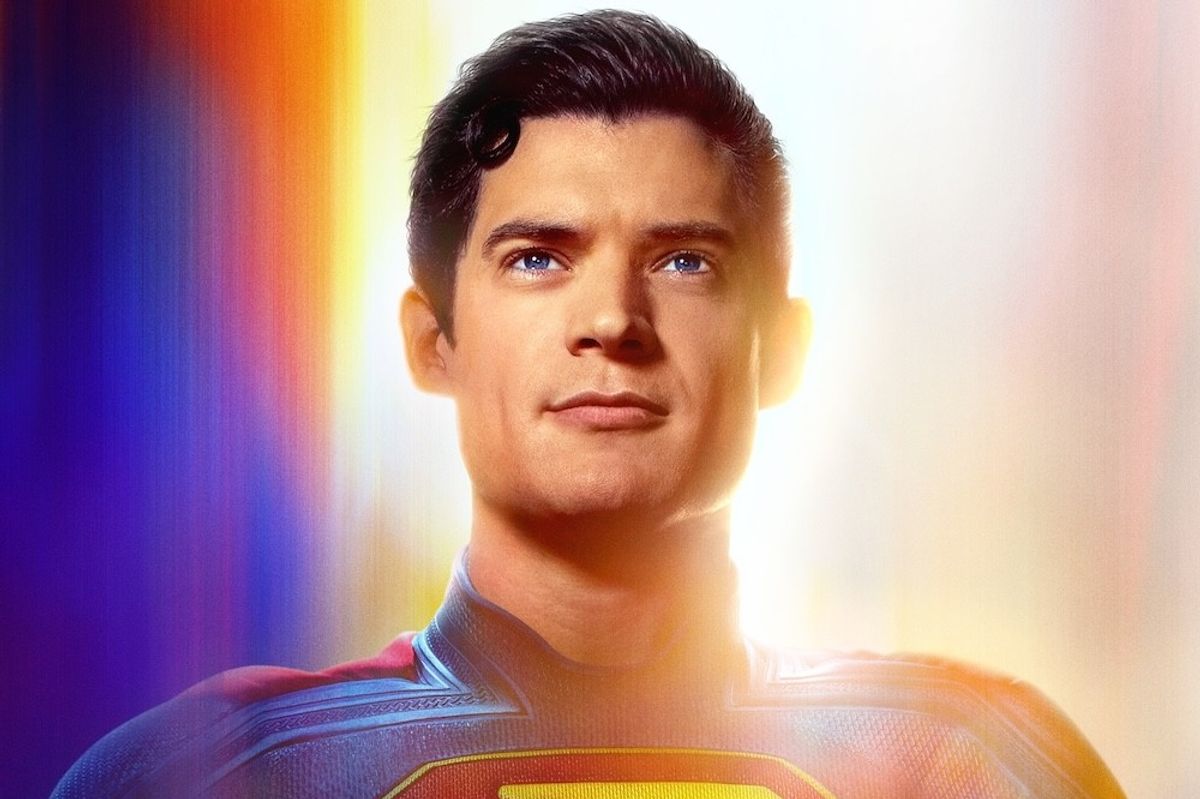
This comic-book Gen X geek has no notes, folks; Superman is straight-up one of the best super-hero movies I've ever seen. James Gunn's DC cinematic universe is, on the basis of this one film, going to dispense with many of the science-fiction and espionage thriller tropes that shaped, so successfully, Marvel movies for more than a decade, and in the place of a lot of that earnest attention to the dramatic, simply stipulating that aliens and meta-humans and super-heroes and everything else is part of the fabric of the world, and has been for centuries. This is not the comic book sensibility made real; this is reality made comic booky, and it delights me. Nearly 50 years ago--back when the character of Superman was barely 40 years old, as oppose to nearly a century now--writers, performers, and filmmakers cinematically realized this hero in a way that drew upon a sense of continuity from throughout the twentieth century; this Superman is part of a 21st-century reinvention, and so long as Gunn keeps his passionate, moralistic, geekily funny version of Clark Kent at the center of his movie universe, I will absolutely be along for the ride.

Monday, July 21, 2025

On Superman, Sentimentality, and Citizenship (or, What Gunn's Superman Knows About America that J.D. Vance Apparently Can't Comprehend)

Daniel McCarthy expanded upon his New York Post editorial, the one I responded to previously, in the pages of his journal, Modern Age. His expansion—“Superman After Liberalism”—isn’t a rebuttal to my response, but he tagged me nonetheless, so I’m going to take the opportunity to respond once more…particularly since the way McCarthy is pursuing his case against James Gunn’s Superman provides me with an important contract to Vice President J.D. Vance, who recently, on the occasion of receiving an award from the Claremont Institute, gave a speech on citizenship which was about as antithetical to the deeply American moral sentiments of Superman as I can imagine.

McCarthy’s argument against Gunn’s vision of the Superman character isn’t changed by his expansion, but he does elaborate on his thesis in some interesting ways. He’s not wrong that “the problem of reconciling the exceptional with the egalitarian” has been a subtheme to telling super-heroes stories ever since Jerry Siegel and Joe Shuster essentially evented the genre (and if McCarthy had either the pop culture knowledge or inclination, he could have made the obvious point that recent comic, cinematic, and television incarnations of Superman—from Christopher Reeve in Richard Donner’s 1978 Superman: The Movie to Henry Cavill in Zack Snyder’s 2013 Man of Steel to many, many others—have all taken different positions on how to address this narrative problem). Nor is he wrong—though he is, I think, incomplete—in suggesting that Siegel and Shuster’s original solution, and the one that supposedly served the character so well for decades, was to write Superman as motivated by a New Deal-era confidence in liberalism as a form of patriotism, the result of his, through his adopted parents, “assimilation into Kansas and America as the land of the free.” I don’t see how anyone remotely online—to say nothing of comic books fan over the past 85 years who have (likely unlike McCarthy) actually consumed Superman media—could be unaware of this aspect of Superman’s history, especially given how relevant it is to debates that McCarthy (and Vance) are deeply involved in today.

McCarthy sees the Superman of the James Gunn film as having abandoned this confidence, as American liberalism has also abandoned it (or maybe, depending on how much and what sort of postliberalism McCarthy embraces, it was fated to turn away from it, in favor of identity politics and government-managed pity). Instead, he sees the Superman played by David Corenswet as unexceptional, bland, and weak (McCarthy makes much of how Superman’s unwillingness to kill makes him reliant upon other heroes capable doing the necessary “dirty work”). And while he allows that there probably could have been, even within his framework, a way of telling the Superman story that asked the “right questions,” this one absolutely isn’t it; in Superman, he sees only a left-liberal film that is so frightened that “fascism has already taken over this country” that its titular character lacks “a place of his own,” leaving him to articulate only lame liberal sentiments with no moral strength of their own.

I’ve already talked about how wrong this argument is. The lame liberal sentiments that McCarthy sees in Superman’s wonderful final words to Lex Luthor—

I’m as human as anyone. I love, I get scared, I wake up every morning and despite not knowing what to do, I put one foot in front of the other and I try to make the best choices I can. I screw up all the time, but that is being human! And that’s my greatest strength.

could, I suppose, be understood as validating a kind of moral individualism and even fatalism. That they lack much by way of realpolitik thinking, and thus arguably open the door to a hypocritical Machiavellianism, showing a face of kindness and sympathy to the crowd while justifying self-interested actions behind your back, is also perhaps true. (Superman didn’t seem too worried about the fate of his clone, for example.) But of course, it’s not like the downsides—the exclusionary classism, racism, sexism, and more—so frequently present in more rigorously particular moral systems are difficult to identify either.

More importantly, to fail to understand the moral strength—and, on an admittedly somewhat attenuated level, what I think can only be understood as an aspect of self-sacrificing Christian love—that is just as possible to be found within this kind of compassion-driven ethical universalism is a major mistake. It’s one that has been made by haters of Rousseau and every attempt within the context of modernity to follow the path toward moral legitimacy—a civil religion based on rights and consent and small-d democratic efforts to build communities of action and legislation—which he suggested for centuries now. I have no idea if James Gunn or David Corenswet have ever heard of Moral Therapeutic Deism, and I definitely reject the idea that what viewers of Superman saw on the screen is just another version of some self-centered, MTD, make-it-up-yourself-morality. But denying that there is any moral substance, any heroism, to someone who puts forward, first and foremost, kindness and concern and sentimentality and good deeds, absent any explicit patriotic attachment or sectarian confession or nationalist vision, is simply a complete misreading of the moral thinking at work in this long, centuries old, deeply important liberal Christian tradition. It’s a complete misreading of the religious sensibility that, as a resident of Kansas, I still see plenty of evidence of all around me, obtaining in communities and families that are interconnected and wired and far less self-sufficient that many who prattle on about “heartland values” insist on making them out to be, but which issue in friendliness and service and charity nonetheless. And finally, frankly, it is a complete misreading of American republicanism as well.

So now let’s turn to Vice President Vance’s partly thoughtful, but mostly pedantic speech, one that Superman would never be pretentious enough to give. In talking about citizenship, Vance starts by making a serious, complicated point:

Social bonds form among people who have something in common. They share the same neighborhood. They share the same church. They send their kids to the same school. And what we're doing [in the Trump administration] is recognizing that if you stop importing millions of foreigners into the country, you allow that social cohesion to form naturally. It's hard to become neighbors with your fellow citizens when your own government keeps on importing new neighbors every single year at a record number.

That social bonds and civic strength develop organically over time through the routines of ordinary life is an undeniable communitarian truth; the whole notion of “social capital” is built upon that understanding. And hence, it’s not unreasonable to see the challenges of ethnic, religious, racial, cultural, and (I think especially) linguistic diversity as genuine ones, ones which immigration restrictions might be an at least partial solution to. There is good research in support of this—but also evenmoregood research that challenges it, making the argument that the obstacles posed by diversity are actually, when one controls for technological distractions and economic barriers which prevent people from interacting as humans (anthropologically social creatures that we are) normally would, quite small, and in any case that such obstacles, absent political polarization, actually fall quite fast.* Robert Putnam, the scholar who developed the idea of social capital, essentially concluded in a later study that the difficulty Vance highlights is a short-term one, one that—in immigrant societies like the U.S.—is always being negotiated by the emergence of “cross-cutting forms of social solidarity and more encompassing identities.”

Presumably, Vance—or at least his speech-writers—are smart enough to know all this. Which means that in holding to this argument, he unintentionally (or, who knows—maybe intentionally!) reveals that his hope through serving in the Trump administration isn’t to fine-tune immigration policy, but rather to change America  away from being an immigrant society at all. And his case for this is plainly ideological—or even, I think, theologico-political, and not in a good way. In the most notorious passage in his speech, he claims:

If you were to ask yourself in 2025 what an American is, I hate to say it, very few of our leaders actually have a good answer. Is it purely agreement with the creedal principles of America? I know the Claremont Institute is dedicated to the founding vision of the United States of America. It's a beautiful and wonderful founding vision, but it's not enough by itself. If you think about it, identifying America just with agreeing with the principles, let's say, of the Declaration of Independence, that's a definition that is way overinclusive and underinclusive at the same time. What do I mean by that? Well, first of all, it would include hundreds of millions, maybe billions of foreign citizens who agree with the principles of the Declaration of Independence. Must we admit all of them tomorrow? If you follow that logic of America as a purely creedal nation, America purely as an idea, that is where it would lead you. But at the same time, that answer would also reject a lot of people that the ADL would label as domestic extremists, even though those very Americans had their ancestors fight in the Revolutionary War and the Civil War. And I happen to think that it's absurd, and the modern left seems dedicated to doing this, to saying you don't belong in America unless you agree with progressive liberalism in 2025. I think the people whose ancestors fought in the Civil War have a hell of a lot more claim over America than the people who say they don't belong.

Some of the reasoning here is obviously puerile. (“Must we admit all of them tomorrow?” So, you’re assuming that “hundreds of millions, maybe billions of foreign citizens who agree with the principles of the Declaration of Independence”—perhaps in part because their own French or Japanese or Canadian or British or Italian or Australian or Norwegian political cultures have long socialized them to accept similar principles of government by consent and natural rights—actually would all want to come to the United States in the first place?) And some of it worryingly strange. (As John Ganz pointed out, the Anti-Defamation League is hardly a “woke” entity these days, but somehow Vance nonetheless thinks it important to insist to castigate them, suggesting that he really does think that anti-Semites, neo-Nazis, and others so-inclined should be given a pass, presumably because they had ancestors who fought for the Confederacy.) But the parts of it which bother me the most are, I think, anti-republican in the most malicious way.

The republicanism of Thomas Jefferson has been endlessly analyzed, and no doubt will long continue to be. But broadly speaking, Jefferson’s republicanism was a fascinating—some would say incoherent—mixture of the aristocratic and the democratic, a mixture of Enlightenment confidence, agrarian sentiment, and noblesse oblige. Jefferson’s Declaration of Independence is not a crystalline distillation of all those ideas, but it does hit all the main points of it, especially as its ideas were later amplified and refined through centuries of American experience and practice. Jefferson’s vision was one of rational human beings exercising their natural right to collectively achieve independence, not solely or even primarily in order to remain virtuous farmers, or to instantiate through the power of a new social contract their own preferred res publica, but simply in order for their personal and communal development, as productive citizens, to be free from the interfering interests of powerful others in their civic spaces. Whatever the inconsistencies one might find in this theoretical framework, it is a substantive one, reflective not of unstated assumptions about some natural necessity regarding borders and identity, but rather of the explicitly stated assumption that a God-and-nature-given sensibility will show the rightness of a free people being able to work out their independence as part of civil order they choose for themselves, absent any distant hierarchy (whether spatially or temporally).

No one actually familiar with the philosophical and historical arguments here can deny that notions of sovereignty—of the right of a people to collectively define and govern their communities, including the borders thereof—were an important component of these republican visions that shaped America’s political culture. But Vance would have us believe that sovereignty needs to be the central concern of anyone concerned about citizenship and freedom:

What does it mean to be an American in 2025? For one, I think it has to mean sovereignty. More precisely, American citizenship must mean belonging to a nation that guards the sovereignty of its people, especially from a modern world that's hellbent on dissolving borders and differences in national character.

The Declaration is by no means a culturally placeless document; among the particulars that Jefferson levied against King George were claims that his actions were stirring up the continent’s native inhabitants to war and allowing the Catholic French to establish a dangerous foothold in Canada. Jefferson was not so idealistic as to ignore all concerns about security and identity. But the power of the document—and really, the power of this kind of liberal republicanism in general—is the way it connects with sentiments of liberty whose natural rightness were, in Jefferson’s view, becoming undeniable with the transformations which moved Western civilization away from the ancient and medieval worlds, and towards a more rights-based one. Jefferson’s embrace of the Enlightenment is hardly defensible in every particular, especially when it comes to race and religion. But the fact that America’s political culture became entwined with Jefferson’s hopes—his belief that, as he put it in one of the final letters he ever wrote, “the mass of mankind has not been born with saddles on their backs, nor a favored few booted and spurred, ready to ride them legitimately, by the grace of God”—is inseparable from what this country has meant to the history of the world. To reduce that all to obsessions over sovereignty (and apparently not so much, in Vance’s mind, popular and democratic sovereignty, which is a crucial aspect of self-governance, but rather martial sovereignty, since he seems especially worked up about the fact that “so many young people…say that they would not die for their own country…[or] put on a uniform and sacrifice their lives for our common nation”) is a serious conceptual loss.

Fortunately, the history of America is filled with people who have understood this country’s civic self-conception more accurately than Vice President Vance does. President Abraham Lincoln, for one, who in perhaps his greatest and most influential speech, emphasized that the carnage of the Civil War, and the kind of community those who waged it were motivated by, was one characterized by a simple, singular “proposition”: “that all men are created equal.” But also, how about the political theorist, and refugee from the Holocaust, and naturalized U.S. citizen, Hannah Arendt? There’s isn’t a smidgen of flakey idealism to be found in her writing—and yet, her whole understanding of her adopted country began with her appreciation of the power of the demos to build civic spaces and secure liberty through revolutionary action, action which is not dependent upon some kind of prior security, but upon a spontaneity available to all. There is, of course, Martin Luther King, Jr., civil rights leader, devout (however flawed) Christian, and democratic socialist, whose commitment to all three of those collections of moral principles formed the pillars of the “beloved community” that he believed all free people ought to and someday would be able partake of, with Jefferson’s words in the Declaration guiding him towards his refusal “to believe that there are insufficient funds in the great vaults of opportunity of this nation.” And what about Zohran Mamdani, the likely future Mayor of New York City? On July 4th, he posted his sentiments: “America is beautiful, contradictory, unfinished. I am proud of our country even as we constantly strive to make it better, to protect and deepen our democracy, to fulfill its promise for each and every person who calls it home.” And Vance—kind of like McCarthy, come to think of it—found that bland statement of liberal patriotism simply horrifying. “There is no gratitude in those words, Vance ranted. “He dares on our 249th anniversary to congratulate [America] by paying homage to its incompleteness and to its, as he calls it, contradictions?....Who the hell does he think that he is?”

Well, for one thing, he appear to think—if only in terms of structure, not substance—pretty much the exact same way Vance himself thinks, if he were only honest or self-reflective enough to notice it, since our Vice President actually ends his own speech saying “we must get to work”—which I think must mean that even he agrees that the work of American citizenship is, well, “unfinished.” But that’s just more puerile rhetoric from angry man, or at least a man who knows his position in the Trump administration and the plaudits he receives from the MAGA base depends upon his performative anger.

A better answer, of course, is that Mamdani, like all good Americans this summer, may not think he’s Superman, but he’s surely been inspired by Malik Ali, the falafel vendor who believes in Superman, jumps into a crater to help him up during his first tangle with the Hammer of Barovia/Ultraman, and then is pointlessly murdered by Lex Luthor while the latter tries to get Superman to tell him the location of his home. Because Superman does have a home, a place—a place of homely, maybe even “bland” liberal republican and Christian virtues, all that not particularly sovereign stuff about doing good and feeling compassion and treating everyone equally and trying again and again, despite all his and our limitations and mistakes. It’s the sort of place that teaches a person to, when offered a falafel by a vendor after saving someone from being hit by a taxi, accept it gratefully.

Did the Kents introduce Superman to falafels while he was growing up? Probably not—probably he came to like them because he’s just another struggling modern person, appreciating the good food and other good works human beings can achieve. There is a substance to this very American, very liberal, very “bland” struggle. It’s a substance I’m happy to admit is in some ways parasitic upon, and therefore must necessarily connect to, all sorts of deeper traditions and values and visions; there’s a reason why I call myself a communitarian and a civic republican and a Christian, after all. But to allow the fact that the Christianity and republicanism and community attachments of modern Americans (like, I think, James Gunn’s Superman) tend to be rather liberal to become a reason to reject their sources entirely is the worst sort of cutting off your nose to spit in your own face. Of course, when you’re talking about a political movement that’s all about reacting against the America that actually exists, not to reform or improve or correct it but rather to just reject its reality, then maybe that kind of cutting and spitting is what passes for respectable thought. It wins awards from the Claremont Institute, apparently.

Wednesday, July 16, 2025

Defending Superman's Sentimentality

[Note: Spoilers follow.]

I’ve seen James Gunn’s Superman, and I’ve written up my take on it on social media: I thought it was absolutely wonderful, one of the very best super-hero movies I’ve ever seen, on the same level as—or maybe exceeding—such movies as Sam Raimi’s Spider-Man 2, Ryan Coogler’s Black Panther, Christopher Nolan’s Batman Begins, Jon Favreau’s Iron Man, even Richard Donner’s Superman: The Movie. Some disagree with that assessment, which is fine; there are all sorts of ways, both stylistic and substantive, to judge big pop entertainments like these, and I’m not inclined to argue (much) with folks whose takes differ from mine.

But a politico-theological argument? That I can absolutely get into.

Given that Superman, no matter how one tells his story, is by definition a hero of the underdog, someone who saves lives, stops disasters, and fights those who oppress and terrorize, it’s always going to be easy to fit him into a particular political narrative, and certainly there’s been plenty of that in the wake of the visuals and narrative choices which Gunn employed in making Superman. (As one of my friends said regarding Vasil Ghurkos, the evil ruler of Boravia who is central to Lex Luthor’s scheme to destroy Superman, Gunn made him look like Benjamin Netanyahu, but sound like Vladimir Putin.) From what I can tell, the lazy political attack on the movie—that it’s “woke” and therefore nothing but progressive propaganda—doesn’t seem to have legs; multiple conservative, Trump-supporting friends of mine have loved the movie, loved the humor and action and heroism the film contains. Another, slightly different attack caught my eye, though, and I want to say why I think it’s completely wrong.

It's an attack made by Daniel McCarthy, the editor of Modern Age, a rather idiosyncratic conservative journal. In a column titled “What Trump Knows About ‘Superman’ That Hollywood Can’t Comprehend,” McCarthy writes that attempts to hate on Superman because of its presumed (and I think actually quite obvious and accurate) messages regarding immigration and respect for civil rights and the rule of law are side issues, at best; the real problem with Superman is its “bland and demoralizing vision” of an America without values. He describes the film’s Jonathan and Martha Kent at “ludicrously folksy stereotypes”; he condemns the fact that this Superman “doesn’t utter a word about ‘the American way,’” but instead “when he confronts Luthor at the film’s climax…insists his failings are what makes him human”; and that Superman’s core replaces patriotism with sentimentality: “Superman hasn’t assimilated to America, but to an unplaceable idea of niceness and self-affirmation.”

Well, as Jules Winnfield once said, allow me to retort.

I called this a politico-theological argument, because it is: it is an argument which is built out of assumptions about the moral importance, perhaps even the moral centrality, of being a part of a national community, a community that itself posits its own character—its own “way”—as reflecting, perhaps even instantiating, something unique and higher. Without being attached to a people and place, moral positions become bland: “niceness” is a characteristic which anyone can possess, and it betokens no sense of strength or specialness. Superman is, McCarthy is saying, just this guy with powers; he does not inspire, unlike Trump, who understands that the point of national leadership is to never be humiliated, to be “so strong” he doesn’t need to engage in violence (unless he chooses to, of course).

Thankfully there are at least some conservative Christians who still haven’t forgotten that the theology which actually emerged from the stories of the Bible, both the Old and New Testament, and in contrast to the idolatry which motivates so much of the MAGA cult, isn’t at all about strength but rather is all about acceptance: acceptance of individual choice and accountability, acceptance of one’s common and flawed mortality, acceptance of the equal dignity of all persons, good or bad, weak or strong, journeying through this earthly life. On that reading, Gunn’s Superman is a deeply religious film, telling the story of the struggles and the triumph—for the moment!—of a tremendously gifted man who cares deeply about his fellow beings (regarding Krypto: “He’s not even a very good dog—but he’s out there alone, and he’s probably scared”), despite his own many limitations (his final words in the movie, after Mr. Terrific leaves Superman in a huff: “I am such a jerk sometimes”). But I think we can go even deeper than that.

Long ago, back when the Blogosphere was a name that was actually recognized by many, I was part of a long discussion over what some scholars of religious belief and practice had terms “Moral Therapeutic Deism.” My engagement in that debate touched on Barak Obama, Rod Dreher, civil religion, and more, but I’d like to draw out just one element of it: the thought of Jean-Jacques Rousseau. And actually, I wouldn’t be surprised if McCarthy had been actually subtly signaling to all the Rousseau-haters out there when he described the “sentimentality” of Gunn’s Superman as consisting of “niceness and self-affirmation,” because that’s just a step or two away from one of Rousseau’s key claims: that modern morality is built, first, upon pity or compassion for others, and second, upon amour de soi, a concept usually translated as “self-love,” but which really connotes a positive sense of dignity, self-care, and accountability.

In any case, for Rousseau, modernity has robbed us of the possibility of a genuinely organic connection to a national community, or really any community identity at all; to take its place, there is the need to educate people in a religious sensibility that arguably is a direct ancestor of MTD. “The Creed of the Savoyard Priest” is a central text here; its ideas were foundational for much 19th-century liberal Christian theology, and frankly, that theology is as American as apple pie: God loves you. God has given you an inner sense of decency; don’t allow learned rationalizations to distract you from it. On the contrary, God wants you to follow your conscience, as that will allow you to best respect and serve and build community with others. As the Priest writes: “Feeling precedes knowledge. Since we do not learn to seek what is good for us and avoid what is bad for us, but get this desire from nature, in the same way the love of good and the hatred of evil are as natural to us as our amour de soi.”

I don’t deny for a moment that there is a potential for moral individualism here that can be, and in some ways absolutely has been, devastating to the moral conditions of modernity. And yet, modernity means more than just the worst aspects of individualism; it also means (as I wrote in that blog post 16 years ago) “the global regime of human rights, worldwide activism on behalf of the indebted and the poor, volunteerism and service in tens of thousands of places across the globe,” etc., etc., etc. How much are all the undeniably limited but nonetheless still real ways in which the world has improved, at least insofar as slavery, coverture, torture, and genocide, over the past two hundred years the result of “people absorbing anemic liberal doctrines about not shooting people who just want to get a better job or to express themselves, about recognizing the need to actually sit down and speak with and learn from those whom you had previously oppressed”? To connect this back to Superman, our hero’s defense of his involvement in the Boravian attack on Jarhanpur ultimately comes down to—and his contentious interview with Lois Lane makes this clear—one simple moral reality: “People were going to die!” Using super-powers to stop (again, for the moment!) a conflict because you don’t want people to die is, surely, pretty simplistic, pretty basic. It is also, well, compassionate; it is sentimental, it is nice.

And this, really, takes us back to the people, the community, that Gunn’s Superman does belong to: his parents in Smallville. As has been noted, past comic and cinematic incarnations of Jonathan and Martha Kent have tended to present them as “paragons of a certain kind of Americana nobility; strong, proud farmers from the heartland,” teaching their adopted son “all the right values and the responsibilities that come with his incredible abilities.” But Gunn makes them “normies” (by the way, this was something, as a Kansan, I recognized from the very first trailer; far from the stereotypical red barn with windmill and grain elevator, miles and miles from town, these are two far more typical rural residents of small-town Kansas in 2025, where the grain fields are overwhelmingly owned by large corporate actors: the Kents have a suburban ranch home and run cattle, and probably both have jobs in town on the side). Are they church-goers? One would guess. But churchgoing in small-town Kansas in the 21st-century isn’t and can’t be imagined as being what it was when Glenn Ford’s Jonathan Kent clapped young Clark on the shoulder just before dying of a heart attack in Donner’s 1978 Superman: The Movie. For better and for worse, that stoic, American Gothic image of the heartland has now all but disappeared. What’s in its place? A lot of good people (even if they are Trump votes, as Jonathan and Martha Kent almost certainly are), who go to church and embrace a message of Christian decency and sentiment—the sort of message that would lead Pa Kent to say, it what was clearly the moral center of the Superman, whatever anyone else might say later:

Parents aren’t for telling their children who they’re supposed to be. We are here to give y’all tools to help you make fools of yourselves all on your own. Your choices, Clark. Your actions. That’s what makes you who you are. Let me tell you something, son, I couldn’t be more proud of you.

Right there, we have parental love, we have tolerance, we have individual responsibility, we have dignity and respect. Perhaps theologically those virtues are “bland” enough, in McCarthy’s words, to not provide a foundation for strength; on the level of philosophy, I’m open to that argument. But insofar as actually lived lives are concerned—particularly the lived lives of Kansans that I know, including many whose politics I think are appalling, but whose support for families and friends and civic work are rock solid—I think this kind of morality, Superman’s morality, a morality that saves dogs and squirrels, a morality that refuses to cause harm to others, fails to prevent all possible harm, but then keeps on trying again and again anyway, is a damn good one. Sentimental yes, but inspiring too, I think. (And from all the memes that are apparently out there celebrating the wonderful, stupid, absolutely Superman-ish line "Kindness, maybe that's the new punk rock," maybe there are more people out there who agree with me, rather than McCarthy.)