
Featured Post

WELCOME TO RUSSELL ARBEN FOX'S HOME PAGE

If you're a student looking for syllabi, click the "Academic Home Page" link on your right, and start there.

Monday, July 24, 2023

Songs of '83: "Sharp Dressed Man"

This fast and smooth driving bit of accelerated Texas blues guitar rock, which entered the Billboard charts 40 years ago this coming week, was the greatest of ZZ Top's Eliminator hits. It didn't chart the highest, nor have the best video; "Legs" takes that honor, which bizarrely wasn't released as a single until 1984, after the album had been out more than a year. But with "Sharp Dressed Man," front man Billy Gibbons's fascination with the technological innovations that he'd heard coming out of European clubs--he was apparently particularly taken with Depeche Mode and OMD, both of which were still a couple of years away from making an impact on American radio-- was undeniable. He sped up the drum machines, used synthesizers to create a floor of sound beneath the bass, and the result is an album--and especially this single--of super-charged boogie rock. That Gibbons was an open-minded musician is well known (his fascination with Prince's guitar playing makes a great story), but the fact that these long-bearded Texas bluesmen knew a good thing when the 1980s and MTV delivered it to them deserves special applause.

Monday, July 17, 2023

Songs of '83: "Lawyers in Love"

The fate of 1970s Laurel Canyon-style singer-songwriters in the 1980s was diverse. Some (England Dan, Paul Davis) went country; some refused to change until world music woke them up to new possibilities (Paul Simon); some focused on soundtracks (Carole King). But others simply adapted their sound, making use of new technologies while following their same muses, thus producing much the same music, only a little brighter, a little tighter, and a little more pop. This is James Taylor, Carly Simon--and most of all, Jackson Browne.

Browne's contrarian folkish sensibility always made room for the enhanced capacities of rock and roll, as the rueful, rocking genius in the lyrics and orchestration of "The Load-Out/Stay" from 1978 makes clear. But I don't think he ever got better than "Lawyers in Love," my absolute favorite Browne composition, which hit the Billboard charts 40 years ago this week. The song reflects both the musical style and the political moment of 1983 with a whimsy and a satire that I think has rarely been equaled by any artist with any kind of pretensions to seriousness. The video is, admittedly, a weird mess, but if anyone in the 1980s came up with a sharper Cold War line than "eating from TV trays / tuned into Happy Days / waiting for World War III while Jesus slaves," I don't know what it is.

Thursday, July 13, 2023

Bernie Sanders, Patrick Deneen, and a “Left Conservative” Solution

[This is a version of a joint review of new books by Patrick Deneen and Bernie Sanders which I have written for Current, and which follows up on my previous, more in-depth review of Deneen's book here.]

Over the past few months, two books calling for a radical transformation of America’s socio-economic and political status quo have been published. One of the was written by a man long associated with conservative arguments and publications, but really isn’t, in my judgment, a conservative book at all; the other was written by a man long associated with democratic socialism, but his socialist arguments incorporate, in my view, a conservative sentiment which the first book frequently invokes but provides few concrete arguments in support of. Insofar as actual intellectual arguments are concerned, the first book, Patrick Deneen’s Regime Change, is the better one. But if one genuinely wishes to understand and develop responses to the harms of state capitalism and liberal statism, responses which are grounded "conservatively" in the collective achievements and socio-economic struggles which actually exist today, then Bernie Sanders’s much more conventional book, It’s Okay to Be Angry About Capitalism, is, I think, nonetheless the wiser one. 

Deneen’s book extends upon his earlier work Why Liberalism Failed, a book that received much praise for its description of the philosophical flaws of liberal individualism which have led to social discontent and cultural breakdown. Deneen ended Why Liberalism Failed suggesting the need for “patient encouragement of new forms of community that can serve as havens in our depersonalized political and economic order,” which situated that book firmly within a long tradition of conservative complaints about and localist responses to our liberal order. Regime Change, however, dismisses with that Burkean prudential sentiment; embracing the idea that “conservatism” (at least the conservatism of the 19th and 20th centuries) partakes of liberalism’s sins, Deneen insists that the “postliberal” future he thinks inevitable requires an “epic theory” which would challenge the roots of the modern order entirely, so as to recover or rebuild something more authentically natural. 

A central component of the epic theory laid out in Regime Change is a wholesale rejection of the egalitarianism which has evolved over the centuries since the Protestant Reformation, having transformed (in ways Deneen presents as almost entirely negative) the manner in which we moderns mostly understand such ancient concepts as “democracy” or “rights.” For Deneen, the demos deserves respect, but not the right to actually, directly, govern itself. Deneen’s more natural political order would be a postliberal in the sense that it would unapologetically look to the cultivation of an elite “few” who, having been trained in the responsibility to exemplify for the “many” proper rulership, would be able to establish laws that reflected collective norms—both cultural and economic (though, on the basis of the pages spent exploring them in RC, much more the former than the latter)—rather than individual interests as manifest through some kind of social contract. The resulting “mixed regime”—meaning one that would balance the ambitions and abilities of the few with the many’s presumed longing for stability—would, in his view, be able to address the challenges of collective life in a manner both virtuous and non-alienating, unlike what liberalism has given us. He calls this “common good conservatism,” but just what it would be conserving—aside from those particular moral and cultural customs which Deneen thinks the working classes ought to be living in accordance with, even when they, in fact, choose not to—is unclear. 

There is a great deal more in Deneen’s rich—and I think dangerous—book, but that is the gist of its ambitious, revolutionary, and decidedly unconservative, at least dispositionally speaking, argument. Reviewers more aligned with America's conservative movements than myself (Jon D. Schaff, Adam Smith, Ross Douthat, and others), operating with the assumption that, as Smith put it, “the question is not whether there will be an elite, but whether it will be a good one,” are less troubled than I by Deneen’s willingness to invoke an idealized natural hierarchy of a pre-Protestant Reformation, pre-liberal Europe as his postliberal guide. But however seriously one takes Deneen’s diagnosis, the fact remains that he sees himself accomplishing this attack on our present managerialist and statist status quo in the name of what he holds to be the common interests of the people, something which “aristopopulism” is necessary to achieve. 

It’s Okay to Be Angry About Capitalism is similarly filled with ambitious, radical ideas, but it has no such revolutionary gist to it, at least not one which is laid out in such a way as to organize the book’s somewhat rambling arguments. Sanders is, of course, a politician, not a theorist—but he is a politician who, over his career, done more to mainstream the idea that capitalism as it presently operates isn’t a natural or virtuous arrangement of affairs, and to therefore get broad numbers of not-otherwise-radical people to think critically about alternatives. As I wrote about Sanders before, “[Sanders’s] greatest accomplishment wasn’t helping make the Democratic party more comfortable with certain (re-named!) democratic socialist ideas but rather helping bring into the mainstream a fruitful mess of radicalisms, all of which are busy promoting their own alternative democratizing visions…. Bernie Sanders failed to win the presidency, but he didn’t fail to fertilize, with his words and actions, long moribund ideas in America.” It’s Okay to Be Angry shows off the fruit of such fertilization, taking on health care, Wall Street, college education, Fox News, and much more. Those looking for a thoughtful democratic socialist critique of the liberal capitalist state will not find one in the pages of Sanders’s book, especially since more than a third of the book is an interesting but not especially deep rehearsal of the greatest hits of Sanders’s political career and campaigns over the Trump years, and much of the rest reflects a progressive liberalism rather than something explicitly rooted in the visions of his hero, union leader and Socialist Party presidential candidate Eugene Debs. But a close reader will see, nonetheless, a focus on productive work which arguably brings a critical unity to Sanders’s case against the “oligarchs” and “billionaires” and the “über-capitalist system.” It is this focus which positions Sanders’s book as a wiser radical response to the problems of today than Deneen’s anti-egalitarian, “aristopopulist” suppositions. 

Deneen writes often in Regime Change about “the many” or “commoners” or “the working class,” at times criticizing them as “far less likely to exhibit certain kinds of virtues related to marriage, family, work, and criminality than the ‘elites’ that they often disdain,” yet nonetheless repeatedly positing them as a non-aspirant, non-managerial loadstone, “more likely to be grounded in the realities of a world of limits and natural processes, in tune with the cycle of life and rhythms of seasons, tides, sun and stars.” That is, Deneen presents those who do practical, material work for living as a static category, a necessary component within a healthy society, but not an actual agent within it. Whereas for Sanders, practical, material work—whether in a factory or a classroom or a farm or an office—is connected to an active democratic dignity, and directly contrasted to those financial elites whose wealth is tied to the flow of the economy itself, rather than to its productive results. Sanders writes, reflecting upon his youthful experience on a agricultural commune in Israel:  

Work, to a large degree, defines who we are, what our social status is, and who our friends are….I don’t pretend to understand everything about human nature but I believe that, very deep in the souls of most people, is a desire to be part of their community to and contribute to its well-being. People want to be productive and have a positive impact on the lives of their families….While the world has obviously changed a lot since that kibbutz was created in the 1930s and since I worked there in the 1960s, what has not changed is the sense of empowerment that grows with working people are treated not as “employees,” but as “owners” who share a responsibility for defining the scope and character of their jobs. The sense of community and worker-empowerment that existed there was something that I have never forgotten. It confirmed my view that there are many ways to organize workplaces, and that we have a responsibility to identity the models that respect workers as human beings, and allow them to realize their full potential….Whether someone is working on a farm, or in an automobile factory, hospital, or school, or delivering mail or writing a book, they want to know that what they do is meaningful and appreciated. They want to have a say about the nature of their work and how it is done….Is it really too much, in the twenty-first century, in the wealthiest country on earth, to begin creating an economy in which actually have some power over what they do for forty hours or more a week? 

Deneen is not entirely silent when it comes to how contemporary capitalism has engendered a financial globalism which has undermined the community-building power of workers, and thus contributed to their suffering. As part of the disruptions to the status-quo which he believes recovering a proper elite would necessitate, he mentions the importance of empowering unions, giving workers direct say on corporate boards (in the style of Germany’s Betriebsrat or workers councils), and using tariffs to slow outsourcing. But those few paragraphs pale beside the long sections devoted to attacking the moral individualism engrained in the policies of the liberal state, and the need to construct a postliberal elite that would model a community consciousness that would lift workers up. 

Sanders, by contrast, goes far beyond Deneen’s acknowledged need to strengthen unions and increase the presence of workers on corporate boards, pushing the radical idea of a social reconstruction of the deeply dysfunction distribution of working opportunities and wages in the wealthiest country in the world, something which Deneen, for all his talk about disrupting the system, never really considers. Sanders, when he can pull himself out of the legislative bubble filled with fights over climate change and infrastructure funding, is clear in wanting to make a full-employment economy America’s social ideal, by way of guaranteeing health care, investing in environmentally sustainable work, redistributing wealth, closely regulating financial actors, increasing taxes on powerful financial interests, easing the creation of worker cooperatives, and much more. 

Admittedly, his invocation of this ideal somethings draws him back into just reciting a laundry list of government programs, in classic progressive liberal statist fashion. But sometimes he is able to see beyond this; sometimes he is able to break through the partisan cant which has been second nature for him for more than 40 years, and talk about the goal of economic democracy—a change which he believes (I think correctly) would enable people within their families and communities to find themselves in alignment with a more virtuous “regime.” While not a religious man, Sanders’s collective vision of higher stage in the democratic evolution of capitalist state is, as I’ve noted elsewhere, downright Pentecostal: 

If we accept that the truth will set us free, then we need to face some hard truths about American oligarchs. This country has reached a point in its history where it must determine whether we truly embrace the inspiring words in our Declaration of Independence, “that all men are created equal” and “endowed by their Creator with certain inalienable rights”….We have to decide whether we take seriously what the great religions of the world—Christianity, Judaism, Islam, Buddhism, Hinduism, and others—have preached for thousands of years. Do we believe in the brotherhood of man and human solidarity? Do we believe in the Golden Rule that says each and every one of us should “do unto other as you would have them do unto you”? Or do we accept, as the prevailing ethic of our culture, that whoever has the gold rules—and that lying, cheating, and stealing are OK if you’re powerful enough to be able to get away with it? 

The condemnation of liberalism presented by Deneen and others, whatever its philosophical insight, leads many to assume that talk of democratic equality and rights is incompatible with presumably conservative concepts like “brotherhood” and “solidarity.” To the extent that competitive capitalism presumes that economically empowering individuals can only increase social alienation, and thus allowing corrupt elites impose their ideology upon us all, then Deneen’s prescription may make a dangerous degree of sense. 

But Sanders’s arguments, supported as they are by the example of higher levels of solidarity and public goods in social democratic societies around the world, point to a different way—a more “left” way. This way would be truer to Christopher Lasch’s belief in building a democracy of producers and citizens--a belief which also inspired the teacher, Wilson Carey McWilliams, to whom Deneen admits he is most indebted for his conception of conservatism. Maybe the conservative, or communitarian, value of fraternity is something that individuals, in all their liberal diversity, still can and do conceive and build and maintain, when the social and economic space to do so is offered to them to do; that’s the wise suggestion McWilliams’s daughter, the political theorist Susan McWilliams Barndt, makes in response to Deneen’s book. There are large differences between the content of Deneen’s and Sanders’s radical proposals, but maybe the biggest difference is simply that Sanders presumes that workers still build communities and traditions when socially and economically and democratically empowered to do so—whereas Deneen’s mixed regime seems to presume that such can only be delivered to them from above.

Monday, July 10, 2023

Songs of '83: "She Works Hard for the Money"

Thus far in this list, we've seen artists who made it on to American radio in 1983 who had absorbed and learned from the achievements of disco, and artists who had rejected and fled from those achievements, and even artists who had somehow just plain avoided that whole technological and stylistic revolution in popular music, especially in terms of gender and race. But what we haven't seen yet is what actual pop disco stars themselves did when their innovations and beats from the clubs and dance halls went, and were changed by going, thoroughly mainstream. (What about Michael Jackson, you're asking? Well, 1) he's a special case, as Thriller and the videos from it were kind of the originating cause célèbre of what 1983 meant in the first place; and 2) MJ's disco era was with the Jackson 5 anyway, Off the Wall excepted.)

In any case, the point is--you're Donna Summer, literally the Queen of Disco. You had no less than seven singles in the Top 10 of the Billboard charts between 1977 and 1980. Then, in an equally short period of time, half of pop radio in America decides that disco is way too manufactured and gay and Black to be tolerated, while at the same time a whole bunch of English bands start dominating urban markets, doing everything you and your people had been doing in the studio for years, only with even newer synths and drum machines. Plus, you're caught up in sticky lawsuits with your label. What do you do? You keep doing what you've always done, only maybe you get Musical Youth (yes, that Musical Youth) to add to the song's vocal power and, learning from what Quincy Jones did with Jackson on Thriller, you get Ray Parker, Jr. (yes, that Ray Parker, Jr.) to add some killer guitar licks. Come the summer of 1983, and suddenly America radio simply can't resist. "She Works Hard for the Money" becomes the first video by a Black female artist to go into regular rotation on MTV, and the rest is history.

Monday, July 03, 2023

Songs of '83: "It's a Mistake"

1983 was the year Men at Work finally fully grasped the American radio recognition and critical plaudits and huge money that they'd been steadily building towards for the previous three years; it was also the year they let it all go, never to remotely approach such popular success again. "It's a Mistake" is, in my opinion, their greatest pop achievement; it was also their last major radio hit. In less than a year, Men at Work's two albums that had earlier been released in the Australian market, and had had some success in the UK and Canada, were released in the U.S., to far greater success than they'd experienced on either side of the Atlantic or Pacific. As 1983 began, Men at Work already had two #1 Billboard hits under their belt, and by August they'd have two more Top Ten hits, including this one, which entered the Billboard charts 40 years ago this week. By the end of the year, they'd won the Grammy Award for Best New Artist, and were beset by internal tensions that would lead the band to split up and never again achieve the kind of pop alchemy they'd enjoyed during that one magical year.

Men at Work weren't really New Wave, despite having picked up some cosmopolitan tricks and technologies from playing in the pubs around Melbourne. But simply because of the era, they were occasionally grouped in as part of the Second British (Commonwealth) Invasion. However you categorize them though, this song, written by Colin Hay, simply rocks, with Ron Strykert, the co-founder and lead guitarist of the band, providing on of my favorite guitar solos from any song released that whole year. Give it a listen, and see if you don't agree.

Monday, June 26, 2023

Songs of '83: "Stand Back"

For the first and only time in this list, a 1983 pop hit directly inspired by another, previous 1983 pop hit. Stevie Nicks was, of course, a creature of the California folk- and psychedelic-rock scene, and when she and her musical and romantic partner Lindsey Buckingham connected with the English band Fleetwood Mac, it resulted in one of the great alchemic meldings in pop musical history, creating an absolute radio juggernaut throughout the late 1970s and the 1980s. But while Fleetwood Mac absorbed a lot of styles in creating its rock sound, it was, despite its foundation in the English blues scene, pretty American, and pretty White. When Nicks, in January 1983, heard an early release of Prince's "Little Red Corvette," with those synthesizers and those funky, Black, post-disco techno-beats, she was inspired, and immediately found a tape recorder to put down a demo of what became "Stand Back." When she was able to get into the studio to record it in February, Prince himself came by to program the drum machine and work the synthesizer (though there is apparently some dispute over just who did what). The single was released and started climbing the Billboard charts in June--less than six months after its original inspiration. Who says pop stars can't work fast when they really want to?

Monday, June 19, 2023

Songs of '83: "The Safety Dance"

Last week, I labeled A Flock of Seagulls, when referencing what I think to have been their greatest pop achievement, as possibly the "most mocked" of all the synth-pop acts of the Second British Invasion. Well, that may require some qualification. Because in late June 40 years ago, "The Safety Dance"--a synth-pop confection that probably no one has ever taken seriously as a work of musical artistry, and which yet has achieved a kind of infectious meme-ability of what can only be called world-historical proportions--started its climb up the American Billboard charts. 

Men Without Hats was essentially a half-American, half-Canadian family band from Quebec, which went through a punk phase before shifting to New Wave in the very early 1980s, embracing synthesized keyboards and a musical aesthetic which was crowding disco out of the clubs in cosmopolitan Montreal at a time when, outside of a few venues in NYC and LA, it basically had no presence across the border. (The song itself technically reflects upon that early transition, since rather than sex, the lyrics are actually about the early progenitors of slamdancing and other post-punk styles mixing it up with those attempting to maintain disco's dominance in dance halls.) The song had such a long, ironically-but-kind-of-actually-beloved half-life that it wasn't unusual, by the mid-1980s, to sometimes here the extended dance version on ordinary pop radio, in the same way that, 10 or 20 years after that, it wasn't entirely surprising to see it referenced on Scrubs and South Park. I suppose it's the sort of tune which someone, somewhere, has surely referred to as a "postmodern masterpiece" (Google gives me nothing when I do that search, but I still believe). In any case, two things I can say with complete assurance: first, Renaissance Faires were never the same after the single's video; and second, "Pop Goes the World," from five years later, is their better song [ducks].

Monday, June 12, 2023

Songs of '83: "Wishing (If I Had a Phtograph of You)"

Climbing slowly up the Billboard charts in the wake of The Police's monster hit from last week, we have my favorite song by A Flock of Seagull's, probably the most-mocked of all the synth-pop bands that penetrated the America radio market. Their biggest hit in the U.S. was "I Ran (So Far Away)" from the year before, and the one they're best remembered for, if only ironically. But this week's radio memory from 1983, "Wishing (If I Had a Photograph of You)," is a gorgeous bit of synth-pop, overwhelmingly because of guitarist Paul Reynolds's echo and delay effects. (Honestly, when it comes to using the guitar to create sonic landscapes, Reynolds beats out U2's Edge, at least when judged on the basis of the work they'd accomplished by these respective points in their careers.) I read once that, besides mocking lead singer Mike Score's hair, AFoS were sometimes rundown by other synth-pop bands of the early 1980s for still making guitars such a big part of their sound. If so, they had the last laugh.

Tuesday, June 06, 2023

Putting the Demos on a Pedestal

[Cross-posted to Front Porch Republic]

In the preface to Why Liberalism Failed, the manuscript of which “was completed three weeks before the 2016 presidential election,” Patrick Deneen wrote that “the better course”—at least for all those persuaded by his book’s arguments about the philosophical flaws, contradictions, and corruption of modern liberalism—“lies not in any political revolution but in the patient encouragement of new forms of community that can serve as havens in our depersonalized political and economic order” (WLF, 2018, pp. xiii, xv). That perspective reflected well the constellation of localist ideas which Deneen has contributed to over the years. By seeing in liberalism an affirmation of individualism and pluralism that invariably leads to the rise of a contractarian state, an economic materialism, and an attendant technocratic elite, all of which actually undermine the demos rather than empower it, the response by anyone concerned about the flourishing of democratic communities has to be focused on the local. WLF didn’t, in my view, engage seriously enough with the broad range of republican arguments which have similarly challenged the liberal order over the decades, making some of its conclusions too easily arrived at, but the questions it implicitly raised about local democracy along the way were valuable ones, and WLF received much balanced praise for articulating a particular kind of post-“fusionism” conservative discontent (even former president Barack Obama, while disagreeing with the book’s diagnoses, was apparently a fan).

Within a year of WLF’s publication though, Deneen appears to have changed his mind about pretty much all that. Writing in the preface of the paperback edition, Deneen explained: 

I know believe I was wrong to think that [the project of developing a political theory which would succeed philosophical liberalism] could take generations….Instead of imagining a far-off and nearly inconceivable era when the slow emergence of liberalism’s alternative might become fully visible from its long-burning embers, we find ourselves in a moment when “epic theory” becomes necessary….[I]n mere months—having seen the American political order assaulted by two parties that are in a death grip but each lacking the ability to eliminate the other, and observing the accelerating demolition of the liberal order in Europe—I now think that the moment for “epic theory” has come upon us more suddenly than we could have anticipated. Such moments probably always arrive before we think we are ready (WLF, 2019, pp. xxiii-xxiv).
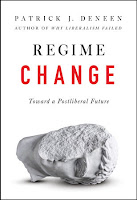
The transition from “patient encouragement” to “epic theory” encapsulates well the thrust of Deneen’s new book, Regime Change: Toward a Postliberal Future (which is being officially released today). WLF was a good book, but Regime Change is a better one, and I think will be recognized as such—as well as one that will gain notoriety in a way that the earlier, more academic book mostly did not. Given Deneen’s new focus in RC, that notoriety may well be welcomed by him. Few books are actually “dangerous,” despite the paranoia which censorious activists, clerics, and politicians delight in spreading about them, but the epic—and profoundly unconservative, at least in any sense by which Edmund Burke, Michael Oakeshott, or Russell Kirk would have understood the term—reach of Deneen’s arguments absolutely crosses over into that territory. 

After all, when a book written in the wake of the attack on the U.S. Capitol building on January 6, 2021, after hundreds of protestors confusedly but sincerely aimed to violently subvert the constitutional procedures of a presidential election, nonetheless speaks seriously of the need for a newer, better sort of elite to employ “raw assertion[s]” of “demotic power” to challenge American institutions, and blithely quotes Machiavelli praising “discord and division” in his Discourses on Livy, arguing (perhaps facetiously, perhaps not) that “mobs running through the streets” were actually a sign of the vitality of the Roman republic…well, “dangerous” seems to be a fit description (RC, pp. 164-165). Reading Regime Change, it is hard to avoid concluding that Deneen has run out of patience, at least when it comes to what he sees as the wreckage of our present condition. To build upon what Deneen wrote on the first anniversary of the Capitol attack, the ultimate aim of RC appears to be the development of a better, more radical elite, one that could guide the people, unlike former president Donald Trump, towards a “genuine populist revolution.”

The elites which Deneen’s epic theory invokes would be the products of what he calls “aristopopulism,” an elite committed not to the often false (as Deneen effectively documents throughout the book) egalitarianism supposedly as work in the managerial liberalism so prevalent in our late capitalist moment, but rather to what he considers to be a more accurate, classical understanding of “democracy.” On his reading of Aristotle, Polybius, and Aquinas, the regime which gives greatest credence to the needs and wishes of the people as a whole is one of mixed classes, in the classical “Great Chain of Being” sense. Under such a constitutional order, a virtuous elite would wield the responsibility to govern a community through the intentional writing and enforcing of laws, while the demos would articulate over time customs and norms which would have their own quasi-governing power, one which the elites, in their virtuous wisdom, would recognize and help sustain through positive law. Deneen strongly doubts that a direct reconstruction of such an arrangement would be possible through the corrupt institutions of the Western world today, dedicated as they are, according to him, to the social reproduction our progressive culture and globalized economy. Hence the need instead to be disruptive, and possibly even violent—Deneen speaks of the necessity of “the force of a threat from the popolo”—in changing the rules of the game. As he puts it, we must employ “Machiavellian means to achieve Aristotelian ends” (pp. 167, 185). 

The key philosophical assumption behind Deneen’s epic theorizing is his near-total rejection of egalitarianism as it has unfolded over the centuries of liberal modernity. Throughout the early sections of Regime Change, he uncomplicatedly stipulates as a natural fact the “ancient divide that pits the ‘few’ against the ‘many,’” a divide which he describes as “the ‘normal’ condition of politics”; it is, in his view, “an endemic political feature of the human condition” that “there is inevitable inequality in the world,” reflected in either “the ongoing presence of arbitrary social differences, or their replacement by natural inequalities due to differences of talent and self-direction” (pp. x, 7, 21). A constitutional arrangement which constructively deals with this division will not attempt to paper over its facticity with promises of equal individual rights—especially since, under finance capitalism, those promises have mostly, according to Deneen, been formulated in terms of a (in his view, presumably hopeless) educational dream of turning “’the many’ into ‘the few’” through a “notional redistribution of managerial status to every human” (pp. 37-38). Rather, a better constitutional regime would turn to “the tradition of the West itself,” which looks not to any kind of transformation through either individual development or collective action, but instead to “[c]ontinuity, balance, order, and stability, grounded in the unchanging truths knowable through human reason and also present in the Christian inheritance of the West”—a “common good conservatism,” one which requires “a virtuous people…maintained through the energies and efforts of virtuous elites” who are “oriented to supporting the basic decencies of ordinary people” (pp. 68, 124).

Deneen admits that the aristocratic-populist elites that he hopes will emerge concomitant to the disruptive, “demotic” challenges to the current order--which they, according to his theory, must simultaneously orchestrate in unspecified Machiavellian ways--wouldn’t be able to play this virtuous role immediately.  But he holds out hope that, once the dominant actors in the present order have been mocked or frightened or voted (or pummeled?) into retreat, “a genuine aristoi might arise… through a kind of Aristotelian habituation in virtue” (p. 185). This new aristoi, in the midst of the ruins of a liberal order whose collapse had been accelerated through decisive action, would theoretically be capable of modeling for the people their proper role, and thus enabling an eventual return to the mixed constitution of the few and the many which the classical tradition elaborated. 

The dangerous potential--and to those who share his traditionalist conservative sentiments, the dangerous appeal--of Deneen’s epic, revolutionary theory of regime change is thus pretty obvious. It has been standard for radicals of various stripes, infuriated by the economic inequality, the bureaucratic incivility, and/or the juridical injustice of so much of the liberal capitalist state as it emerged over the 20th century, to call for either a retreat from or revolt against it. The kind of “conservatism” that has historically emphasized the virtues of community (which, it must be remembered, is as often found on the left as the right) frequently opts to express its radicalism via retreat--that is, via turning towards the patient tending to of one’s own democratic, collective space, conscious of the harms which more systematic aspirations often involve. Hence the localist spirit of so many animated by these concerns, whether it be Wendell Berry’s defense of regional food systems, Bill Mckibben’s push for genuine (not corporate-subsidizing) energy independence, or a hundred other examples. But Deneen’s Regime Change, with its calls for revolutionary change, shifts away from such patient work--which, therefore, also suggests that the postliberal shift may be (as Adam Smith intuited in a recent Front Porch Republic essay) a shift away from localist concerns entirely. And to my mind, that means, inevitably and frustratingly, a shift away from actual democracy as well.

Deneen has elsewhere written thoughtfully—though I also think somewhat tendentiously—about the “crisis of democracy,” asserting that the turn to a framework of moral pluralism and pragmatism in the social sciences in the 20th century resulted in an “institutionalized relativism,” which itself could only result in attacks upon the “absolutism” present in “the mass of humanity who retained conservative beliefs due to unexamined prejudice or hostility to change.” Deneen’s understanding of pluralism in this particular case could be seriously contested, but leaving that aside, just consider his focus: he sees a crisis not relevant to democratic practices and procedures, but rather pertaining to the beliefs of the demos (though not the whole people, however defined: only “subcultures” of it). Deneen’s concern is apparently with the demos, the people, as a category which holds certain beliefs, not with how (or to what degree, or even if) the people, whatever their beliefs, actually govern themselves, which is the usual meaning of “democracy”--that is, rulership by the people.

Regime Change does lay out a positive vision of the demos, defending “the wisdom of the people,” and showing how liberalism—including both the individualism which produced mass democracy and the materialism which produced post-Industrial Revolution liberal capitalism—has tended to marginalize the virtuous capacities of, and undermine the sustaining social conditions of, communities of people in the name of “progress.” (Deneen’s reading of John Stuart Mill is particularly intriguing here.) But that positive vision depends upon the persuasiveness of his affirmations regarding the source of that wisdom, and that persuasiveness is lacking. He does not deny that what he various calls “the people,” “the working class,” or “the many” are currently in bad shape, writing that “[r]eams of statistics demonstrate that they are far less likely to exhibit certain kinds of virtues related to marriage, family, work, and criminality than the ‘elites’ that they often disdain” (p. 17). But that data does not stop him from constantly hypothesizing about their traditionalist potential, speaking repeatedly of the “instinctual conservatism of the commoners,” who “tend not to view the world as fungible launching pads, but rather, one of inherited homes” (pp. x, 60). (He holds out hope that they are “potentially more numerous” than their hypothesized opposites as well—p. 159).

Repeated incantations, however, are not arguments. Millions of voters (though not a majority) supporting Donald Trump in 2016 and 2020 is hardly dispositive support for his insistence upon the immanent existence in the United States of what he curiously calls a “nonaspirant” demos: a people collectively longing for an elite to, through their governing behavior, situate and contextualize and thus perhaps validate their presumably stable routines. As regards those routines, he waxes agrarian in depicting them: “grounded in the realities of a world of limits…in tune with the cycle of life and rhythms of seasons, tides, sun and stars” (pp. 27, 23). His repeated formulation of the masses as being perversely victimized by elites who present the “remnants of traditional belief and practice… [that inform] the worldview of the working class” as the views of society’s true oppressors (p. 28), makes it clear that (given that a slight but nonetheless real majority of even those Americans lacking a high school diploma consider the legalization of same-sex marriage to have been good for the country, in the same way that a majority of voters with lower incomes voted for Joe Biden in 2020) that the “working class” which Deneen has in mind is probably very much a “subculture” indeed.

That isn’t to deny that a liberal democratic society ought to enable subcultures to organize and collectively articulate their own communal norms (at its root, that's what any and every "populist" movement, from the People's Party to Occupy Wall Street, have always been about). The atomization inherent to liberal capitalism absolutely should be resisted, and there are important ways in which the organization of local and regional democratic practices and procedures, as both socialist and subsidiarian thinkers have argued, can help accomplish those ends. (It is perplexing that when it comes to the actual political organization of the demos, Deneen gives almost no thought to cities or counties or states; he is critical of what he sees as liberalism's tendency to breakdown "the onetime solidarity of subnational communities," but nonetheless his national conservatism basically leaps from the family and neighborhood--with a nod to the communitarian truth of Hillary Clinton's "it takes a village" manta--to the nation-state and the international society beyond--pp. 221, 225-226).)

While even just thinking of the American demos as simply national, Deneen’s recommendations for establishing a foundation for his theorized revival of a true mixed constitution between the few and the many—such as increasing the scope of democratic representation by expanding size of the House of Representatives, or strengthening the power of labor by putting workers’ councils on the same level as corporate boards when it comes to determining company policies and wages, or dramatically mixing the American people across regional and class differences by re-instituting the draft (pp. 168-171, 173-174)—include many excellent suggestions that would promote civic strength and identity, and thus counter the less democratic elements of our current order. But the content of that civic identity—which is, today, profoundly urban and pluralistic—is simply not what Deneen imagines it to be. Nor will it be, not unless his revolutionary aspirations actually include using state power to forcefully inculcate inegalitarian attitudes upon the people, which isn’t something he ever mentions. (He does allows that, in the midst of other imagined, Machiavellian disruptions, “forms of legislation that promote public morality, and forbid its intentional corruption, should be considered,” but as during a recent debate Deneen participated in alongside Diedre McCloskey, a widely respected transgender economist, he demurred from voicing specifics as to what those forms should be—p. 181). 

In the end, I think that if Deneen wants the demos to find his theory of regime change at all plausible, his articulation of it should show less uncomplicated assurance in the enduring accuracy of what Aristotle, Polybius, or Aquinas wrote about the culture of “the many” in the centuries before the rise of industrial technology, mass consumerism, and urban patterns of life made possible the movement of yeomen into a professional, specialized middle-class, and more explorations of the way that a constitutional order beyond our own would address the demands for greater democratic and socio-economic empowerment. Because such demands are there. As John Médaille observed as part of a response to Deneen years ago, “culture is downstream from breakfast,” and it was the demand for breakfast—not just the ability to obtain it, but also the ability to make decisions about how and where and with whom one should be able to obtain it—which truly gave birth to liberal modernity, far more than John Locke’s philosophical abandonment of the classical mixed constitution. Locke’s ideas, and those of subsequent liberals, arguably served the needs of those seeking breakfast quite poorly in the long-run, making it increasingly easy, over the centuries, for an individualism which prioritized efficiency over community, and progress over common sense, to warp our understanding of the democratic authority which the people came to believe should be equally shared among all breakfast-seekers. But that warping cannot be simply wiped away, much less mocked or frightened or voted (or pummeled?) into hiding by the potential threat of some angry mob.

Deneen’s epic, dangerous, anti-egalitarian theory shows great love for “community,” but it is a love which places the demos of the community on a pedestal, presenting their supposedly static traditions and routines as enacted beliefs that will inspire and guide the governing elite, but which denies them any formal ability to make decisions for themselves, or at least not any beyond what Deneen calls “the slow accumulation and sedimentation of norms and practices over time” (p. 132). Deneen has always been suspicious of overly romantic, quasi-religious idealizations of democracy, preferring instead what he once called “democratic realism.” Well, democratic realism has to include, I think, dealing with the people as they actually and presently exist, in all their busy, urban, depressing, glorious, subcultural plurality. Nothing in Regime Change suggests that Deneen places himself in the position of the East German apparatchik mocked in Bertolt Brecht’s famed poem "Die Lösung": Would it not be easier….To dissolve the people / And elect another? Still, one hopes that he will make the effort, in subsequent writing, to make it clear that any postliberal readers who draws that unfortunately not unreasonable conclusion from his book are in the wrong.

Monday, June 05, 2023

Songs of '83: "Every Breath You Take"

This is the big one, folks, or at least one of the very biggest. Go back to this very week, 40 years ago, and the summer of Synchronicity--the fifth, last, and best album by The Police--exploded onto America's airwaves, with "Every Breath You Take" leaping into the Billboard Top 40 the very first week of its release, rushing quickly to the #1 spot. The Police arrested us, and it was weeks before we were finally let go.

1983, as I argued at the beginning of this series, can be seen in retrospect as the year when all sorts of urban, technological, cosmopolitan, racially and sexually mixed tropes and beats, various styles and instrumental tricks that had been percolating for years in the clubs of Great Britain and the discos of New York and elsewhere, finally and truly broke through and redefined pop radio in America. The face of that transformation--a transformation that woke up MTV to what increasing numbers of young Americans were actually listening to--was, of course, Michael Jackson, the 1970s R&B star whose Thriller was the biggest album of the year: 22 weeks at number 1 in sales, and the Grammy winner of Album of the Year. Yet right behind that product of the funky, multi-racial American stew which was disco? The Police--and this terrific, creepy, beautiful song crafted by that post-punk, post-reggae, New-Wave-Before-New-Wave trio actually peaked longer than any of Thriller's hits, lasting a full two months at #1, and winning Song of the Year the same year Jackson took home the album title. If any single pop record defines 1983, it's probably this one.

The Police are hard to fit into my thesis, it's true; it's more like they oversaw it from above, or from the side. As Tom Breihan once wrote, The Police "messed around with synths, but they were never synthpop. They rode the wave of punk, but they were never punk. They weren’t prog either, but they’d been schooled in prog, and people who cared about such things could revel in their sophisticated musicianship. The Police were perfectly at home in arenas and stadiums, and they made big, echoing, open-chord rock songs that resonated far and wide. They were new, but they weren’t too new." Possibly similar sorts of things could be said about Elvis Costello, The Pretenders, Joe Jackson, Talking Heads, The Clash, Blondie, and more. These were all pop and rock performers that made it onto the radio after having schooled themselves in a mid-to-late-1970s era when punk and disco climaxed and began their decline, but definitely still weren't dead, and so some of their sound was constructed out of musical remnants that for most of the rest of the Second British Invasion, just a few years later, had arguably been supplanted by all the new toys coming out of dance halls of London, Paris, and Berlin. ("Born in the 50's" isn't on anyone's list as the standout track on The Police's first album, 1978's Outlandos d'Amour, but it situated them well all the same.)  

Speaking of 1978, The Police are one of only five acts--two others of which were mentioned in the above paragraph--who threaded the American pop radio needle in such a way as find a home not just on the Billboard charts, but also my radio-listening memories, for both this 1983 list, and my Songs of 1978 list, from five years ago. And The Police--definitely in terms of sales, but probably in terms of cultural impact as well--were the biggest of those three. The Police song from 1978 that stands out was, of course, "Roxanne." By 1983, they'd worked through whatever shared passions they'd once had for reggae and rock guitars and were instead exploring the whole world of music in utterly different directions: atmospheric jazz, classical, urban funk by way of Western Europe, and much more. Sting's strange mix of poetic and literary sensitivity, on the one hand, and contemptuous, almost clinical arrogance on the other had colored almost every note they released. And of course, by this time, they all basically hated each other, or at least Sting and Stewart Copeland couldn't even get through and interview without threatening to quit the band or bust one another in the chops:  

The story of "Every Breath You Take" has often been told, and just as often retold. Originally grasped, hungrily and somewhat defiantly, by the band as their best and biggest break for pop glory, it wasn't long before The Police, as the song became omnipresent, began to dump on its arrangements, and to own up to the stalking, possessive, borderline abusive sentiment which gives the lyrics their vaguely repellent power, counter-posed against the way Andy Summers's marvelously fractured, suspended-chord guitar riff keeps drawing you in. Is it a musical masterpiece for misogynistic creepers? Sure! And as Stephen Metcalf arguably implied in his comment which helped frame my take on 1983 from the beginning, there is something in the sublimated anger, the kind of presumption, that Sting intentionally or otherwise wove into this tune which anticipated (or even incorporated?) its own backlash: the pitiless drive to make a very self-determined style of music in face of all sorts of cosmopolitan trends and changes. But originally, all this subtextual stuff that didn't stop every aspiring crooner (Ian McShane!) or post-disco wanderer (Andy Gibb and Marilyn McCoo!) from covering the song, to say nothing of Robert Downey, Jr., turning it into a hipster ballad or Puff Daddy turning it into a glorious hip-hop tribute. Because it's great 1983 song, maybe the greatest, and that's the truth. So hey, we might as well stick with the original, and enjoy.