Featured Post

WELCOME TO RUSSELL ARBEN FOX'S HOME PAGE

If you're a student looking for syllabi, click the "Academic Home Page" link on your right, and start there.

Wednesday, September 28, 2005

What Deterring Abortion Means

Hugo Schwyzer is talking about Proposition 73 out in California, the referendum that would require that parents be notified if an underage child of their's seeks an abortion. Hugo plans to vote no on the proposition. His reasoning for doing so is heartfelt, thoughtful, and completely respectable. And also wrong. He writes:

"Do I want to see an end to abortion in this country? Yes. Am I willing to advocate for laws to restrict access to abortion to adults or minors? No. Despite my own history, I've flirted in the past with supporting anti-abortion regulation. My faith informs me that all life is equally precious, including life in the womb. But with great heaviness of heart, I've come to agree that it's destructive and pointless to try and end abortion legislatively....If my daughter were pregnant, I would want to know. Perhaps I would want her to keep the child, or choose adoption--though those would not be my decisions to make. But even greater than my desire to know, I would want her to be safe. Ultimately, it wouldn't be about me, but about her and her needs. And if for some reason she felt she couldn't tell me or her mother, I would want her to be able to turn to medical professionals."

I added the final emphasis there, because Hugo's comment touches on the delicate, difficult heart of what deterring abortion--assuming one wants to deter abortion, which Hugo surely does--plausibly may sometimes mean. Not that I fault him for pulling back from this aspect of the debate; I actually tend to think that parental notification laws, and similar laws which have nothing to do with the procedure itself (like the partial-birth abortion rigamorale, which--however disturbing the surgical act itself may be--I think to be a distraction that generates legislative grandstanding mostly irrelevant to the real issues at hand), but which rather concentrate on the actual choice of abortion, are the most difficult parts of the pro-life agenda to get past. Unfortunately, I also think they are the most important; if we can't agree on this, then the widespread practice of abortion is never going to go anywhere. (This, of course, assumes I'm speaking to other opponents of abortion; in other words, this is an intra-faction argument.)

One commenter on Hugo's site observes that "the fact that not all parents are 'good' enough to allow their kids to go through with [abortions] without objection is a feature, not a bug." He puts it crudely, but correctly. The reason parental notification laws are even debated is because they presume the legitimacy of the interference of others (particularly parents) in a choice that is nominally guaranteed but regarded by many as morally wrong. To require notification (not consent, mind you; the proposition only mentions notification, and it allows for legal alternatives for those who come from abusive or dysfunctional homes) means the state is officially saying to those under the age of 18: "We are not going to let choosing abortion be easy. We will make it, possibly, burdensome. We will make it other peoples' problem, not just your own."

The question must be asked of those of us in agreement that abortion is often wicked and always tragic: is it an evil that is nonetheless so thoroughly tied up in complicated facts of embodiment and gender and power that any attempt to interfere with the ability of anyone, including (or especially!) a minor, to choose it is unwarranted? Or can we make our way through that tangle, and attempt to at least instantiate some sort of deterrence of abortion? For many opponents of abortion, apparently including Hugo, the integrity of the individual's choice (even if their choice is a poor one) is a fundamental that must be protected at all costs, because otherwise the risks are just too painful to imagine (foolish teen-agers with mean parents clearly being the absolute least of it). So the only alternative available to those who come to such a conclusion is persuasion, example, and taking positive steps--economically and otherwise--to try to make abortion every bit as "rare" as Bill Clinton said he wanted it to be. This is a legitimate pro-life position, I think, and I respect people who hold it--indeed, I wish more social conservatives would acknowledge it and copy from it, because the dominant "conservative" pro-life position in this country all too rarely thinks about all the positive financial and educational steps that could be taken to help women choose otherwise than many of them currently do.

Nonetheless, it's not my position. I recognize that a whole lot of people--and specifically, young women--out there face terrible, unjust, ugly choices. But I do not understand how the problem that their choices pose to society are made any easier by refusing to allow any kind of social consensus, any kind of deterrence, any kind of interference, to present itself in between the individual and their choice. If you think abortion is a bad choice, and if you agree that majorities of one's neighbors also think it is a bad choice (and there is scads of polling data which backs up that second claim), then I am at a loss as to why one would think that abortion cannot be a focus of social expression through law. Not any law, to be sure: Roe v. Wade and Planned Parenthood v. Casey are still the law of the land, meaning their are constitutional concerns that must be satisfied. (And I'm not just dodging the issue by saying that; I have plenty of complaints with both Roe and Casey, but neither do I think that the constitutional interpretations--specifically about the limits of moral consensus in a liberal society--they laid down can or should be easily dismissed.) Moreover, whatever majorities may exist that are troubled by and support discouraging abortion, such support certainly does not exist at present (except perhaps in a few small regions of the country) for laws that would actually make the choice of abortion, in practice, impossible. Abortion is widely accepted as legitimate alternative. But does that also mean that nothing can or should be done to communicate that it is a disapproved of alternative? That you don't think any person, or any two people, ought to be allowed to make this choice entirely on their own? That the weightiness of the decision ought to be prolonged and made more tangible and pressing? If, I suppose, you think that the pain and harm and burden of abortion is ultimately, and solely, the province of the person having the abortion--that is, if your baseline reading of the situation is, "Who's the chooser here?"--then of course you musn't attempt to complicate or interfere with her choice; that would be oppression. But if, on the other hand, your basic framing of the problem is one that denies that abortion is wholly within the realm of the private, then the (limited, carefully legislated, intelligently enforced) expression of mild public concern--and compared to the actual disciplinary powers of the state, what could be more mild for 99% of those minors who seek abortion then to oblige parental involvement?--is a no brainer, assuming support for such exists.

So why is it so hard to accept, then, even for those opposed to abortion rights? Because we're individualists at heart, and we have a terrible time getting free from the feeling that when someone--especially someone whose situation is sympathetic, someone who we want to protect--feels no alternative but to do something that we rightly consider shameful and sad, perhaps we ought to support them in their (unwarranted but understandable) wish to tell the rest of the world to get lost for a while and leave them alone. Moreover, and more importantly, we worry about that 1%, or maybe it'll be more than 1%--the young women (often just girls) who have been raped, perhaps even by a family member, or more likely are simply (but no less tragically) so fearful of their parents, or so distraught by their situation, that they'll seek whatever unclean, unskilled abortion services they can find when confronted by the formal demands and interference of society. Yes, those cases exist, and in all likelihood more of them (probably not very many, but likely at least a few) will be brought into existence by a parental notification law. Hugo says that above all else, he wants the girls and young women of California to be safe. He doesn't trust this law will be enforced as it ought, and even if it is, the fact that it just may be that someone's choice will be made less secure, less smooth, and less safe by it is, he thinks, reason enough for him, an opponent of abortion, to nonetheless oppose it.

It's not. It's not because to hold to such a position is to claim that one's opposition to abortion is every bit as private as the choice one attributes to the person in the sad state of needing or wanting or being compelled (sometimes by one's boyfriend, or father, or friends, or peers) to seek an abortion. It is, other words, to say that one's opposition to abortion arises from a personal squeamishness, a distaste. (Which for a lot of pro-lifers is, unfortunately, quite accurate: again, one of the reasons that I think so much time and energy has been lavished on the partial-birth abortion debate is because, fundamentally, talking about how one socially discourages a choice is hard, while showing off terrifying bloody photographs is easy. It's the difference between those principled abolitionists who spoke of the ruined dignity of the slaves, versus those who just went around telling scandalous, disturbing stories about whips and leg chains, and who opposed slavery because Harriet Beecher Stowe's Uncle Tom's Cabin kept them up at night.) If opponents of abortion cannot engage the idea that there is a collective concern here--call it a moral principle, a natural law, a religious imperative, whatever--then the ability to articulate that truth is going to be forever held hostage to the undeniable, unavoidable reality of every single real of hypothetical tragedy out there. In which case, politics really must be just about the management of incidentals, with all the serious questions safely privatized away.

This isn't a call for hard-heartedness or realism, much less extreme disregard for costs. We have to be consciously engaged in trying to work out the best and most responsible and humane ways to formulate this expression of concern, this relatively minimal but still vital insistence that those who are still legally their parents' children not be able to act otherwise when confronted with such awful choice. And let me be forthright--it's not like I've followed all the ins and outs of the debate over Proposition 73. Maybe it's a lousy law; maybe it doesn't seem likely to even be able to do what its proponents claim. That would be one reason to oppose it. Or maybe an abortion foe could oppose it by arguing that, before parental notification become mandatory, the possible exceptions be better supported and more widely distributed; interference would therefore have to wait on changing society so that the costs of interference would be even less than they might otherwise be. Again, a reasonable argument, and within limits a responsible and necessary one (though if relied on too often, it begins to sound like an argument that Martin Luther King responded to, in essence, when he insisted that the moral cause of civil rights ought not be forced to "be patient" while the white power structure slowly "moderated" itself). But Hugo doesn't make those arguments; instead, he mournfully allows that, given the world we do have, it's just too destructive to presume to implicate the choices of individuals (or at least this special, terrible, particular kind of choice) in our morally worried social reality. I respect Hugo tremendously, and have enjoyed reading his ruminations for a long time now; but for a pacifist who presumable believes that Christians can and should, in fact, as a people, proclaim peace despite "the way the world is," I can't help but think that the decision this opponent of abortion has come to on Proposition 73 is a damn odd one, to say the least.

Monday, September 26, 2005

My Wife Hates Keira Knightly (or, Definitive Versions)

Well, she doesn't really hate her. But she's not going to go see her latest movie, coming out in November: a new adaptation of Pride and Prejudice. (Here's the trailer.) Why not?, I ask her. You love Jane Austen. Because it'll be travesty!, is her response. Two hours to tell the story of Pride and Prejudice?! They'll have to hack scenes and characters and dialogue right and left! They'll ignore subplots and subtlety! That's no way to treat a masterpiece! "Elizabeth Bennet is a modern woman..." (so the trailer says)--baloney! They've plainly no idea what the story is really all about! How cheap! And so on, and so forth.

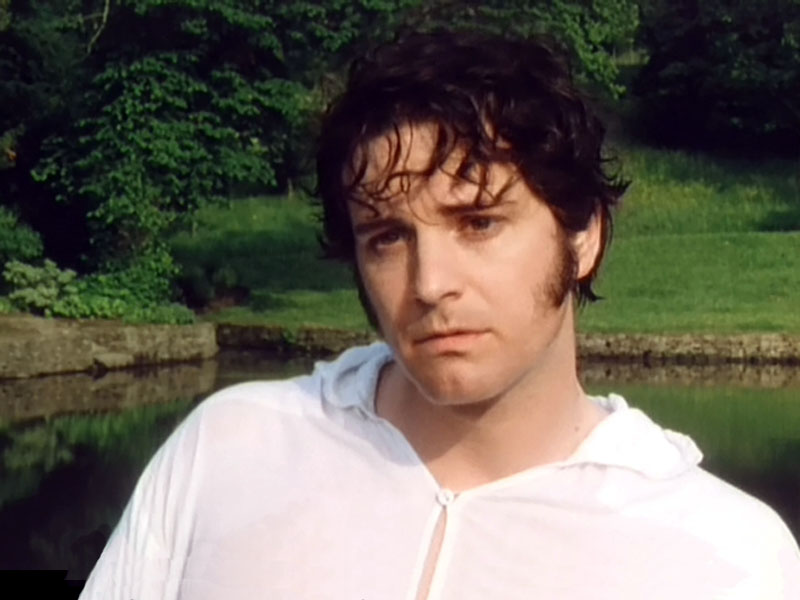
As you might be able to guess, Melissa is a massive fan of the classic BBC Pride and Prejudice miniseries. Is she simply ticked that the new version will not feature the smoldering, tousled good looks of Colin Firth? Admittedly, that may be part of it. But I suspect there is something more at work in her ferocious reaction. What it comes down to is this--as far as my wife is concerned (and clearly she's not alone) Pride and Prejudice has already been done. The miniseries was practically flawless; who could possibly want to watch--or be responsible for exposing a loved one to--an inferior adaptation when such an excellent treatment is still available? In short, we already have the definitive version of Pride and Prejudice; that's what people should be watching. For movie studios to waste their time creating another, likely bad adaptation of a such a classic piece of literature is not just foolish....it is, in a sense, disrespectful of what the BBC achieved.

I'm not a fan of Jane Austen the way Melissa is, but I can see where she's coming from. I'm only going to compare the new version to the old, and I'm confident the new version will come up short, so why bother? Yes, yes, of course--copying and adapting and transforming old stories into new is what art is all about, right? I don't disagree, particularly when it comes to film, theater, and song. But even if I grant the importance of innovation and recreation, can't I also insist that some works of art are just so excellent, so complete, so full on their own terms, that one can be forgiven for wondering is there's anything besides the lure of a fast buck behind those who insist on continuing to rework these stories and songs and images even further? (Case in point: Madonna's atrocious cover of the classic "American Pie." Another case in point: Jonathan Demme's The Truth About Charlie, an insulting remake of the flawlessly smart Charade.) I think Melissa is right when she says, in essence: there's no reason to offer me another Pride and Prejudice; Keira Knightly and Co. can't offer me a take (at least not a "realistic" take, which is what the BBC version and this new one both presume to be) on the story that's already been done about as well as can be done. So just don't bother.

Of course, not everyone will see it that way, as not everyone recognizes the same definitive versions of particular works of art. Some people insist that the original production is always definitive (I would argue this is almost always the case with the Beatles; I have only rarely heard a Beatles cover that is even comparable to the original), whereas in other cases a song or book or film fairly begs for more definitive treatment (I would argue this is the case with most of Bob Dylan--while his oeuvre has suffered from hundreds of crappy covers, more often than not it is other performers who really nail the spirit of his own songs: think Hendrix's "All Along the Watchtower"). Sometimes an adaptation utterly transforms what came before (Bobby Darin's cover of "Mack the Knife"), thus setting the stage for a whole new raft of interpretations. And sometimes an artist will cover himself, thus putting an interesting spin on what constitutes a definitive version (which is the superior version of Hitchcock's The Man Who Knew Too Much--the 1934 with Peter Lorre, or the 1956 with Jimmy Stewart?).

I can think of a handful of movies and songs that I consider definitive, basically unsurpassable--I'd rather listen or watch them over again than anything else that might come down the pike: Robyn Hitchcock's "Robyn Sings" (a complete cover of Bob Dylan's Royal Albert Hall concert); the 1959 Julie Andrews/Rex Harrison London recording of My Fair Lady; Harry Connick Jr.'s covers of "Pure Imagination," "Maybe" and other standards on "Songs I Heard"; the whole movie Singin in the Rain (every song in the film is a remake from the 1920s and 30s); Ray Charles's "Georgia on My Mind" and "It's Not Easy Being Green" (what, you thought that was a children's ditty? guess again!); Kenneth Branaugh's Henry V. I treasure them all, just like Melissa treasures her BBC Pride and Prejudice. What are your definitive versions? Do you have any?

Friday, September 23, 2005

Liberalism and Antiliberalism in Fast Food Nation

As promised, here are my thoughts about Eric Schlosser's Fast Food Nation: The Dark Side of the All-American Meal. It's been out for a few years now, obviously, but the data and arguments it presents aren't any less relevant, and it remains a great read--you can engage the book from the perspective of economics, sociology, agriculture, cultural history, or any number of other viewpoints. That's probably one of the reasons WIU chose FFN to build this year's "First Year Experience" around--every freshman was given a copy of the book, and there have been a variety of activities and seminars to give students and teachers an opportunity to talk about the book and its arguments further. I gave one of the first faculty presentations on the book, a couple of weeks back, so I figured I might as well recycle my comments into a post, especially considering that, on my reading, FFN exemplifies the need to think about how one frames the debate about consumption before (or at least while) engaging in it.

FFN is divided into two parts: "The American Way" and "Meat and Potatoes." The second section is appropriately named, since that is where Schlosser digs into the real mechanics of fast food production in America and around the world: the potato farms, the chemically designed tastes, the feedlots and slaughterhouses (and the appalling health and safety conditions within), the health hazards of modern meat production, and so forth. It is also in this section where Schlosser's attack on the "all-American meal" is clearest and most powerful. The details are often disturbing, sometimes disgusting, and always fascinating. He talks about how the meatpacking industry has systematically lied about the environmental damage wrought by its huge slaughterhouses; how it purposefully relies upon the most vulnerable of all labor pools, illegal immigrants (and digs up an incredible exchange from a federal investigation into slaughterhouse practices, in which the head counsel for one of the largest meatpacking conglomerates openly admits that they want conditions to be primitive enough that they have a lot of turnover in the plants, because short-term employees don't receive health insurance, to say nothing of vacation time); and just how dangerous certain jobs in the meatpacking industry today really are. And, of course, he is anything but reticent about the health costs of such huge, sloppy, risky, bloody, unregulated meta-production practices: there is, quite simply, an awful lot of shit in our meat. Schlosser's investigative work here echoes great exposes of the past, of course, like Upton Sinclair's The Jungle; but he goes beyond them by examining the ins and outs of the labor struggles, corporate duplicity, real estate shenanigans and business monopolization which produces the food which then gets served to us with such regularity all across the globe. It's a great, scary, persuasive attack on a system that regularly eludes both presumed health and economic norms and explicit government standards.

Schlosser's conclusions, then, should not be surprising: there needs to be a stricter enforcement of labor laws, OSHA regulations, and the minimum wage (fast food chains, both along their production line and at the service end, routinely churn through workers with the aim of keeping job training costs to a minimum, all the while benefiting from government subsidies which reward them for taking "risks" on new workers); inspectors from the USDA and FDA need to be given sufficient centralized authority and manpower to demand investigations and keep their own records (current laws allow meatpacking plants to essentially set their own schedules for investigations); antitrust laws need to be turned against major agribusiness conglomerates (there are today, amazingly enough, only about 1000 potato farmers in all of Idaho, a relatively weak and disorganized group in the face of big fry companies that dominate the market); and so on. He takes, in short, what would be widely recognized as a liberal stance, or at least a liberal egalitarian or a positive liberal stance: that it is the responsibility of the government to work to create conditions wherein people choices and lives are empowered and improved. Through the regulation of worker safety and insurance, health standards and procedures, and labor and corporate relations, the industry can be made cleaner, safer, less economically exploitive and dangerous, and more secure--and it can be done, Schlosser persuasively argues, pointing to several instances in which McDonald's and other large fast food chains quickly and radically changed some of their basic practices when under popular pressure, at very little ultimate cost to the consumer. Reform liberalism at its best, you might say.

The problem with such a reading of FFN, however, is that it doesn't do justice to want Schlosser is attempting, with (unfortunately) much less success I think, to do in the first part of the book. In those chapters, he spends his time talking about the emergence of the fast food industry and the social and economic developments which made it possible (including the huge economic push to Southern California, the home of the first true fast food chains, provided by the military-industrial complex, and a wonderful and terrible story about how General Motors, with the assistance of other automobile companies and various oil interests, managed to secretly purchase and bankrupt trolley and rail companies across the country, thereby enabling the dominance of car travel in 20th-century America). He tries to get inside the heads of those who pioneered fast food, and those who work at it today. And again and again, he makes clear his deep dissatisfaction with our reigning commitment to speedy, homogenized, cheap service, no matter what its consequences to our lifestyle. Unfortunately, that dissatisfaction is not very easily articulated in the context of his reportage, because few of those he profiles feel it themselves. And so, Schlosser has to make that point for them, sometimes condescendingly. A highlight comes early in the book, as part of an interview with Carl Karcher, one of few surviving pioneers of fast food's early days:

"I looked out the window and asked how he felt driving through Anaheim today, with its fast food restaurants, subdivisions, and strip malls. 'Well, to be frank about it,' he said, 'I couldn't be happier.' Thinking that he'd misunderstood the question, I rephrased it, asking if he ever missed the old Anaheim, the ranches and citrus groves.
"'No,' he answered. 'I believe in Progress.'
"Carl grew up on a farm without running water or electricity. He'd escaped a hard rural life. The view outside his office window was not disturbing to him, I realized. It was a mark of success."

That Schlosser is disturbed by all that he sees--the obsession with growth and profit, lowering costs and increasing speed, reducing everything to its most simple, reliable and repeatable common denominator--is quite apparent; it comes through all the time in the text, particularly in the first part of the book. He profiles a Little Caesar's Pizza franchise owner in Pueblo, CO, and recognizes him as a pretty hard-working, decent, and caring fellow; yet when this restaurant owner chooses to do something nice for his employees, Schlosser can't help but be appalled at what he does: buy them all tickets to a "Success Seminar" where they get exposed to celebrities touting this or that nostrum for personal wealth and fulfillment, an event which Schlosser thoroughly ridicules, except for the moment following a powerful address by Christopher Reeve, at which point he writes that "[e]everybody in the arena, not matter how greedy or eager for promotion...know deep in their hearts that what Reeve has just said is true...[t]heir latest schemes, their plans to market and subdivide and franchise their way up, whatever the cost...vanish in an instant. Men and women up and down the aisles wipe away tears, touched...by a sudden awareness of something hollow about their own lives, something gnawing and unfulfilled." And then, predictably, this moment of awareness is followed by a crass pitch from a New Age dietician.

His point is clear: the spirit of growth is morally bankrupt and intellectually worthless; the ability to parlay every choice into an opportunity, the central promise of the hyped-up, globalized, speedy service American way of life, isn't worth it. Schlosser lays his cards on the table at the end of his Afterword, when he writes: "Whatever replaces the fast food industry should be regional, diverse, authentic, unpredictable, sustainable, profitable--and humble. It should know its limits....This new century may bring an impatience with conformity, a refusal to be kept in the dark, less greed, more compassion, less speed, more common sense, a sense of humor about brand essences and loyalties, a view of food as more than just fuel. This don't have to be the way they are." It's a powerful ending. The problem is, it's not really a liberal one. On the contrary, all that talk of regionality, authenticity, limits, humility, compassion, and common sense, sounds like the sort of think a conservative like Edmund Burke might say (and probably would, were he alive today and being shuttled through some soulless American suburb on a quest to find a Burger King).

Of course, plenty of liberals do talk like that, about how "the people" (Americans, the middle class, whatever) have foolishly bought into an overconsumptive way of life that divorces them from simpler, more authentic pleasures, and which along the way is making them less healthy and less happy. Strictly speaking, however, when someone starts actually attacking our whole culture of consumption and growth and speed as Schlosser does, they are not longer engaging in liberalism reformism: this is no longer about using the government or education to improve the quality of extent choices (making for cleaner slaughterhouses, purer meat, less exploitive restaurants, etc.) and thus increasing, in a positive way, the liberty of persons; no, this is about actually judging, and perhaps limiting, the sort of choices people can make. A good liberal egalitarian wants McDonald's to operate in a more equitable and enlightened manner, but only an antiliberal actually thinks we would be better off without the sort of "liberties" (namely, being able to eat a cheap meal pretty much anytime that will taste the same pretty much anywhere in the world) which McDonald's makes possible. Perhaps it isn't strictly conservative, or communitarian, or socialist--but it definitely moves in that direction. (Perhaps if Schlosser had leavened his book with ideas drawn from real critics of liberalism, thinkers like Christopher Lasch, Roger Scruton, or Immanuel Wallerstein, then we'd know if we was more populist, traditionalist, Marxist, or what.)

This is most obvious when Schlosser talks about advertising. Like a great many self-described liberals, he thinks (and I agree with him) that great damage is being done to the diets, health, and material expectations of children by the incessant and often misleading advertising which fast food chains engage in, especially insofar as tie-ins to popular culture goes. (Schlosser takes several tired but still pertinent shots at Walt Disney, and how his empire both anticipated and enabled the fast food mentality.) His solution is to demand that all television advertisements aimed at children that promote food high in fat and sugar be immediately banned. And, of course, this solution puts him square in the middle of that uncomfortable intra-liberal debate over just how legitimate it is for the government to control the "speech" of advertisers--who are, after all, simply making known and encouraging a particular choice. I don't want to argue that point out here--my position, to anyone who has read this far, is probably obvious, and the opposite position, which refuses to grant any greater persuasive power (and thus acknowledge any greater need for regulation) to the market than to ordinary political speech, is pretty well laid out by my friend Nick on his new blog here. I just want to observe that if you truly believe that our ability to make choices is being warped in unhealthy and environmentally unsustainable ways by economic conditions and powerful interests, then you must not believe that individual choice is all that inviolable in the first place. Which probably means that you think choice is of limited valuable unless people are in a condition to make the right (cultural and social) choices. Schlosser's investigative work, and his clear if implicit conviction that much that is wrong with the fast food industry goes back to our having been placed on a conveyer belt that has conditioned us to expect regular delivers of ever more food, ever more cheaply and ever more reliably, shows him to be thinking about fast food in structural and moral terms. And those are terms which demand a critique of liberalism, not a repair of it.

In practice, of course, such liberalism and antiliberalism are somewhat reconcilable. Schlosser speaks admiringly about a few fast food chains that don't play by these rules, and thus break out of the culture he condemns (and, not coincidentally, therefore serve high quality, good tasting food). These places--Conway's Red Top restaurants of Colorado Springs, or the In-and-Out Burger chain in California and Nevada--are owned by families, not corporations; they reject the franchise model; they pay their employees a good wage with benefits (and thus keep employees for a long time); they buy and make their food fresh (no prefabricated syrup for the shakes, no microwaves for the burgers, no pre-pealed, cut, and frozen potatoes for the fries); and--perhaps most tellingly--they are highly idiosyncratic, with their respective companies replete with old family mottos and scriptural injunctions. That's a populism that can't be called into existence by more or better government regulations. But at the same time, one can easily imagine a reformist, regulative response to the fast food industry which was aimed explicitly at preserving and extending such local ownership and variety. A good example which was brought up during my presentation was Germany's approach to beer: the country has tight regulations in place, refusing to allow any drink that is made with more than a few key ingredients, or prepared in a manner that doesn't involve a significant amount of hands-on work, to be labeled "pure beer." (Until 1987, the restrictions were even stronger; such drinks could rarely be sold anywhere in West Germany.) One could, of course, point to the actual history of the Reinheitsgebot and snicker at how it originally was more about Bavarian protectionism than Deutsch authenticity, but that doesn't change it's practical effect today: it has helped create a beer culture that insists that there are some things that really ought to be left as they are, not speeded up, or watered down, or shipped everywhere hither and yon. A regulation which is premised upon a purity and health requirement has helped shape much more than the range of (liberal) choices available to consumers; it has helped conserve and socialize an authentic, limited, local set of consumptive practices, practices not at all dissimilar to those Schlosser is plainly hoping for. (Another example of such a compromise are some policies which my own family's has benefited from; a topic for yet another post on these interrelated themes.)

So perhaps, in the end, FFN is one of those many works that wish, whether in an informed or a merely naive or unconscious way, to make use of liberal state to reform conditions so that at least partially non-liberal, localist forms of life might be preserved. Of course, this leaves unasked the question of whether such is even coherent: can liberal empowerment do anything more than just generate, intentionally or otherwise, ever more liberal bureaucracies and expectations? A hard theoretical question, and not one Schlosser is in a position to help us with. But if nothing else, he does a superb in helping us deal with the question of whether we should eat at McDonald's, and thus endorse the exploitations of powerful agribusinesses, the abusive labor practices of meatpacking firms, the terrible health standards of the meat they serve us, the disruptive economic impact of chain proliferation, not to mention exposing ourselves to E Coli, mad-cow disease, and any number of other hamburger-born pathogens that arise from this country's depraved and foul meat-production procedures. Can you guess what his answer is? I knew you could.

Thursday, September 22, 2005

The Fat of the Land

Well, it's the first day of autumn, 2005. A good time for another long, meandering post, don't you think?

I was up early this morning, and went for a short bike ride in the pre-dawn light; a deer, a fox, and a couple of raccoons crossed my path, as the sky slowly turned a lighter and lighter shade of blue and pink. This is a great time of year: it gets me thinking about the harvest, good food on the table, a sense of the land wrapping things up for another season. All that, plus fat. Unfortunately, it's hard not to think about that when I'm out sweating on my bike. I'm 6'2", and I'm tipping the scales at just under 230 lbs. For years after I reached my full height, I was fairly slim--I stayed at 185 lbs. for most of my undergraduate career, maybe maxing out around 195. Then came marriage and graduate school and the dissertation, and suddenly I'd put on twenty pounds. And despite numerous half-hearted plans to reverse the trend, there's been a slow but steady increase ever since. No, I'm not particularly overweight or out of shape, but I've definitely grown a gut.

I've never really been tempted to hit the gym, submit to a fierce diet regime, and turn myself into a physical Adonis (assuming I even could)--I don't want to work that hard. (Not to dismiss the example of those who do--like an old friend of mine who has gone in just a few years from being heavier than I to being a competitive marathon-runner.) Plus, I suspect that many of the pressures which get brought to bear on those who aspire to "fitness" are, as Hugo Schwyzer smartly put it, "less about health and more about attempting to conform to an unrealistic beauty standard." Still, I don't like how I look, mainly because it is manifestly the case that I'm not living as lightly (literally) as I could be. And that's become increasingly important to me over the last few years: living simply and ethically, which among other things puts a big question mark over many of our activities and life choices (including how one uses or abuses one's body, as well as what one puts into it).

This probably sounds like just more of my usual leftist communitarian shtick, and it is partly that: I'm hardly immune to all the condemnations of fast food, SUVs, mini-mansions, suburban sprawl, capitalism, or America itself out there which frame themselves as attacks upon the costs and crudities of bigness and overconsumption. (I recently gave a favorable presentation to a faculty group here at WIU on Eric Schlosser's Fast Food Nation; I'll try to get a post about that up in a day or two.) And let's be honest--a lot of those sorts of critiques are driven by an elitist disdain, or the mad desire to be one of those wealthy, informed, superior, beautiful people who get to look down all the rest of the McDonald's-patronizing proles out there. Many ugly or at least wholly irrelevant sentiments can get wrapped up in the criticism of fatness, sentiments that Daniel Ben-Ami does a good job exposing in this article. Not that I agree with his rejection of the anti-overconsumption line of thought, not the least reason for which being his failure to actually engage any of the more serious arguments out there attacking how so many of eat, buy, and live. Instead, Ben-Ami is content to simply affirm that, well, of course all consumption is good, because all consumption reflects the desire to improve oneself materially and enjoy the benefits thereof, and who could possibly be against an increase of material wealth in the world, especially amongst the world's poor? That, dare I say, doesn't come close to touching on the real issue....which is what makes all the more interesting that he does get to the heart of the matter in a casual aside that deserves a lot more thought than he gives it:

"[A] key part of the reason [for the popularity of the anti-overconsumption argument] is the institutionalisation of the idea that there is no alternative to the market. Capitalism, in one form or another, is seen as the only realistic way of organising society. In terms of political debate there is what Thomas Frank, a liberal social commentator, describes as 'the systematic erasure of the economic.' In other words, cultural matters are open for debate but fundamental economic questions are not....Matters related to the sphere of consumption are [thus] open to debate. This includes not just the literal act of consumption itself but related questions such as brands and identity....In contrast, the productive sphere is seen as fixed. This is not just a technical question of the manufacturing process for, say, semiconductors or plasma screen televisions. It means that the possibility of developing a qualitatively better economy is denied. Humanity's creative potential, including the possibility of transcending the limits of the market, is banished from discussion."

For Ben-Ami, this just means that we need to shake off our doldrums and get fascinated again with the "productive" side of the equation again. Bring back supply-side economics--we need to concentrate on growth, on making everyone just as fat as Americans are! But what it suggests to me is the possibility that the argument about "fatness" often gets weighed down with condescending and unwarranted judgments exactly because those who criticize consumption are themselves committed to fixed economic perspective: they can only think of themselves as consumers, and so all there is to do is complain about all those other (lousy, low-class, overweight, irresponsible, trashy) consumers out there who haven't figured out the right way to spend their money or time, the right foods to put into their bodies so to maximize bodily outputs. As long as that is the only frame of reference available, then of course the debate won't go anywhere: if the protesters outside the McDonald's restaurant are nothing but (upper-class, well-educated, oh-so-enlightened) consumers themselves, trying to get the patrons inside to get with the program, well, it won't surprise me to see the Big Mac win every time.

Fortunately, that's not the only frame of reference available. If one turns away from the idea that one is expected to be contributing to the "right" parts of the economy by making the "right" choices, and instead reconsiders the economic sphere in light of entirely different, not necessarily consumptive and choice-driven priorities, then it becomes possible to makes certain critiques without necessarily falling into exclusive or condescending language. A friend of mine recently returned from France, and like so many who visit that country, was impressed at how healthy and fit the people he met were, how there seemed to be an inverse relationship between how little the French obsessed about food and looks, and how well they ate and appeared. Sure, his observations are just anecdotal, but they're also quite common, and the explanations behind those observations are probably not any less true for being commonplace: the stereotypical Frenchman or Frenchwoman eats more slowly and walks more; it takes longer to get things done, and the things done take up more time than most Americans are willing to accept. Put in more theoretical terms, one might say that they move bodily through a more circumscribed world, where more foods are local, more daily routines and circumscribed, and diets and habits have an organic connection (or, at least, far more organic than is the case for the average American city-dweller) to the natural limits of things. They see something else beyond the food and the road, that's all. The French may be among the world's foremost "fat American"-bashers, but it's quite possible that, when one gets down to fundamentals, most of them aren't doing so just because they think we all ought to change our diets: perhaps it has more to do with an amazement at the narrow, locked-in way (more food, faster food, more diets, faster diets, etc.) in which we approach the whole matter of consumption in the first place.

This needn't be cast in American/anti-American terms. Might it not be the case that, at least on some level, those all around who live healthily aren't doing so solely because they want to make themselves into a certain sort of person (with the tight stomach and firm abs), but because they genuinely find a certain kind of joy and empowerment in constraining and disciplining themselves? Of course it is--just listen to any long-distance runner or biker talk about the groove they fall into, how they find a deep reward in being able to relate to and feel their body in a way that has nothing to do with consumptive inputs and productive outputs. And, if you listen carefully enough, you'll find the same sort of language coming from fine chefs and fans of good food all across the country. For them, the point is to get away from the one-meal-follows-another-routine: by tuning (and therefore limiting) their minds and bodies to meals and ingredients that can't be reduced to quick, mass-produced fuel, they can consume (often luxuriously!) without losing sight of everything else food can be. I don't mean to collapse all this to a single theoretical observation, but I think it's compelling nonetheless: in my experience, people who are really close to, really appreciate, and loving indulge in the bounty of the world around us are rarely poster children for gluttony; similarly, the truly healthy people are rarely those who viciously hit the gym after every (thoughtless) lunch meal, trying to cut themselves a perfect body before rushing back to work. Good food and good health require a much simpler submission to the rhythms of the world, at least to some degree; I don't know if you could really get away with calling that an "economic" question, but I do suspect that refusing to acknowledge the pace of one's own personal economy is a sure way to fail to enjoy all that one's body allows. And as one's personal economy is at least partly a function of the larger, public one....well, I guess this comes back to the "American way of life" (or at least the rather hyped-up version of which that has dominated the public imagination for many decades now) after all. In the abstract, it seems so hard to imagine that we can and should re-assess how we manage our pace and presence in the world; when confronted with distant examples--like the French--the tendency is to insist (like the good "realists" we imagine ourselves to be) that those who resist the lure of the cheap and compact and quick are fooling themselves: that the traditional French diet (which is arguably in decline anyway!) is nothing more than "trick[ing oneself] into experiencing what is actually self-denial as a kind of pleasure." Heavy word there, "trick." It assumes that there's some falsehood lurking around. But doesn't that beg the question? Why is the pleasure that one can find in such alternative construals of the modern world necessarily false?

Last weekend we went out to visit a small Amish community near Macomb. They're farmers and carpenters; they run a local grocery store and sell some baked goods. Nothing special. But we've been lucky enough to find, through them and other local organic farmers, suppliers for a lot of our meat and vegetables; we're taking baby steps towards becoming more sensitive consumers. (Part of this is a return to something I grew up with, a topic I also need to blog about soon.) The Amish and other small farmers we've met around here are hardly svelte; they probably don't work out much. Some of them have guts that put mine to shame. But they look pretty fit too. And why shouldn't they be? The harvest is coming in; they're enjoying the fruits of their labors (literally, in some cases). They work hard, and eat pretty well, and live a life which, as any economist could tell them, they probably ought to have abandoned long ago--that is, assuming they want to get ahead in life. Thankfully, not many of them do: or at least, they don't accept that such "getting" ought to involve getting away from a more landed (in every sense) way of life which provides with them with more than enough to get fat on. That's a fatness, one might say, that you could be proud of.

(More here, if you're actually still interested.)

Tuesday, September 06, 2005

A Week of Ideas and Anguish

Last Wednesday I flew to Washington D.C. for a busy APSA meeting--I presented a paper (one version of which you can find here), chaired the aforementioned discussion about conservatism with fellow bloggers Henry, Scott, and John (we hope to get their papers, plus our discussant's comments, up on Crooked Timber fairly soon), and served as a discussant myself on a panel on early 20th-century Chinese liberalism, which I probably sweated more about than any other event from the whole four days. (I don't think I've so much as thought about Sun Yat-sen, much less read anything about him, since I was getting my M.A., over a decade ago.) Plus interviews, plus meetings, etc. It was a very busy and engaging few days, as APSA always is for me. I know academics who get burned out on conferences, and perhaps someday I will as well, but so far I still crave them--they're where I get my batteries recharged, where I get jazzed on the latest argument or insight or publication. I'm lucky that I've been able to attend as often as I have.

Lucky--now there's an understatement. There I was, along with a few thousand of my professional peers, hanging around a couple of hotels in D.C., buying books, swapping stories, arguing over papers and drinks, going out to dinner. But not just that--because whenever there was a free moment, in the mornings or evenings or during the day, people were talking about Katrina and New Orleans, crowding around the TVs to watch the latest horrifying footage. Flooding, starvation, fires, chaos, violence, despair, disease, and massive, massive incompetence. It was the topic of almost every non-profession-related conversation I overheard or participated in; and in fact became the topic, either explicitly or implicitly, of more than a few of those discussions as well.

Two of such stand out. On Thursday I got together with Damon Linker, an old friend and our discussant for the conservatism panel on Friday. He told me about the David Brooks column from that morning, with its invocations of terrible, catastrophic floods from America's past (the Johnston, PA, flood in 1889; the hurricane which destroyed Galveston, TX, in 1900; and most importantly the awesome Mississippi flood of 1927), and the huge, and hugely unpredictable, consequences they have had on the socio-economic fabric--and the political leadership--of the country. He ended that column writing:

"[F]loods are also civic examinations. Amid all the stories that recur with every disaster--tales of sudden death and miraculous survival, the displacement and the disease--there is also the testing. Civic arrangements work or they fail. Leaders are found worthy or wanting. What's happening in New Orleans and Mississippi today is a human tragedy. But take a close look at the people you see wandering, devastated, around New Orleans: they are predominantly black and poor. The political disturbances are still to come."

While talking about this over our snacks, watching CNN out of the corner of our eyes, my friend predicted the end of Bush. His approval ratings will be at 35% or lower within two weeks, and won't recover. The Democrats will be able to hang so much on him that it'll take a massive blunder on their part for Bush's record not to create a huge opening for them in 2008.

I was thinking about that discussion when, Saturday morning, I checked out a panel discussion on progressive politics in the U.S., with presentations by Rogers Smith and Bill Galston, and comments from Jeffrey Isaac. Each presented some fascinating information and controversial opinions; a great discussion overall. But what really stood out to me was Isaac's apparent lack of confidence in any of these devastating events to actually translate into reform or any kind of progressive political action at all. He said he certainly hoped heads would roll, that the voting public would respond productively to these terrible visuals of poverty, disarray, and finger-pointing . . . but he doubted it would happen. Instead he feared, he said, that the majority of American citizens have become so convinced of their isolation from, or so settled in their opinions about, public life that they simply couldn't be roused, much less led to demand accountability from, their (mostly Republican) leaders. President Bush will hug people and try to come up with money he's directed to be spent elsewhere, FEMA Director Michael Brown will talk about how hard he's trying, the libertarians will tell you that the government couldn't possibly have done any better anyway, and soon the masses will be led on to the next media event. (Katrina? That's old news. Yes, yes, all the refugees are starving in the Houston Astrodome, we know. But hey, Rehnquist died! Hit the Senate lights; it's confirmation time.)

I don't know which it'll be. Brooks's latest suggests that we are at the "bursting point," and that even Republicans are "mad as hell" at an administration which has systematically, if unintentionally, underfunded and misdirected the federal government's ability to fulfill its most basic responsibility: collectively providing security and aid at a time of crisis. Laura thinks that David is right: that no one "can seriously talk about small government now"; that "perhaps this will lead to more consciousness of the poor in their own backyard"; that seeing as how "one of the major accusations of the relief effort was that troops couldn't be sent in to Jefferson Parish, because they were in Falluja," we can be certain that popular support for the war in Iraq has probably ended overnight. I hope she's right. Certainly Brooks's columns are exactly the sort of thing which Timothy Burke ("I do honestly beg your pardon for saying so to those of you who are regular Republican voters, because I know you're not necessarily at all the same as the people who now represent your party on the national stage . . . [but if] you can't be bothered to draw the line between your decency and the screaming indecency of your leadership, then what's the point?") and Henry Farrell ("Bush and his friends and supporters tell us that they're conservatives. Conservatism, if it has any moral content at all, is supposed to be a political philosophy of values, of taking responsibility for one's actions and inactions. Not press conference spin, blame shifting and Potemkin relief efforts.") have been eloquently pleading for over the past few days. But does Bush read Brooks? More pertinently, do Republican voters? I think Damon was probably right at least insofar as that there's probably a couple of weeks worth of a window open, at most, for such anger to coalesce and have consequences. If his prediction isn't born out in that time, I fear Jeffrey's may be the more accurate one after all.

Thursday, August 25, 2005

Still Here

Yes, we survived the move. The day of the move itself--our anniversary, August 13th, as it happens--was pretty terrible: a U-Haul truck without air conditioning, and then a rainstorm to give us a respite from the heat just when we arrived in Macomb and needed to unload the truck. It was a long, sweaty, dirty, damp, miserable day. But did we really expect anything different? It's a rather humbling and sad thing to see all one's worldly possessions--all the clothes, furniture, books and boxes--shoved, like a jigsaw puzzle, into the back of a moving truck. You keep thinking it won't possibly fit, that you've got too much, that life has grown too complicated....but since you've got no alternative you just keep at it, twisting things this way and that, throwing stuff out at the last minute, and then suddenly it's done: your whole material existence has been reduced to a 24' by 11' by 9' space. And then, of course, you get to drive it somewhere, open up the truck, and let it all tumble out again, in a (hopefully unbroken) mess. Even under the best possible driving and weather conditions, I don't see how moving yourself could ever be a joy--and the larger your family, the less joyful it becomes. I don't have any deeper desire at the moment than for the job here at WIU to work out, and that is solely because the idea of moving again next summer gives me a headache.

I love WIU so far--the faculty and staff have been friendly, outgoing, and involving. I even liked orientation, if you can believe that; I just sat back, inundated with handouts and schedules, impressed that a regional university like this could have so much energy (and, not unrelatedly, sufficient money and organizational know-how to put that energy to productive use). I really can't say anything about my classes so far, except that I need to re-acquaint myself with teaching large sections, of which I have several. We also like Macomb, so far; as we'd hoped, we've obviously learned a few tricks over the years, and so acclimating ourselves and the kids to life in a small city, even smaller than Jonesboro, hasn't been hard so far. There's a lot of fun little things to discover around town, and we've been busy discovering them. (While there aren't any bike paths, there is also sufficiently light traffic that quite a few people ride their bikes everywhere, and I'm anxious to get mine back on the road after having been in storage for most of the last three years.) The girls are enjoying school so far, and our local church has been very welcoming. All in all, if we can blot out the memory of the move itself and ignore the unfinished and bothersome remnants of such all around us (the boxes that we really ought to unpack, but just don't have the desire to; the long list of things we probably should complain to the landlord about, but instead will probably just live with), we should be fine.

As always, there's a lot on my mind, and a lot I could write about. But don't expect anything here until after Labor Day--still too much work to do at home and the office, plus the upcoming APSA conference I need to prepare for. (I've organized a panel on conservatism which will feature Henry Farrell, John Holbo, and Scott McLemee, so I'm sure I'll want to say something about that on the blog afterwards.) A shout out to William Polley, an economist and fellow blogger who also began a new position at WIU this year, and has been kind enough to share his knowledge of the Midwest with me on a couple of occasions as we've made out transitions. I've been here less than two weeks, of course, so what do I know? Still, I think WIU and Macomb is going to bring some good opportunities our way.

Tuesday, August 09, 2005

Leaving the South

As usual, real life makes hash of the best-laid blogging plans of both mice and men. I really ought to write up something about how well my political theory and film class worked out; there was a great discussion of Thomas Frank's What's the Matter with Kansas and populism in general a couple of weeks back at TPM Cafe that, given my interests, I ought to comment on; and then of course there's all the news of the day. But I'm going to have to pass. I managed to write a review of Half-Blood Prince which got more traffic than practically everything else I've ever written combined; that ought to suffice for now. In the meantime, I'm surrounded by boxes, and soon we will be heading north to my new job in Macomb, IL. On Saturday we'll be moving from Jonesboro, and Arkansas, and the South--who knows? Perhaps for good.

We've lived in the old Confederacy for the past 10 years. Some would, with fair amount of justice, suggest that the first 6 of those 10 years, from 1995-2001, didn't count: living in Northern Virginia, while attending graduate school in D.C., does not residency in the true South make. A few would go even further, and suggest that the last 3 of those 10 years don't count either, as Arkansas, while a Southern state, is really more Midsouth than Deep South, and it's true that you're a lot more likely to meet people around here who consider themselves cowboys rather than rednecks. So by a very strict definition, my family and I were only Southerners for one year--2001-2002, when I taught at Mississippi State University. But I stand by my first, more expansive claim. For most of our married lives, and the whole of daughters' lives, the South has been our home. It's a home I'm going to miss when we're gone.

I'm not pretending that our years in this part of the country have completely remade me; there are many ways in which I would fail any authentic Southerner test. (I'd probably fail to qualify as even an authentic Southern tourist: despite multiple moves, and putting a lot of miles on the car in the meantime, over the past decade, our American South checklist still has a lot of holes in it. We've managed to visit Charlottesville, but not Richmond; New Orleans, but not Baton Rouge; Memphis, but not Nashville; Little Rock, but not Fayetteville; Birmingham, but not Mobile. In fact, we've yet to even set foot in either of the Carolinas or Florida. So even by that standard we're pretty pathetic, though we have promised Melissa's parents, who are making the trip from Michigan to help us move, that we'll make a quick trip down to Vicksburg, just for them.)

Still, I don't think my talk of "leaving" and "missing" the South is therefore so much communitarian hot air. The fact is, we really kind of fit into this place. Yeah, I could go and on (and have, many times before) about how much I wish someone could discover here in the South the socially conservative, economically progressive, populist alternative that I think our country needs, and how frustrating it is to realize that few if any other Southerners, white or black, share that perspective. So, sure, politically it has been frustrating. But socially or culturally? It depends on what your frame of reference is. In the D.C. area, of course, there was an embarrassment of entertainment riches (the National Zoo has spoiled us forever, I'm sure). But since then? Yes, we've missed the art and music that so often bypasses even large cities in the South, but living in a relatively small town--as we have done for the last 4 years, and which we will continue to do--means you just have to make do without it, and that'd be the case no matter what part of the country you lived in. And the meantime, here in the Bible Belt, there are benefits. There was Megan's kindergarten teacher, a true Coke-for-breakfast Mississippian who taught her the right way to say "ma'am." There were Wednesday evenings, which I learned soon enough not to assign a lot of homework for since half the class would be attending Bible study. There were the church or city-sponsored (admittedly, sometimes it was hard to tell the difference) barbecue and catfish and crawdad cook-offs; there were the parades where every other float was sponsored by some church youth group or another. I liked living in a dry county, despite its affect on the restaurant business; I liked living in a community where I didn't have to worry about porn videos catching my daughter's eye at the video store. Yes, there were crazy people writing in to the local paper about the IRS selling the U.S. out to China, but you get those everywhere; a gentleman patiently correcting a newspaper report on how frog legs have fallen out of favor with the locals, and making some recommendations for where to get the best samples of this regional delicacy to boot on the other hand....well, somehow I fear I won't get much of that north of the Mason-Dixon line.

The courtesy and conviviality, the willingness to watch out for one another, the sense of shared interests and intentions (not too mention the food)--no, it's not everything the movies and books and stereotypes make it out to be, but our years in the South have taught us that it's more real than the cynics might think. (It would take us unawares, sometimes: suddenly a friend would tell a story, or whip up a dessert, or crack a joke, and we'd suddenly realize we were in the presence of a culture still peculiar enough to be considered something very much its own.) The downsides, of course, are real too: some folks we knew who moved to Jonesboro from out west were amazed at the willingness of strangers--folks at the store, neighbors next door, police officers walking through the park--to comment (not always approvingly) on how they were raising or disciplining their children (or weren't!). And not all the stereotypes are so comparatively light-hearted: until we moved to the South, we never imagined we'd meet someone who could say, without the slightest embarrassment, that she doesn't shop at the local Wal-Mart because so many black people shop there also. Heaven knows we won't miss that. Oh, and we won't miss the smoking either, which from what we can tell is taught to most students around here in about the 4th grade.

It's a mixed bag, like every place. On the one hand, I never cared for the summers that lasted well into fall, and I missed having seasons. On the other hand, I'm really going to miss the pecan and magnolia trees. Politically, there's a lot I'd like to see changed. But I also know that a lot of those changes would bring consequences and losses with them, and since--culturally and socially at least--I'd kind of like to see the South hold onto as much of its distinctiveness as it can, I'm not sure the costs of those changes might not sometimes outweigh their presumed benefits. No, I don't care one bit for the Republican bait which most white Southern voters have swallowed, but I tend to believe that most of what needs to be done in the South--politically, economically and otherwise--can be done on their own peculiar terms, without some unnecessarily intrusive, modern-day progressive reconstruction. Living in the South has, contrary to what the usual liberal story has to say, enlightened us. I dearly hope we don't lose any of that as we take our children "back" to Melissa's and my native Yankee soil.

(I suppose once I'm set up at Western Illinois University, I'll get back around to blogging again. In the meantime, for a more personal and religious take on what we're leaving behind, click here.)

Sunday, July 17, 2005

Half-Blood Prince Review: Up to the Next Level

Let's get the obligatory review paragraph out of the way first. I agree with Melissa (who finished the book about 8 hours after I put our copy down): this is the best book in the series since Prisoner of Azkaban. The story J.K. Rowling wrote for this volume is both thrilling and tragic, and more importantly, it does exactly what it needs to do: it takes to the whole tale of Harry Potter to the next level, and beyond....only you may not realize it until you're nearly finished with the book.

Okay, now on to discussion. There's a lot that needs to be said about this book, and you can't say it while worried about spoilers. You've been warned.

******

I mentioned in my "Pottermania" post last year that:

"the next book simply must be some kind of 'Battle for Hogwarts'-type story....[H]ow could Rowling make us believe that another year could go by, with Draco and Co. occasionally attempting to kill Harry, or at least being suspected of such, without everything coming to some sort of crisis? I can't see how she could do it; for Rowling to put off some sort of internal Gryffindor/Potter/Slytherin/Malfoy showdown (with Snape playing a fascinating, unclear role) until the seventh volume would be untrue to her overall story, to say the least."

My reasons for feeling this way were numerous, but they all boiled down to my conviction that ever since Voldemort was resurrected at the end of Goblet of Fire, the wizarding world, and in particular Harry Potter's part of it, was living on borrowed time. He's here, and determined to kill Harry Potter--even with the protection of Dumbledore and all sorts of powerful magic, how can the world of Hogwarts, the environment through which Harry moves and grows, remain an oasis? In Order of the Phoenix, Rowling was able to stretch things out by creating dissension among the ranks of wizards; in terms of the overall plot, the fate of Hogwarts and Malfoy and Snape and all the rest of the elements of Harry's world were caused to teeter but not go over the edge, solely because Voldemort was presented as wishing to make use of the doubt surrounding him and Dumbledore. The result was a satisfying, but also frustrating, adventure: you kept waiting for everything to come crashing down, and in the meantime so much of the book, despite brilliant characters and plot devices, seemed plodding and overwrought. The final climax, with the fight with the Death-Eaters, Sirius's death, and the revelation of the prophecy by Dumbledore to Harry, gave us what was necessary, but not what was sufficient. My impression, and the impression of many others, was that Order of the Phoenix was about clearing away brush, getting the final stage set up. It was good, but too long and not terribly rewarding; still, it got the job done and now, finally, with the sixth volume, we'd see Harry's world truly change.

By the time I was more than halfway through Half-Blood Prince yesterday, I thought Rowling wasn't pulling it off. Yes, I was intrigued, excited, and gratified by all the scenes with and information about Snape, Malfoy, and Voldemort; learning about Tom Riddle's history was fascinating, the introduction of the horcruxes was mysterious, and the tension with the Ministry over the war with Voldemort's followers was persuasive and affecting. But still, this exposition-heavy tale seemed sometimes like a retread from the first three books of the series: Dumbledore mysteriously sharing, and then withholding, of information; Harry's friends and allies still misunderstanding or distrusting one another; etc. I thought: Rowling doesn't get it; she doesn't see what kind of action she needs to bring on to live up to the stage she's unintentionally set; she still wants it to be a nice kids-at-school, growing-up book, when actually she's taken apart every reason to believe such an environment could sustain the weight of Harry's story; and so forth. I was liking it, but I was also disappointed in it. Despite all the new stuff--the appearance of new characters and relationships, and the sidelining of others--a lot of it felt like another Order of the Phoenix or worse: just treading water, while we await some new marker to tell us that the real finale is that much closer.

And then I hit the mid-point of chapter 25.

From that point (Harry's conversation with Trelawney) until the end, without let-up, Rowling rips one assumption (delusion?) out of the way after another. We learn that Snape's betrayal of Harry goes back to the original, fatal betrayal of his parents; we see Dumbledore weak and fearful in a horrifying scene of evil magic in the cave, and dependent upon Harry to complete his task; finally we see that everything that Harry has been obsessing about and warning people about for the entire book--and really for the entire series if you think about it--is correct: Snape is an agent of Voldemort, his betrayal is total, he has been guiding and manipulating Draco, and who knows who else, against Voldemort's foes from the very beginning. I re-read chps. 27 and 28 over again, searching for any sort of hint that there is some level yet hidden, some machination guiding the action. (Perhaps Dumbledore was pleading for Snape to kill him, because the potion he had drunk was slowly and painfully killing him? But that doesn't sound like Dumbledore at all, and anyway, how would Snape have known where Dumbledore and Harry had been?) I don't think there is. I think Rowling told us the score right from the book's beginning, when Snape makes the Unbreakable Vow to complete Draco's task; it is we, the readers, who listened to Dumbledore and trusted him, and assumed--along with everyone else, except Harry--that such an evil pact must not be the whole story, that the truth is yet to be discovered, the last shoe yet to be dropped. Well, guess what? Harry was right, we--and everyone else--was wrong. Harry had made the leap to the next level; it was the Ministry, Professor McGonagall and all the rest of the Hogwarts faculty, even Ron and Hermione, even Dumbledore himself, with all his lectures and assurances, who hadn't. I think this is something Rowling intended us to realize, once everything (literally in the case of the tower!) came crashing down: we readers were looking for something that was right in front of our eyes all along, which we still didn't see, because we allowed ourselves to believe (for reasons not dissimilar to those of all of Rowling's fictional characters) other than our most obvious impressions. The incredible, tour-de-force chapter "The Flight of the Prince" might be the best thing Rowling has ever written--yes, in a sense it's just another magical shoot-out, but thematically, with the chaos and confrontations, the fires and explosions, Snape and Potter screaming defiantly at one another, tearing away at every duplicity and bit of false decorum that Rowling had woven into their relationship for six years....it left me in shivers. Yes, she takes it to the next level all right, and does it in a way that leaves as shocked and wounded as her characters themselves. I couldn't have asked for anything more.

As for details--well, obviously my guess about the identity of the Half-Blood Prince was completely off. Snape was one of my suspects, but I was thinking about the prince as someone related to or involved in Voldemort's immortality; that he would have an entirely different significance in the book was completely off my radar. I was gratified that Draco's fate was made so central to the story, since I would have loathed for Draco to senselessly remain a bit player in Rowling's story (and I'm very anxious to see what becomes of him; like Peter Pettigrew, I suspect that he may, in the end, turn out to be an ally). The horcruxes are close enough to the means I imagined for Voldemort's immortality that I'll claim I got that one right. And, of course, with Dumbledore dead, Draco and Snape having fled, and Harry determined to move on, the central complication of Hogwarts in the story has essentially been resolved (or at least rendered moot). But who cares about all that now? What of the final volume?

Melissa reminds me that there are still a couple of important things we need to learn about Snape before the end. In particular, while we agree that Rowling is not pulling readers' legs, and really does consider Snape to have been essentially and fully revealed, it think it may be still important to understand how he came to take that Unbreakable Vow: was he happy to assist in Dumbledore's murder, a true "believer" in Voldemort, or was he a selfish and wretched man who kept playing both sides, until in a moment of challenge (Narcissa's pleading request, with Bellatrix suspiciously watching) he committed himself because he could imagine no other choice. (Perhaps part of the loathing Rowling says was in Snape's face when he killed Dumbledore was a hatred that comes from his self-deluded belief that Dumbledore's (mis)use of him had brought this on himself?) I also suspect that somewhere along the line, it'll be revealed that Snape, back during his student days, had been crazy about Lily Evans--and perhaps had hated himself for loving a Mudblood like her--which of course made her marriage to James Potter, Gryffindor hero, all the more galling, and his particular hatred of their son that much more clear. (My evidence for this guess? Apparently, Lily was very good at potions, Snape's area of expertise....) Of course, there is also the new mystery of "R.A.B.," who we learn has already stolen one of Voldemort's horcruxes and (perhaps) destroyed it. My guess is that it will be someone we've never heard of before, someone utterly disconnected from Harry's and the Ministry's world. And why not? Are we to think that Voldemort, through all his years of terror, made no other crusading, determined opponents besides those associated with either the Ministry of Magic or Hogwarts? Speaking of which....I think Rowling will have Harry be true to his final words in Half-Blood Prince; I think that Harry's relationship with Hogwarts in the final book will be, if not merely marginal, than highly unusual: perhaps he'll become a teacher (someone has to replace Snape!), or will only use it as a base of operations. I just don't think Rowling, having delivered this powerhouse wallop, will back off and return her story to "normal"; I expect the final volume to feature a very different Harry, acting on his own or with his friends and allies (perhaps a reformed Draco? a revealed R.A.B.?) to carry out his mission. Freed from the Hogwarts routine, I hope we finally see a lot more of characters who deserve a chance to shine: the now wounded Bill Weasley and all the rest of Ron's older brothers, Luna, and Neville, who I strongly suspect and fear is down on Rowling's "won't-make-it-out-alive" list. (And while we're at it, bring back Victor Krum!) Harry Potter, badass? Well, after this book, I think it's about time, don't you?

Friday, July 15, 2005

Regarding Harry...

Just a few more hours until Melissa and I can pick our copy of Harry Potter and the Half-Blood Prince, and we're pretty excited about it. Should we snobbishly hold ourselves above the hype? Of course not! Being opposed to commercialism doesn't mean that we are obliged to swim against the tide of everything and anything that the culture decides to commercialize, especially if it just happens to be something as wondrously fun as J.K. Rowling's Harry Potter books.

Over the last couple of days, this old post of mine has gotten a fair amount of attention, thanks to this link from my fellow Times and Seasons co-blogger Gordon Smith, who was kind enough to share the results of my snooping with the world. You can expect a review of Half-Blood Prince soon, probably by late Sunday evening. In the meantime, a couple of Potter-related reflections:

1) Back in that old post, I talked about how Pottermania descended upon our home last year, when over the summer I read the first three books to our oldest daughter, Megan (now almost nine). It was a wonderful summer of joint reading and imagining, one that I hope can perhaps be repeated with our other children someday. Unfortunately it'll have to be with different books, since Megan has shared most of the secrets of Rowling's world with her five-year-old sister. (I suppose she'll still want to read them someday, but it won't be with the kind of thrill and self-discovery that attended Megan's and my journey through the books, I'm afraid.) In fact, containing Megan's excitement has actually become something of a running battle in the Fox household. We stopped at the third book last year; she bought her own copies and read and re-read them to death, and desperately wanted to go on. Melissa and I both thought that Goblet of Fire, with Cedric Digory's death and with its cliff-hanger ending which drives you right into Order of the Phoenix, was something we needed to keep her away from for a while. And we tried...but ultimately to no avail. She picked up details from friends, teachers, cousins, and stray comments from Melissa and I. She obsessively pestered us with questions, and crowed with joy at every little detail she was able to discover about who died or what the Triwizard tournament was and so forth. Finally, after several months of standing firm, introducing her to many other books, and telling her to be patient, a school librarian gave her a copy of Book 4, telling her she was more than ready for it, and all our plans fell apart. Melissa in particular was put out, but we didn't want to Megan into the situation of feeling guilty for responding to a friendly librarian's well-intended act. And so we allowed her to finish the book (she'd already absorbed several chapters by the time she somewhat shamefacedly told us what was in her bookbag).

As it turned out, Melissa and I know our daughter pretty well--she did read all of Goblet of Fire, but not without some terrors. At about 10pm that night, she came out into the living room, scared but putting up a brave front: she couldn't bear to put down the book (she'd gotten to the final climactic encounter with the resurrected Voldemort), but was almost paralyzed by what she was reading. I took her into our room, and read the rest of the chapter to her, with her hugging my side. Then I talked to her until she fell asleep. It was a sweet reminder of the our experience the previous year, but probably my last one. She's off into the wide world of literature on her own now, and losing that closeness was inevitable. We haven't let her read Order of Phoenix yet, but I wouldn't be surprised if she does so by Christmas; when she does, she'll encounter new terrors and wonders, and I suspect this time she won't need me at all. (Good girl, he says with a sniff.)

2) Pope Benedict's condemnation of the Harry Potter books made "The Daily Show" last night, so I suppose most anyone who cares has heard about it by now. Given my own religious commitments, the pronouncements of this pontiff, as much as I respected his predecessor, don't weigh on me authoritatively. Plus, to be frank, going off what little I know about how large organizations respond to cultural events, I dare say that if Pope Benedict could demonstrate to me that he, personally, has in fact read so much as a single word of any of the Harry Potter books, much less Rowling's whole oeuvre, I'd eat my hat. (Or better, his.) This news event has a lot more to do with the agenda of crusaders like Michael O'Brien than anything else.

That said, there is something to consider here. Much of the stuff out there about Harry Potter and Christian attacks on the series is just groundless and silly, either trumped up out of nothing or clearly emerging from some bizarre evangelical margin. But there is, at the same time, a core of Christian parents who have genuine and legitimate concerns about introducing only morally-uplifting and faith-affirming (or at least not faith-denigrating) literature to their children. Clearly, Harry Potter isn't The Chronicles of Narnia; Rowling's adventures take place in the modern world, and her heroes and villains interact against, and are thematically shaped by, the essentially secular background presumptions of modernity. But that hardly means that they are bereft of moral worth, or inappropriate for even the most committed New Pantagruel-reading antimodern. Regina Taylor, a Christian fantasy author who speaks directly to this audience, makes the the case for Harry Potter here (link via the always insightful Caelum et Terra blog). I think everything she has to say deserves close consideration, especially the way she smartly shows how critics of Harry Potter have greatly overdrawn the supposed moral differences between Rowling's "magic" and those who employ it, and the situation of magic in J.R.R. Tolkien's Lord of the Rings trilogy (points 1 and 2), as well as how Rowling actually employs a consistent and admirable moral imagery throughout the books (points 4 and 5). I really couldn't add anything more to all that. But insofar as the complaint that Harry Potter himself, as a character, is just another banal modern boy, offering nothing insofar as moral aspiration goes, let me make one point.

Yes, in the course of his adventures Harry Potter lies, defies authority figures, breaks rules, and generally is presented as a figure for whom progress is tied to individual development and a celebration of his "true" self. He has to find his own way, his own heart must be his guide, he must break with tradition and discover the truth, etc., etc.--the same old liberal pieties, right? Well, yes. But it is much too easy to think you can leave things off there. If you're a committed antiliberal, and are going to attack Harry Potter as a species of the literature of modernity, as being flat and empty and open, without any reflection of the actual (from a religious point of view) created moral universe, let's be clear on what you're attacking. Among examples too numerous to list, you're attacking The Adventures of Huckleberry Finn--another story of a boy who is cast out (or casts himself out) onto a wide, open, flat world, which flows past him without guideposts and within which he is nonetheless called by the lives and actions of others (first and foremost Jim) to make, with only his own soul as a resource, judgments about right and wrong. If you insist on saying that Harry Potter's manifest goodness and courage is compromised by its being part of a banal and individualistic, rather than a richly detailed and naturally determined, moral universe, well, more power to you--but I think you're greatly underestimating the degree to which the divine order depends upon an original interiority, an acceptance that morality, and the world it subsequently shapes, is larger on the inside than on the outside. Harry Potter isn't a Christian hero, any more than is Huckleberry Finn, but the modern world they inhabit is not essentially lacking as a route to the recognition of truth than anything by C.S. Lewis. Even on the most shrunked moral stage a noble heart can beat out a path to a larger world. It's a path my oldest daughter plainly discerns in Rowling's books, though she couldn't articulate it that way; and to the extent other children are having the same experience, I would have to say that world is a better place for the fact that so very many children haven't paid much attention to over-enthusiastic interpreters of Pope Benedict's counsel like O'Brien, and apparently have no intention of doing so anytime soon.

Monday, July 11, 2005

My Homeland, the 51st State (and Why There Should Be Even More)

We got back from another one of our semi-regular pilgrimages to the Fox family home in Spokane, WA, last week. As usual, the vacation was a delight. (Many photos available here.) First and foremost for family reasons--I'm the only child of Jim and Kathleen Fox to live further east than either Washington, Oregon, Idaho or Utah, so we aren't able to get together with my family and in-laws, and our kids aren't able to spend time with their Fox cousins, nearly as much as we'd like. Big vacations like these can't erase that distance, but they go a long ways towards building connections that mitigate it somewhat. The fact that my folks have been fortunate enough to be able to build a family cabin big enough to contain us all, on top of a hill (dubbed "Fox Hill") that will likely stay in my family's hands for years to come, only makes these occasional gatherings even more fun. And, of course, the reason for this gathering--honoring my parents' 40th wedding anniversary--was a special one.

But completely aside from family, we also like visiting Spokane because it gives us a chance to ramble around Washington and other parts of the Pacific Northwest with our kids. We've taken them to Seattle and Portland and Coeur d'Alene, and driven back and forth along the Columbia River Gorge; this trip, we made it to both Mount Rainier and Mount St. Helens. (I particularly wanted to visit the latter, since this year is the 25th anniversary of the 1980 eruption which I remember well.) Whenever I return to Washington, I'm always struck once again by the diverse beauty of its environment: the Cascade Range, the Yakima River Valley, the Palouse Prairie, etc. And, of course, I'm reminded of how much I'd like to divide it up.

The ambition (mostly humorous, but sometimes serious) to carve a new state out of parts of Washington, Idaho, and a little bit of Oregon has been around for a long time; I remember people talking about it when I was a kid. The most reasonable plan usually calls for taking the region often referred to as the "Inland Empire" (here's a rough map) and renaming it "Columbia," with Spokane as its capital, bordered by Canada on the north, Kalispell and Missoula, MT, on the east, Wenatchee and Yakima, WA, on the west, and maybe Baker City, OR, on the south (just so long as we get Hells Canyon). Granted, most of the local people who talk about creating such a state are doing so only because they want to make some sort of point about the ideological divide between the liberal, metropolitan enclaves of Seattle and Portland, and the conservative, mostly rural territory which those areas politically dominate. But if you look at it that way, you force the question of who is really being "served" or "represented" by whatever strange ideological combinations the boundaries of Washington (or any state, for that matter) call into being--and by that standard, poor Eastern Washington benefits a lot more from wealthy Western Washington than local politicians care to admit. Which means, of course, that the debate founders on the usual dispute over economic advantage vs. political liberty, with plenty of mockery and cheerleading to be found on both sides.

I don't see it in those terms however; my concern is more cultural and civic. The whole theoretical point of granting substantive political power to individual states--given that the logic of "one man, one vote" suggests that we ought to actually abolish both the electoral college and the U.S. Senate, and turn the whole United States over to a single unicameral legislature--is the old republican notion (as transformed by James Madison and Co., of course) that people will take their democratic duties as citizens more seriously when they feel a greater attachment to that public of which they are a part. Of course, that's only part of the issue--the historical reason for granting substantive political power to the states in the U.S. had little to do with theory, and a lot to do with the fact that distinct sovereignties existed along the eastern coast of North America, had existed for quite some time, and couldn't be gotten around in any imagining of a new American polity. But still, that factors into the theoretical concern--if you have historical localized attachments, then they need to be constructed, legitimated, and assembled in such a way as to preserve their function in the larger whole. As the country has developed, much of that function has broken down, at least in part due to the unweildliness of certain state boundaries as they've developed over time. Spokane (despite what some of its boosters claim) doesn't dislike Seattle, anymore than Pendleton dislikes Portland or Bonners Ferry dislikes Boise. They just don't have a lot of mutual affection for each other, that's all. So, why not divide up certain boundaries to reflect the developed history of these places? The result would be along the lines of what Michael Lind suggests: more states, making for more and more balanced representation.

Okay, I admit, Lind's vision of 75 states is a little much. Moreover, Lind is, as always, a purely civic nationalist; his vision is entirely wrapped up his drive to make the American nation a more unified and democratic political body. I'm sympathetic to such republican concerns, obviously, but I also think that Lind's proposal foolishly ignores the cultural and historical aspects of belonging. You can't just divide up states left and right for the sake of representational equivalence, however worthy the goal; the roots of identity begin locally, not with lines drawn for wholly political purposes. Sure, politics is part of it--as I've discussed before, boundary-drawings, like all foundings, is a complicated affair, with outright acts of political will balanced against the pre- (and non-)political elements of "people-making," whether linguistic or geographic or cultural or otherwise. But nonetheless, the affective aspects of identity, as they grow (and change) over time, need to be considered. Which just means that it'd obviously be plain electoral suicide to try to get the Great State of Texas, with all its myth and history, to submit to a break-up. If you're going to be that crazy about it, you might as well throw your lot in with those who advocate annexing British Columbia and Alberta as well. I don't think a purely representative calculus will serve America--to say nothing of eastern Washington--very well. The goal shouldn't be achieve a perfectly responsive representativeness (we arguably already are too addicted to that chimera anyway, what with recall elections and ill-considered election laws hampering the overall process); rather, the goal should be more representation in general. Where possible, where the people's sympathies clearly support it, let's have more states, with a larger Congress and more representatives serving the people on a smaller, more affective basis. (Which will also, I think, also turn out to be more effective--but that's, as I say, a separate matter.) Moreover, let's start with my Inland Empire homeland (and let's do it soon, before my father is too old to run for governor).

What other new states do I think are plausible? Well, Lind's list, over-enthusiastic as it is, contains some obvious possibilities. Clearly, California should be split up--it's too large, spread out and disconnected as a population for current arrangements to be defensible. Plus, there's precedent for northern California separating itself; consider the proposed state of "Jefferson". Splitting up New Jersey, perhaps in conjunction of some redrawn boundaries within New York and Pennsylvania, would follow natural population lines. (No doubt Long Island would love to be its own state.) I'd personally like to give Michigan's Upper Peninsula back to Wisconsin, since that makes more sense geographically, but dividing the state along a north-south line, giving the U.P. to the west half and forming a new state out of the Detroit area and the "thumb" probably wouldn't cause too many tears (at least not if my Ann Arbor-raised wife's opinion is any indication). And that doesn't even begin to address harder cases, like Puerto Rico. But this would give us 5 new states, and they'd be fairly evenly divided between "red" and "blue" too, on my reading. Why not 55 states? We could add another line of stars to the flag, don't you think?