Featured Post

WELCOME TO RUSSELL ARBEN FOX'S HOME PAGE

If you're a student looking for syllabi, click the "Academic Home Page" link on your right, and start there.

Saturday, February 03, 2018

Songs from '78: "Baker Street"

Forty years ago today, the first single from Gerry Rafferty brilliant--and criminally forgotten among even many serious pop listeners--album City to City began to make its way up the charts. That single, which for nearly every casual pop listener in America who happens to know Gerry Rafferty's name (and for a long time, I wasn't one of them) pretty much defines the man is, of course, "Baker Street." He cranked out multiple great pop songs in the late 70s and early 80s, songs marked by lyrical wit, a wonderful balance of jazz, blues, and folk instrumentation and straight-ahead guitar-based rock, and a subtle tone that fit his retiring, introspective, distrustful approach to the pop world as a whole--"Night Owl," "Right Down the Line," "Get it Right Next Time," etc. But "Baker Street" is the song that took root in my skull and never left. I'd forget the tune or lyrics months or years at a time, and then I'd catch a moment of it on the radio, and it would all come back. Apparently, for Rafferty the song is an expression of finding new hope in the midst of the frustrating urban banality of the lawyers and studios of the music business, but to me it's always been a song of the summertime and outdoors. Not the hopeful beginning of summer, but late summer, when the vacations are over and everyone is tired of swimming and school is about to start and it's time to get back to work...and yet, maybe, just maybe, the good times aren't quite over yet. And out into the late, hot (but finally cooling down!) sunset-colored world you go.


Friday, January 26, 2018

Can Wichita Elect a Governor?

[The Wichita Eagle ran a shortened version of this argument this morning; he's my fuller piece. And yes, I've already handicapped the governor's race as I see it today; consider this an addendum.]

Wichita is the largest single city in Kansas; more than a fifth of the state’s total population resides in our metropolitan area. It’s the regional economic center for over half the state. Its media outlets have greater penetration across the breadth of Kansas than those from any other city. And yet, for all that, it’s been a century since a Wichitan was elected to live in the governor's mansion in Topeka. Why?

True, Mark Parkinson (who was governor from 2009 to 2011), was born in Wichita–but he lived his adult life, and built his political career, in Overland Park and Olathe. And it's true that Edward Arn (1951 to 1955) came to Wichita and had a law practice here–yet he left for his military career, and when he got involved in politics he relocated to Wyandotte County, only returning to Wichita later in his life.

No, the only real example of a Wichitan in the Kansas governor’s mansion was Henry J. Allen (1919 to 1923), a newspaperman from Clay County who came to Wichita as a young man and built a small publishing empire here before being elected governor, then later returning to live the rest of his life in our city. (You can visit his historic Frank Lloyd Wright-designed home, the Allen-Lambe House, in College Hill.)

There’s no law mandating where governors come from, obviously. If you look through the list of Kansas’s 46 governors, dozens of Kansas cities, towns, and rural counties are represented. Still, there are some commonalities among nearly all of them, especially over the past half-century: namely, some strong connection to the University of Kansas, to the state capital in Topeka, or to the cross-border urban agglomeration of Kansas City.  Given the way in which politics is often a function of path-dependency–people making use of the connections, both personal and financial, that others have already established, thus deepening them–maybe it isn’t surprising that Wichita, despite its large population and economic base, should go a century without providing a successful gubernatorial candidate.

Will 2018 break the streak? Among the serious candidates there are multiple Wichitans running: Republicans Wink Hartman and Mark Hutton (and maybe we could claim Ed O’Malley as an adopted son), and Democrats Carl Brewer and Jim Ward. Since this a year--thanks to the deep divisions in the state Republican party caused by Brownback’s great unpopularity, as well as the increased fired-up enthusiasm one sees on the Democratic side--in which state politics may be rather unpredictable, perhaps this will be Wichita’s chance.

But then again, perhaps not. I was recently asked, during a presentation I was giving to a local civic group here in the city, if I thought both parties coordinated to maintain the political dominance of the Topeka-Lawrence-KC corridor. I seriously doubt that--I’m not a conspiracy theorist by nature. But when one compares the positioning taking place in our state parties, and adds to that a close look at the campaign finance analysis provided by the Wichita Eagle, one may begin to wonder.

Kris Kobach, thanks to his name recognition and his small core of ideologically committed followers, is widely--and, I think, rightly--considered the favorite to win the Republican nomination, with Lt. Governor Jeff Colyer, seen as his most plausible rival. Yet this is despite the fact that Hartman has more money to spend on his campaign than both of them combined, and that O’Malley and Hutton both have had more individual donors here in Kansas than either of the front-runners as well.

Similarly, on the Democratic side, the late entrance of Topeka-based state senator Laura Kelly into the race was surely at least partly the result of a panicked party establishment convinced that, in this year of opportunity, they needed a better connected candidate than a couple of politicians from Wichita. Yet this despite the fact that their level of state-wide name recognition (Brewer’s in particular) dwarfs hers. That Kelly’s fund-raising has quickly outpaced (if not entirely overtaken) all of the other Democratic candidates might reflect the reality of this judgment–maybe it’s just another reminder that the entrenched political connections of northeast Kansas are self-reinforcing.

I suspect that Wichitans running for governor today face challenges similar to our city’s social and economic prospects as a whole: namely, we often seem stuck in the middle, too big not to be considered a major player, but not big enough to compete with the major players who came before us. We clearly have the people (look at those candidates!) and the money (Wichita-area donors max out their possible contributions more frequently than those anywhere else in the state). But is that enough to convince political operatives and party establishments to take us seriously? Not to mention the voters in the primary contests in August?

As always, success breed success. So if any of those Wichita candidates break through--and if course, there are many other variables at play here than just location--they’ll be doing more than ending a long political drought: they may also open the doors to a political change in our state parties which is long overdue.

Monday, January 22, 2018

Songs from '78: "Dust in the Wind"


This week, 40 years ago, "Dust in the Wind," the second single released from Kansas's fifth studio album, Point of Know Return, starting climbing up the charts. It would take months, but eventually it achieved the omnipresence which it was perhaps fated to enjoy. (Oh, don't lie: you started humming this song the moment you read the title of the post.) True, progressive rock was probably on its last legs by 1978, but its makers, like the band Kansas, still hung around, wondering what was going to come next, incorporating power pop hooks into their elongated symphonic-hard rock compositions, as well as throwing some folky art-rock into the mix. Like pretty much every other outfit grounded in rock and roll who ever turned, for whatever reason, however briefly, to poetry, the results were, as one delightful review put it, a "wan and ridiculous rehash of bargain-basement exoticism," which really sounds more like something that ought to have been said about The Moody Blues (of course, it probably was). Still, I don't care. Is this one of my favorite songs? Not nearly. Was it very much a part of the zeitgeist of 1978--and, for that matter (thanks, I suppose, significantly to Bill and Ted's Excellent Adventure), probably still part of today's as well? Damn straight.

Sunday, January 21, 2018

How to Stop This Man?

[Long, and of interest to only three people. You've been warned.]

Donald Trump has been President of the United States for a year. He shouldn't be. Completely aside from his utterly changeable--and I think most bad--policy preferences, he's not remotely qualified, he doesn't have the minimum level of responsibility, empathy, or basic competency which the presidency ought to presume, and on top of that he's an obviously incurious, narcissistic, vindictive, demagogic, and paranoid human being. Also, he may be mentally ill, and at the very, very, very least, he showed basically no civic allegiance whatsoever to the laws of the country he pledged to enforce in his utterly casual attitude toward offers from various Russian actors, including possibly the Russian government itself, to help him attack his opponent in the general election. So, in short, he's a horrible president and public servant. What do we do about it?

(Is there any new insights in this post? Not really. Is it worth reading anyway? You decide.)

The goal is to get Trump out of the presidency. (There are other goals, but that's the goal I'm talking about in this post.) Setting aside any violent, non-constitutional options, we have about three serious possibilities: impeaching him, having the Republicans drop him as their presidential candidate in 2020 (thus either forcing Trump to run as an incumbent independent president, or obliging him to retire once the election takes place), or defeating him in the general election (this would have to happen even if the Republicans didn't re-nominate him, should he choose to run as an independent, which he very well might). True, there's also the "25th amendment option," but I'm going to lump that in with impeachment, since in both cases it would require, at the present time, members of Trump's own party, either in Congress or in his Cabinet, turning on him.

Of course, given the way the major political parties currently operate, and have operated for nearly a half-century (or really, even longer; the last time it took either the Republicans or Democrats more than a single vote to "decide" who their presidential nominee would be was 1952, and the last time any party refused to re-nominate an actual sitting president was a full century before that), I actually think impeachment or a 25th amendment-style coup is more likely over the next two years than the Republican party going into 2020 with any plan up their collective sleeves besides backing their president in the general election. But since this is an post addressed to political enemies of Trump, let's set that aside, and settle on focus on politics: what political strategies might be employed to convince Republicans to dump Trump, or failing that, convince Republicans not to vote for him in the 2020 general election?

A few friends of mine and I got into an argument about this after Senator Jeff Flake attacked Trump on the Senate floor. There were those who praised Flake, and saw such attacks as crucial: what was needed more than anything else, they thought, was for more Republicans like Flake, Republicans who otherwise agreed with Trump's agenda nonetheless recognizing, and speaking out about, what a corrupt, despicable person he is. But others (including me) disagreed. It's not like we dismissed Flake's speech, but we didn't see what was so useful about him giving it. Was he prepared to oppose Trump's agenda in the Senate? Was he going to actually turn against the Trump administration with the only and best tool he had: his votes? It seemed to us that the most important things was to use every tool available to us--money, organizing, protests, mockery, whatever--to try to convince Republicans that Trump was a drag on their own agenda, and thus that getting Republicans to betray their own president would be a great success--while anything less than that, while certainly not worth condemning, isn't particularly worthy of praise.

The argument made by those in the former camp was that, should we get our wish and Flake and other Republicans start voting--sometimes, strategically, with clearly broadcast talking points explaining the anti-Trump reasons why they are so voting--along with Democrats, then it would be likely that Trump would simply frame such acts as coming from a bunch of RINOs who had joined up with Democrats and liberals, aiming to bring down Trump for partisan reasons, and that would only help him--because nothing serves to fire up Trump's base more than giving him a partisan enemy to beat up in front of his supporters.

It's not a bad argument. It builds upon the idea that Trump's demagoguery, though it relied upon partisan structures and partisan expectations to come to power (that is, the Republican party, much as many of them didn't like Trump, fell in line behind him in order to protect their agenda), is now operating free of the partisan realities which shape the incentives of Washington DC, and is a sui generis threat in the history of America's constitutional order. As such, political suggestions are short-sighted, because our strategy should be focused solely on demonstrating Trump's unfitness for office (as one of my interlocutors put it "talk about his Tweetstorms and not his policies"). A political strategy which attempts to break apart the Republican agenda that enabled his rise to power, by disrupting, blocking, and interfering with the goals of those who allowed Trump to be nominated, perhaps particularly by goading Republicans to stymie their own party in Congress, is all, from this way of seeing things, so much crying over a horse that has left the barn, because now that Trump is in office, convincing Republicans they made a bad choice by working to make Trump and them, collectively, ineffective will only rebound to Trump's benefit. Essentially, since he doesn't really care about the Republican party which he leads, striving to knee-cap it will only give Trump something else he can rant about...maybe all the way back to the White House.

It's persuasive case, but I disagree with it. Sure, party tribalism runs deep for all sorts of psychological reasons. But Republican-thinking voters vote for the Republican party because it does Republican things. If some Republicans helped stop their own party from being able to do Republican things, well sure, Trump would denounce them as traitors. But would it really have no affect on the thinking of all the other Republicans, the ones who want to see Republican things get done, the ones who had "fallen in line" behind Trump? I find that hard to believe. Rather, it seems to me that if Republicans like Flake were to start sabotaging their own party's agenda through their votes, demonstrating to the Republican leadership that the continued presence of Trump at the top of their party is actually making it harder for the party to get anything done, it would be an obvious call to all those Republicans who fell in line that there's no incentive for them to remain in that line any longer. In which case, impeachment or no re-nomination at at least lots of Republican voters staying home in 2020 becomes an even greater possibility than it already is.

I'm not mocking Flake, or saying his words have no significance. Such attacks on Trump are needed so as to build understandings that others may be persuaded by. But insisting that the threat posed by Trump is so sui generis that it is actually hurtful to urge those in a position to do so to hurt him an a partisan, political way, and to affirm instead the need that the attacks on Trump, to be successful, must not be sullied by partisan politics, but instead be expressed in non-partisan expressions about Trump's constitutional unfitness, seems wrong to me. Perhaps that's because I'm simply unable to see a way of talking about politics in a way that 1) actually addresses the realities of power as it is being exercised by a dangerous individual in our country at this moment, and 2) doesn't involve engaging with the partisan realities and seeking partisan leverage. Maybe, in some sense, Trump really is beyond party, because perhaps the real base of his power structure is his Twitter cult and not the Republican party. But even if that is so, it is still a fact of our system of government that his power and influence, whatever it rests upon, is wielded through the aegis of the Republican party, and thus undermining that--through votes!--is fundamental to stopping his reign.

The U.S. Constitution wasn't written with parties in mind. The rise of political parties--which was necessary, if you're going to have a mass democracy; at least, no one has yet seriously proposed any way of running such a polity without them--fundamentally changed how its internal levers of power operate. While it is appealing--and I'm speaking here as someone who likes much of the civic republican rhetoric which shaped those early, non-partisan understandings of democratic government!--to think that Trump ought to be taken down as Trump, the bad president, rather than as Trump, the bad Republican president, I just don't see any reason to believe that such is possible--and I am unconvinced that Trump is so separated from any need for a political party to enable to him to reach those aforementioned levers that doing the latter (I think inevitable thing) will backfire. Maybe it'll turn out that I'm wrong; maybe later I'll change my mind. But for now, it seems to me that, for better or worse, stopping Trump means electorally defeating him everywhere possible--and not simply expressing constitutional sorrow over what a creep he is. If nothing else, it give me a game plan to attempt, in whatever small and local ways I can: and no, as decent a fellow Flake may be, he's not planning, to my mind, the right anti-Trump game.

Thursday, January 18, 2018

Songs from '78: "Werewolves of London"

For much of last year, I got caught up in just how fine a year I thought 1987 was, at least insofar as the pop/rock radio I tuned into was concerned. I ended up celebrating ten different albums from 1987, all of which I still regularly listen to 30 years on. I was kicking around doing something similar for this year when an FB friend of mine pointed out this fine blog, which is going to be looking at all sorts of albums that are hitting their 50th anniversary throughout the year. Well, 1968 was an important year--in additional to everything else, it was the year I was born, for whatever that's worth--but I can't reach back 50 years in my musical memories. But 40 years? I could do that. After all, it was 40 years ago, 1978, the year I turned 10 years old, that really first started to listen to the radio, or at least so I remember.

Moreover, the more that I thought about it, the more I realized that I loved and still love much of the music of 1978. Yes, there was a ton of crap on the radio--but there's always a ton of crap for every ounce of good pop; it's always been that way, and always will be. More importantly, I think back to what I was listening to in 1978, and I'm remembering a tremendous amount of solid rock and roll--shaped as it was by the rise of funk, the rise and (relative) decline of both punk and disco, and the decline and (almost total) fall of progressive rock. All those influences, ebbing and flowing, flooding and retreating (but sometimes enduring), making a pop sludge that spread across the airwaves in a late 70s world. Why shouldn't radio have been loud and mixed-up and filled with little discoveries in such a cultural environment? The late 70s were a moment when almost no one could successfully lie to themselves and pretend that the post-WII dominance of the supposed American Century wasn't collapsing all around us, but no one (yet) had any idea of what was going to come next. The twin forces of global finance capitalism and the personal computer and internet revolutions were still just glimmers in the eyes of a few bankers and geeks, and the death gasps of the old studio system was allowing a bunch of film and art school graduates to make some of the finest films that had ever come out of Hollywood, and probably ever will. And pop music? Well, I'm here to tell you: if you're willing to search for it, it was a very, very, very good year.

So I've picked out 30 or so songs that were released in 1978, or that achieved prominence in 1978, or that--in a couple of instances--I just strongly associate with 1978, my first year as a radio listener, and I'm going to share them here, usually as close as possible to their actual listed release dates. Get ready for a lot of fine rock and roll, everyone; I'll be here at all year.

******

Warren Zevon was a terrifically talented songwriter and musician, and he wrote and recorded a lot of wonderful, cool, catchy songs. But "Werewolves of London"--released on January 18, 1978, the first single from his marvelous album Excitable Boy, the only fully realized work of his whole musical career--was the big one, a lean, driving rock tune and a monster hit, with a bluesy rhythm (provided by half of the original Fleetwood Mac line-up) and lyrics that are just winking and clever and ridiculous enough that their macbre nihilism--are we singing to the werewolf? do we admire him? what's the deal?--becomes part of the whole song's outrageous charm. How many times have all of us sung along with it (even though we probably don't get all the lyrics quite right)? Hundreds, I'm sure. From the dirty, glorious, decadent yet still solid underbelly of 1978, this is the right song to start us out.

Tuesday, January 16, 2018

Handicapping the Kansas Governor's Race

Back to blogging? Well, I'll try.

So a little over a week ago, the day before Governor Brownback's final State of the State address, I gamed out some possibilities for Kansas's 2018 gubernatorial race on Facebook. The post attracted a fair amount of attention, and let to a couple of long private conversations with some campaign insiders. I'm posting an updated version of my post here, adjusted some things I've learned and by the latest campaign fund-raising numbers, which were released just a couple of days after my original post.

1) The longer Sam Brownback remains as governor--meaning the longer the Republican leaders in Congress fail to take a simple vote on his nomination to an put-him-out-to-pasture ambassadorship--the harder it will probably be for any Republican gubernatorial hopeful who isn't Secretary of State Kris Kobach to put together a financially and electorally successful coalition of "of-course-I-reject-Brownback-but-of-course-I-embrace-the-Kansas-Republican-majority" GOP primary voters.

2) Why doesn't Kobach have to thread such a needle? Because his name recognition and his small-but-disproportionately-powerful-and-well-connected base of GOP true believers (not just in Kansas, but among Trump-supporters and immigration-bashers across the country) make him the prohibitive favorite for the nomination already, especially assuming a large and divided field, and in particular if Brownback remains governor for weeks (or months?) more to come, forcing all of his other Republican competitors (with the possible exception of Wink Hartman, who is essentially self-funding and will appeal to the libertarian faithful and probably no one else) to dance among each other while he focuses on winning the general. His comparatively low campaign fund-raising numbers thus probably worries Kobach only a little; through his association with President Trump, his talk radio show, and his constant inserting of himself into battles over voter rights across the country, his narrative--one which is guaranteed to be persuasive among at least one segment of Kansas Republican voters--has been set.

3) Kobach being chosen as the GOP nominee is probably Greg Orman's only actually plausible route to the governor's mansion as an independent candidate. To win the governorship, he will need to capture both Democratic voters (which will be a much harder proposition in 2018 than it was when he ran, without any Democratic competition, against Republican Senator Pat Roberts in 2014, but ultimately probably not all that hard; being a young, moderate, self-made millionaire will always appeal to some) and, more importantly, Republican voters. Why more important? Because there is simply no evidence I am aware of which plausibly suggests that there are enough actually "independent" (however you define that) voters in the state of Kansas to carry him to victory, even if he also won every single vote cast by Democrats. State-wide, registered Republican voters often outnumber registered Democratic voters by 2-to-1, which means his winning over GOP voters is crucial. (Might we have a repeat of 2014 with the Democratic candidate pulling out? That seems to me astonishingly unlikely, given the rise of activism and energy among Kansas Democrats since Trump's election, to say nothing of the excitement of the blue wave that has been slowly building for Democrats all through 2017).

4) In other words, if the polarizing, extreme, no-daylight-between-me-and-Trump Kobach is the GOP nominee, then Orman just might, perhaps, have a real shot of picking up enough alientated segments of the Republican electorate in November.

5) Which puts the ball in the Democrats' court. The Kansas Democratic party may yet be years away from fully shifting in a metropolitan, diverse, progressive/populist direction, but it has definitely at least begun to do so; James Thompson's win back in March of the Democratic to run in the special election over Dennis McKinney, who as a perfect example of a traditional, socially moderate/conservative, rural-based, New-Deal-appealing Kansas Democrat, proves that. All of which means that if former Kansas Secretary of Agriculture Josh Svaty gets the nomination, who hues to that old model at least insofar as his religious opposition to abortion rights is concerned, then part of the state Democratic base will likely fracture at least slightly, even despite the momentum which the nomination of Kobach will inspire locally. The pro-choice Orman would be the obvious beneficiary of any such fracturing, assuming he reaches out to the right women's groups and says the right things (which he surely would; I think he's politically naive, but he's definitely not politically stupid).

6) That means you're going to see some Kansas Democratic activists playing some three-level chess if Svaty seems to be hanging on in the run-up to the convention over the next few months. (Which he might: more than one local Democratic insider has pointed out to me the decent number of millennial activists, who played a big role in Thompson getting his nomination, who are trumpeting Svaty's youth, as well as the fact that he seems to be taking the Sanders approach when it comes to fund-raising; he had the greatest number of small individual donations of any candidate, Republican or Democrat, who reported.) The question they'll ask themselves is simply: do they want to stop Kobach more (which an Orman win would do), or want to elect a Democratic governor more, especially if the unlikelihood of that, thanks to a nominee with little name recognition and with a divisive impact on the party, was increasing? I could easily see Orman managing to poach for his team a number of prominent Democrats if Svaty seems capable of capturing the nomination.

7) But such three-level chess won't only happen among some Democrats in the (I think ridiculously unlikely) case of Svaty going all the way. Every serious Democrat knows the registration disadvantage in Kansas, and every one of them knows that none of the alternatives for the Democratic nomination--former Wichita mayor Carl Brewer, Kansas state senator Laura Kelly, and Kansas state representative Jim Ward--can remotely compete with Kobach's name recognition. (Fox News watchers from Idaho or Indonesia know the man, for heaven's sake.) They also know Orman has the money to make the run, and thus they know Democratic vote poaching will happen no matter what they try to do. And finally, they will also know that, among Republicans who don't like Kobach, Orman will, on average, have a much better shot of grabbing them than any Democratic candidate would, for all the usual partisan tribal reasons. So which gubernatorial candidate, they may think to themselves, will best be able to control the bleeding and do some triangulation in a three-way race that will likely be Kobach vs. Orman vs. a Democrat? (Obviously if Kobach's people fail to carry him through to the nomination, and the GOP gubernatorial nominee turns out to be an establishment Brownback-clone like current-Lt. Governor Jeff Colyer, this calculation will change...though perhaps not that much. Though if the Republican primary electorate somehow, bizarrely, actually manages to nominate a moderate without ties to either the Brownback legacy or the exciting-but-distasteful-to-many Kobach machine--say Kansas Leadership Center president Ed O'Malley, another relatively young man who is wildly popular among Wichita's donor class--then not only does this whole calculation get thrown out the window, but both the Democrats and Orman might as well just call it good and head home.)

8) Wasn't all this Orman-inspired angst--in the midst of what, in the wake of the unpopular Brownback administration and facing the polarizing Kobach juggernaut, was supposed to be year of hope for state Democrats--going to be avoided by Kelly's late entrance to the race? Her fund-raising numbers support that: after announcing only a month ago, and having to report her donations after only two weeks, she had still out-raised both Ward and Brewer. More than a few observers declared her the prohibitive Democratic nominee the day she announced, and with good reason; after all, she's from northeast Kansas (it has been more than a half-century since either state party had a successful flag-bearer who wasn't part of the Lawrence-Topeka-Kansas City nexus), and she has former governor Kathleen Sebelius--and her donor list--on her side. But worries remain. Her name recognition is minuscule (less than half of either Ward's or Brewer's). And her getting into the race so late smacks of...well, of a bunch of people getting desperate, fearful that the wrong candidate will result in the Democrats losing their best shot at the governor's mansion in years. Ward, despite his tireless efforts on behalf of the Democratic party and progressive causes, has a personal history that will likely make at least some Democratic donors and activists leery, with their memories of how 2014 Democratic gubernatorial candidate Paul Davis was treated (one meeting with a client at a bar/strip-club = Davis, lifetime pimp and pornographer) driving them to aforementioned game of three-level chess. And Brewer?

9) Well, here is where my somewhat adjusted predictions come into play. Moving from the city level to the state level (or higher) of government makes good sense in terms of policy experience; less so in matters of politics. For better or worse, voters think about local and city politics differently than they do about the much more partisan levels of politics above that. And here in Kansas, especially in terms of trying to organize a financially and electorally plausible route to a major party nomination and then a general election win, while being from Wichita (which is already often seen as conservative also-ran city by many state Democrats) as opposed to being from metropolitan Kansas City poses...well, some image problems. Still, Brewer was basically a successful mayor of the state's largest regional economic urban engine, and as a consequence--and given the fact that the Wichita media market has far more penetration throughout the state than anything from the northeast corner--he has more positive name recognition than any of his Democratic competitors. Yes, his fundraising numbers have been terrible, but there have also been shake-ups in the campaign to get things going...and more importantly, Brewer's strongest financial basis will likely be, frankly, moderate Wichita professionals and business-people, and so long as there's a shot that an O'Malley, or even an establishment Republican like Colyer, could win the nomination, many of them will be keeping their pocketbooks closed.

10) So, my conclusion? So long as Orman moves forward with his plan for a no-holds-barred run, and so long as Kobach seems on track to be carried over the finish line to the Republican nomination (likely against the wishes of at least a few major figures in the Kansas GOP) by his devoted fans, you'll eventually see certain Democratic players and donors looking more and more at Brewer. Why? Because despite not having the same organization or base of support that Kelly and Svaty and Ward all do, and despite being from the wrong part of the state, he has two things going for him. First, there is very little evidence that any remotely sizable portion of the Democratic base would be turned off by his candidacy (and the fact that it was apparently African-American turnout that made the difference in Doug Jones's recent election in Alabama will not be lost on the people who seriously contribute to the local Democratic party, I think). Second, his leadership record, because he's been out of state politics, will lack the sort of red flags which might prevent a disaffected moderate Kansas Republican who really doesn't want to vote for Kobach from considering the Democratic alternative, and turning to Orman first. (And that goes double, obviously, for moderate Kansas business-people who liked and worked with Brewer in Wichita, and basically don't have any problems with Democratic priorities, but could be scared away from donating to his campaign by anything that looks, or could be painted as, too extreme.)

11) Long story short? I wonder if perhaps the single greatest variable as to whether or not the state of Kansas might actually elect not just a Democratic governor (we've had those), but a black governor (we've never had one--in fact, so far as I've been able to discover, no African-American has ever been elected to any state-wide office in the entire history of Kansas), is whether or not Trump and the Republican majority in DC, in whose hands Brownback's nomination rests, continue to be a bunch of Keystone Kops, thus Kobach's path to the Kansas GOP gubernatorial nomination through a crowded, divided field that much more likely.

Okay everyone, have at me.

Saturday, December 30, 2017

30 on the 30th: Cloud Nine and "That's What It Takes"

Well, it's my birthday; I'm 49 years old. Looking forward to hitting the half-century mark in just a year's time, I'm wondering a lot about how I got here, and where I'm going to go, and whether I have the strength or time or resourcefulness to get there. And so, of course, in a mystical coincidence that George Harrison himself wouldn't have been surprised by in the least, I end this journey through albums of 1987 that still mean a lot to me 30 years on with a beautiful, reflective, wise, and ultimately upbeat work that was released late in the year, one that I listened to endlessly as winter settled in all around me towards the end of my first semester at BYU: Harrison's awesome Cloud Nine.

I wasn't a huge Beatles fan as a kid, but I heard them; they formed part of my earliest rock and roll consciousness, listening to the radio and being overwhelmed by music from these bands and performers that, in later years, I'd come to recognize as giants. Of the solo work by the individual Beatles, I probably was more likely to identify something by McCartney or Lennon than Harrison. I really didn't know much about him, truth be told. But then this album hit, and "I Got My Mind Set on You" was all over the radio, and I had to give it a listen. And what an ear-opener it was. By turns jangly and smooth, atmospheric and blusey, echoing all of (what I later came to recognize as) Harrison's loves from rockabilly to Indian mysticism, I adored it. Most of all, I guess, I loved how song after song struck rueful, introspective, but never despairing tones. This was an album that owned up to the passage of time, the passing away of things--yet kept its eyes focused straight-ahead nonetheless. In the decades since 1987, as small triumphs and smaller tragedies have piled up and shaped me, this album's sounds have meant more to me all the time.

How to pick one song off it? I'll go with "That's What It Takes," a song I can't find any live recording of anywhere, but whose sound--with Eric Clapton and Harrison trading guitar solos, and Gary Wright's keyboards, under Jeff Lynne's direction, providing a dreamy synthetic undercurrent throughout--is one of the greatest pop creations I've ever heard. "Don't let it stop / never fade away" indeed.


Friday, December 29, 2017

The Ten Best Movies I Saw in 2017

In alphabetical order. Remember, these are the best the movies I saw for the first time this year, not necessarily the best movies that were new this year (though four of these were):

Dunkirk. This movie was superb in every way: visually, aurally, narratively, dramatically, the whole package. If forced to choose, I would have to call this the best movie I saw this year, and it stands, I think, with masterpieces like Paths of Glory, Das Boot, The Big Red One, and Apocalypse Now as one of the greatest movies ever made about war. I've never seen the chonologically-uneven-but-still-overlapping-storylines method work as cinematically well as it did here; through that means, Christopher Nolan could show us desperation and heroism, selfishness and sacrifice, in equal measure, with none of those messages every undermining the other. An exciting, sobering, thrilling, inspiring film.

Foxcatcher. There are a lot of ways in which I wonder if this movie might have been even better if this strange story of muscular connection, miscommunication, and mental illness had been kept more intimate, on a smaller scale. After all, far and away the best stuff in the movie were the close, loving scenes between Channing Tatum and Mark Ruffalo, as the wrestling Schultz brothers who found themselves caught in the creepy machinations of John du Pont (with a wonderfully weird performance by Steve Carrell). But then, you're dealing with a real-life story that involved the U.S. Olympic team and one of the richest men on the planet, so keeping is small-scale probably wasn't an option. Anyway, a captivating, tragic, strangely mis-sized story.

Locke. Now, talking about a mis-sized movie, here's the complete opposite: a film that, except for a few minutes at the very beginning and a final shot or two at the end, takes place entirely within the driver's seat of an automobile being driven by Tom Hardy over a period of several hours to London. Through it all, we're watching the face of Ivan Locke (up close, in profile, through the front windshield), as he makes and receives phone call after phone call, from his wife, his child, his co-worker, and from doctors and an old tryst of his, and as he tries to hold together a life that, thanks to both his own choices and the randomness of fate, is flying apart in desperate fashion. A fascinating movie, one that Tom Hardy did incredible work in.

Logan. I saw a half-dozen superhero movies this year; of them all, Spider-Man: Homecoming was without doubt the best. That movie was a perfect genre delight; it was exciting, affecting, funny, tragic, and outrageous in exactly the way a superhero movie should be. But it didn't make my list. Why not? I suppose because it simply, superbly, fulfilled my hopes and expectations--whereas the two superhero movies that did make list did so not only because they were good movies, but because they did something with the superhero genre that I found moving and thrilling in unexpected ways. Logan is one of those two. Anyone old enough to remember what a stunning revolution the character of Wolverine was in the American comic book world when Chris Claremont and John Byrne re-invented him in the early 1980s has probably been, at best, ambivalent about the way old Logan was been used and abused in the comics, on tv, and in the movies in the decades since. Hugh Jackman himself made it clear how tired he was getting of the character, and that he was hoping to walk away from Wolverine on a high note. Well, with Logan he got that. At least as much a dystopian Western as a superhero movie, with near-Tarantino levels of violence, but violence that was (with maybe only a couple of exceptions) never distracting or exploitative, but rather inherent to the ugly, emotionally draining story being told, this was a movie that transcended its genre, and deserves all the praise it received.

Mr. Turner. I'm not a huge fan of Mike Leigh's work--he is, as I think any movie-goer will admit, not the most audience-pleasing director out there--but I'm glad I gave this movie the time to work on me. His and Timothy Spall's depiction of the painter J.M.W. Turner was never in-your-face ugly, but neither was it prettified; rather Leigh and Spall and everyone else involved in the movie's set design and cinematography found a wonderful, subtle quality in how they presented this gross man, living in his dirty world, and drawing out of that personal and environmental ugliness a light and color which endures. There was a great, clever carefulness to how it was all put together, and probably not the sort of thing most movie-goers are looking for. I don't know how I would have responded to the film in the theater, but in the quiet of our living room, watching it slowly on Netflix, its magic, its pathos and occasional quiet wit, really worked on me.

Rififi. One of two movies on this list that I watched this year and kept hitting myself while doing so: "How could I have not seen this movie already?" Anyway, at some point this year Melissa and I rewatched Ocean's 11, and while it remains as fun as ever, I found myself mildly turned-off at just how smooth the whole story was; I felt like I needed to see a caper where the cleverness comes at a cost. So that led me back to the acknowledged classics, and when I saw this movie--with its brilliant, 33-minute-long, dead-silent, perfectly executed heist, which is then followed by an ever-more raucous and desperate collapse of their whole criminal conspiracy--I knew why it had always been included as one of the very best.

Run Silent, Run Deep. This was the other movie that I could have slapped myself for having missed for all these years. Yeah, it's a submarine war movie, with all the tropes we've become familiar with: diving deep, cutting the motors, running silent, trying to listen through the murky depths, hoping to fool the other submarine or the battleship above. Did those tropes originate with this film? Probably not, but man, did it hit every genre note and then surpass them. I've got to give credit to the wonderful alchemy of Clark Gable and Burt Lancaster as the leads: you can't help (or at least I couldn't help) reading Gable's performance as stagey and melodramatic, while Lancaster's seemed to feature a hyped-up, ostentatious naturalism. Yet, in a way, they made that work for their characters: the old captain, holding on to his command, and the young officer, torn between duty and instinct. A great, fun, passionate film.

The Secret in Their Eyes. It might be easy--and perhaps not inaccurate--for the mostly white, mostly upper-middle and upper-class, critical film audience in the U.S. to downgrade this movie slightly as stereotypically misogynistic and "Latin." To be sure, machismo plays a big role, one that the leading lady (the beautiful and compelling Soledad Villamil as Irene Menéndez, the American-trained judge returning the post-Dirty War Argentina) not only doesn't object to, but in fact happily employs in pursuit of her goals. But there's more than sexual stereotypes in this film; it is, besides an intriguing romance, a taut, politically realistic police procedural, one that begins with a shocking act of violence and ends with one of the psychologically creepiest scenes I can remember. This film deserved its Oscar, that's for sure.

Their Finest. Not many people saw this movie; I think it hardly played in any American theaters. I only knew about because someone online mentioned that Dunkirk wasn't the only movie about the drama of Dunkirk in 2017, and I only saw it because it showed up as an option while I was flying to (or maybe when I was flying back from?) Singapore. Anyway, it's sort of a romantic comedy, but it's also a scrappily un-American and un-Hollywood movie about movies--which becomes one of the great in-jokes in the film, when for political reasons the English film brass decide that the war-propaganda Dunkrik movie that the stars of this actual movie are making--titled "The Nancy Starling," the name of one of the little boats that assisted in the evacuation (though actually it didn't)--needs to have an American character show up for some reason. The movie is alternately quietly witty and an outright tear-jerker; sometimes manipulative and sloppy, with a couple of utterly out-of-place performances, it's nonetheless a wonderful movie about myths and their importance: the stories we tell ourselves when we're young and our plans aren't working out, and when we're old and need to be reminded of why we made the sacrifices we did. A charmer (and frankly, I'd watch "The Nancy Starling" in a heartbeat if it actually existed).

Wonder Woman. Of course, the other superhero movie which broke genre expectations was the wonderful Wonder Woman. Not as good a movie as either Logan or  Spider-Man: Homecoming, it had some real weakness (I'm looking at you, Steve "the Hollywood suits told director Patty Jenkins that she had to give Diana a love interest so here I am" Trevor), and some of its plot points just fell plain flat. So why is it here? For the obvious reason: this is a major studio, summer-blockbuster, superhero-genre release that starred a female character. And fault my feminist cred or attack my gender essentialism all you want: it is, I think, simply indisputable that there were scenes in this movie--narrative choices, dialogue, jokes and thrills and emoting all alike--that simply could not have been done with a male lead. The fact that the story was solid, the acting generally excellent, the special effects and visual style all engaging are important, but more important than any of that is that Wonder Woman carried this movie. That's not only important, it's good.

The Ten Best Books I Read in 2017

Here's my list, in authorial alphabetical order:
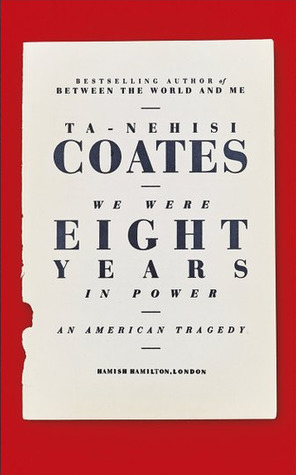
33916061Ta-Nehisi Coates, We Were Eight Years in Power: An American Tragedy. I've read Coates's essays for years, but it was this book, which puts together some of Coates's best work for The Atlantic and, more importantly, ties them together through multiple mini-essays by which Coates himself reflects, both critically and autobiographically, on what he was trying to do in those essays and what that effort says about where he was, intellectually and politically, at the time, which truly captivated me, and made me realize what an intellectual treasure he is. Coates has been subject to a huge amount of debate and argument in the wake of Trump's election, and I have some conflicted opinions about all that. But as to the question of whether Coates is a writer absolutely worth reading, I'm not conflicted at all.

Evicted: Poverty and Profit in the American CityMatthew Desmond, Evicted: Poverty and Profit in the American City. This is a detailed, careful, but also (I think) compulsively readable work of sociology, and that in itself is a rare enough thing that it deserves celebration. But this book deserves a wide readership not just because of the author's skill, but also his subject. Desmond's years of enthographic investigation and diligent research as produced a close, unsparing study of one rarely examined (or, at least, I hadn't ever examined it before) aspect of American poverty: the role played by substandard housing, and the whole range of laws, practices, and assumptions which make stable housing so precarious, and its loss so devastating, for the American poor. I found it a blistering, relentless work of exposure, one that anyone who cares about economic justice should read.

Rod Dreher, The Benedict Option. It would be very easy, and not especially wrong, to present Dreher and Coates as perfect antagonists: Coates is both utterly secular and convinced that white supremacy, under many different guises, best explains America today, whereas Dreher has made himself notorious this year for publishing, after many years of argument on his blog and in other writings, what many people have read as a manifesto for white conservative Christians who feel themselves under attack in an America far more secular, and far more diverse, than it was a generation or two ago. But I'm going to stand by the importance of Rod's arguments, and not just because I consider him a friend (full disclosure: I'm listed among those Rod thanks in the foreword); in the midst of his--self-confessed!--tendency to apocalyptic thinking and us-vs.-them hysteria, he is working out here an argument about modernity and its discontents, and how both conservative Christians, as well as anyone who cares about their received traditions, should respond to the arguably destructive "mobilities"--in terms of technology, economy, and identity. It's not a message that speaks to everyone equally, including Christians; those whose religious doctrines differ from his--the books is far more dependent upon certain specific political-theological claims than I think Rod realizes--aren't really his audience. But many besides that audience have read the book this year nonetheless, including myself, and I'm glad I did.

The detective novels of Tony Hillerman, particular The Fallen Man. We've had a paperback copy of Hillerman's Dance Hall for the Dead on our downstairs bookshelf forever; I think I might have inherited from my maternal grandmother, who has a big fan of Hillerman's detective stories. For whatever reason, at the beginning of the summer I pulled it off the shelf, read it, and found it a delight--and quickly grabbed another four Hillerman novels (The Blessing Way, Coyote Waits, and Sacred Clowns, plus the above) from out of our university library, which I then read one after another over the summer, enjoying them all (though some more than others). Hillerman wrote 18 novels starring Sheriff Joe Leaphorn and his assistant Officer Jim Chee, so I haven't even gotten a third of the way through his corpus; maybe I do another Hillerman run next summer. For now, I'm going to put The Fallen Man up as the best of the five I read; it's a compelling mystery, all the more mysterious because, in the midst of all the tradition and tension on the Navajo reservation where these stories are set (and which Hillerman regularly used to great, spooky effect), this is a surprisingly straightforward story of human passions and jealousies gone wrong.
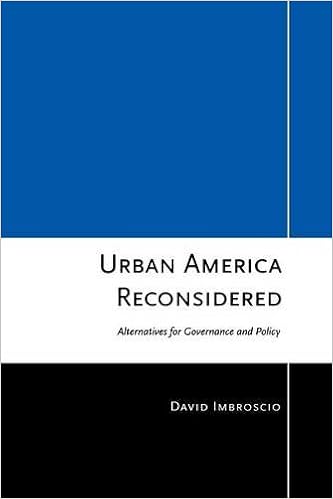
Image result for Urban America Reconsidered: Alternatives for Governance and Policy image David Imbroscio, Urban American Reconsidered: Alternatives for Governance and Policy. David Imbroscio himself gave me a copy of this book around a year and a half ago, and to my shame I've only gotten around to reading it now. Why to my shame? Because it's excellent. David makes an clear, careful, and (I think entirely) persuasive argument against the liberal assumptions underlying both urban regime theory and liberal expansionism, two dominant theories in urban sociology. More importantly to my mind, he puts into the context of urbanist arguments about state-market relations, community development, and a host of other concerns the ideas of Marxist, localist, distributist, social-democratic, classical republican, and numerous other critiques of liberalism. I've been able to recognize those connections before, but I lacked the language to properly describe those connections, and that's a language David provides for me here. The fact that these connections range widely might be considered a flaw, but I don't see it that way; this is a book about asserting the plausibility of a new context for thinking about city problems, and, as the final words of the book say, starting a conversation within that context. For my part, I've been flailing around in that context for a few years now, but now I've been given a map, to help me better understand where I've been, and what areas of exploration remain open for me.

Leigh Jenco, Changing Referents: Learning Across Time in China and the West. Years ago, I assumed that I was going to make my career as a scholar of Chinese political philosophy and intellectual history. That, obviously, didn't happen, for a lot of reasons. But despite my lack of linguistic expertise or even much by way of a publication record, I've somehow been able to keep at least one toe in the scholarly world of East Asian thought and comparative political theory over the years, so much so that I keep getting invited to conferences to speak on matters I really don't know that much about. Leigh Jenco's wonderful, challenging, and partly exasperating book--a superb intellectual exploration of the ideas of Chinese radicals in the early 20th century, and how those ideas arguably challenge many theoretical presumptions about how we compare ideas across cultural and linguistic worlds--provided an opportunity like that for me this year, in which I traveled to Singapore and discussed matters philosophical with a lot of scholars way above my pay grade. That trip, and the book which prompted it, provided me some of the headiest intellectual experiences of my year.

Ursula LeGuin, The Dispossessed. This is one of those classic sci-fi novels that I should have read decades ago, but never did. I'm grateful for whomever it was that planted into my head the idea of teaching an Honors Seminar on speculative fiction, and focusing on the work of Le Guin as a way to do it, because as a result I read not only this book, but also The Left Hand of Darkness and a dozen short stories of hers, and I basically loved them all. But if I had a choose one for this list, it has to be The Dispossessed, because of its incredibly detailed imagination of a radical anarchist world, but also because of the compelling way in which that act of world-creation gave force to the equally compelling character development which takes place throughout the book. An awesome sci-fi tale, one worth treasuring.

Cooked: A Natural History of Transformation Michael Pollan, Cooked: A Natural History of Transformation. I've read Pollan's work for years, but like with Coates above, I'd never sat down and read through any long, detailed argument of his before this one. I am glad I finally did! Pollan not only reminded me why he's one of the best scientific journalists writing today, but he also enabled me to see how thinking about cooking--in all its chemical, nutritional, historical, and social aspects--isn't just an side-issue to his long pre-occupations with food, health, and agriculture, but rather an essential continuation of it. We are, and have been ever since that key moment in human evolution many thousands of years ago, cooking animals, and understanding how so much of everything from our taste buds to our civilizations are wrapped up in transforming the animals, plants, earth, and air around us into bread, brisket, and beer is both deep and fascinating. A wonderful, thoughtful, and mouth-watering book.

Rob Sheffield, Dreaming the Beatles. I'm pretty certain that I didn't read another book this whole year that gave me as much unmitigated, geeky, fascination-filled pleasure as this book. I'm not the greatest Beatles fan in the world, but I'm enough of a fan that Sheffield's delightful semi-stream-of-consciousness "history" of the Beatles captivated me with its musical minutiae, its sharp commentary, its frequent laugh-out-loud moments, and its plain, unapologetic fan-boyishness. He makes the case that we all, every one of us popular music-consuming inhabitants of the modern Western world, can't help but be "dreaming" the Beatles whenever we strive to make any sense of all of our pop world; as far as I'm concerned, he makes his case very well.

The Tolkien Reader J.R.R. Tolkien, The Tolkien Reader. Not being satisfied with one Honors Seminar on speculative fiction, I decided to teach another, this one with a focus on Christianity and fantasy literature, particularly as represented by the Inklings, Tolkien being the most famous member of that group. As part of this class, we read a lot of Tolkien, C.S. Lewis, and Charles Williams (plus some Dorothy Sayers and Madeline L'Engle as well), much of it new to me. None of it, however, hit me as deeply as some wonderful essays and short stories by Tolkien, stuff that I've known about forever but had never taken the time to read. I'm not talking about his justly famous "On Fairy-Stories"; I mean "Farmer Giles of Ham," which I found terribly sardonic and witty, "Smith of Wootton Major," a simply delightful and thought-provoking fairy tale, and most of all "Leaf by Niggle," which is hands-down the best, most haunting and revealing, short work of Christian fiction I've ever read. Tolkien was not just the author of so many of us geeks' imaginary lives; he was a damn fine writer, and this collection proves it.

Honorable Mention: Edgar Cantero, Meddling Kids. Not by any stretch one of the best books I read this year, but this close (but not nearly close enough!) parody/re-imagining of the Scooby-Doo gang investigating an old, mystical, eldritch horror-mystery years after their retirement was a fun summer read. More importantly, it got me thinking about Scooby-Doo stories in general, which--thanks to the help of some FB friends--got me hooked on Scooby-Doo: Mystery Incorporated (by far that best television-watching experience I had all year), and that in turn got me fascinated by great cartoons of my past and opened me up to some great current cartoons, Samurai Jack, Gravity Falls, and (especially) Over the Garden Wall in particular. So, this was a book that revealed to me (or reminded me of) a whole world of imagination, and for that I must give it credit.

Thursday, November 30, 2017

30 on the 30th: Nothing Like the Sun and "Straight to My Heart"

Coming almost to the end here of my series of great albums that I still listen to, 30 years on. I started with U2 in March, then there was Prince in April, Suzanne Vega in May, Level 42 in June, The Grateful Dead in July, Def Leppard in August, INXS in September, and Bruce Springsteen in October. And what now, on the 30th of November, as winter finally begins to really set in here in Kansas? Sting's majesterial Nothing Like the Sun.

Yes, that's right, Gordon Sumner himself: Sting. You liked him, once. Oh, I know, you don't believe you ever did; you've forgotten, or you might even actively insist that you remember hating the man. Especially late 1980s Sting, with his seemingly aristocratic flirtations with Latin American and North African rhythms and jazz instrumentation, with his oh-so-enlightened devotion to protecting the rain forests, with his casual referencing of how his records were banned in Chile by Augusto Pinochet, and most of with his long hair, right? I swear, Sting probably even beats out U2's Bono for the title of major recording star whom everyone insists they never liked these days.

Well, anyway, the point is, you're delusional. You may not have been the man's greatest fan ever, you may have never really forgiven him for breaking up The Police, but you bought his albums, and put up with his world-beat noodling and mediocre poetry and jazz affectations because the results were so much more than the sum of their parts. This album, in particular, was fantastic, filled with clever, engaging, challenging, fun, moving, thoughtful music. Everyone was listening to it, myself included, and we kept on doing so, even as tastes changed, because some of its tracks were just so infectious. And then, I guess sometime around 1995 or so, everyone suddenly decided Sting was a pretentious hack, and had always been a pretentious hack, and the love we all had for this album dropped out of sight. (The only time I saw Sting was when he was on tour for his later album, Mercury Falling, in 1996, when we were living in Washington DC, and I can still remember the gleeful, vicious snark that the Washington City Paper employed in talking about his show. Which was awesome, by the way. Natalie Merchant opened.)

Anyway, here we are, 30 years on, and I love this album still. What track to choose? My favorite (or, at least, my favorite original composition from the album; I confess I really adore Sting's cover of "Little Wing" on Nothing Like the Sun, as overplayed as it definitely became), "Straight to My Heart." Something about this tune just grabbed the college-freshman me: it was a goofy paean to a surprisingly ordinary romance ("Come into my door / Be the light of my life / Come into my door / You'll never have to sweep the floor"), and yes, sure, it made me feel sophisticated and worldly and fine. Watch Sting sing it live from 1988 in Verona; maybe all the annoyance will come rushing back--but the coolness of the song will too.