How to Stop This Man?
 [Long, and of interest to only three people. You've been warned.]
Donald Trump has been President of the United States for a year. He shouldn't be. Completely aside from his utterly changeable--and I think most bad--policy preferences, he's not remotely qualified, he doesn't have the minimum level of responsibility, empathy, or basic competency which the presidency ought to presume, and on top of that he's an obviously incurious, narcissistic, vindictive, demagogic, and paranoid human being. Also, he may be mentally ill, and at the very, very, very least, he showed basically no civic allegiance whatsoever to the laws of the country he pledged to enforce in his utterly casual attitude toward offers from various Russian actors, including possibly the Russian government itself, to help him attack his opponent in the general election. So, in short, he's a horrible president and public servant. What do we do about it?
(Is there any new insights in this post? Not really. Is it worth reading anyway? You decide.)
The goal is to get Trump out of the presidency. (There are other goals, but that's the goal I'm talking about in this post.) Setting aside any violent, non-constitutional options, we have about three serious possibilities: impeaching him, having the Republicans drop him as their presidential candidate in 2020 (thus either forcing Trump to run as an incumbent independent president, or obliging him to retire once the election takes place), or defeating him in the general election (this would have to happen even if the Republicans didn't re-nominate him, should he choose to run as an independent, which he very well might). True, there's also the "25th amendment option," but I'm going to lump that in with impeachment, since in both cases it would require, at the present time, members of Trump's own party, either in Congress or in his Cabinet, turning on him.
Of course, given the way the major political parties currently operate, and have operated for nearly a half-century (or really, even longer; the last time it took either the Republicans or Democrats more than a single vote to "decide" who their presidential nominee would be was 1952, and the last time any party refused to re-nominate an actual sitting president was a full century before that), I actually think impeachment or a 25th amendment-style coup is more likely over the next two years than the Republican party going into 2020 with any plan up their collective sleeves besides backing their president in the general election. But since this is an post addressed to political enemies of Trump, let's set that aside, and settle on focus on politics: what political strategies might be employed to convince Republicans to dump Trump, or failing that, convince Republicans not to vote for him in the 2020 general election?
A few friends of mine and I got into an argument about this after Senator Jeff Flake attacked Trump on the Senate floor. There were those who praised Flake, and saw such attacks as crucial: what was needed more than anything else, they thought, was for more Republicans like Flake, Republicans who otherwise agreed with Trump's agenda nonetheless recognizing, and speaking out about, what a corrupt, despicable person he is. But others (including me) disagreed. It's not like we dismissed Flake's speech, but we didn't see what was so useful about him giving it. Was he prepared to oppose Trump's agenda in the Senate? Was he going to actually turn against the Trump administration with the only and best tool he had: his votes? It seemed to us that the most important things was to use every tool available to us--money, organizing, protests, mockery, whatever--to try to convince Republicans that Trump was a drag on their own agenda, and thus that getting Republicans to betray their own president would be a great success--while anything less than that, while certainly not worth condemning, isn't particularly worthy of praise.
The argument made by those in the former camp was that, should we get our wish and Flake and other Republicans start
voting--sometimes, strategically, with clearly broadcast talking points
explaining the anti-Trump reasons why they are so voting--along with
Democrats, then it would be likely that Trump would simply frame such acts as coming from a bunch of RINOs who had joined up with Democrats and liberals, aiming to bring down Trump for partisan reasons, and that would only help him--because nothing serves to fire up Trump's base more than giving him a partisan enemy to beat up in front of his supporters.
It's not a bad argument. It builds upon the idea that Trump's demagoguery,
though it relied upon partisan structures and partisan expectations to
come to power (that is, the Republican party, much as many of them didn't like Trump, fell in line behind him in order to
protect their agenda), is now operating free of the partisan realities
which shape the incentives of Washington DC, and is a sui generis threat
in the history of America's constitutional order. As such, political suggestions are short-sighted,
because our strategy
should be focused solely on demonstrating Trump's unfitness for office
(as one of my interlocutors put it "talk about his Tweetstorms and not his policies").
A political strategy which attempts to break apart the Republican
agenda that enabled his rise to power, by disrupting, blocking, and
interfering with the goals of those who allowed Trump to be nominated,
perhaps particularly by goading Republicans to stymie their own party in
Congress, is all, from this way of seeing things, so much crying over a horse that has left the barn,
because now that Trump is in office, convincing Republicans they made a
bad choice by working to make Trump and them, collectively, ineffective will
only rebound to Trump's benefit. Essentially, since he doesn't really care about the Republican party which he leads, striving to knee-cap it will only give Trump something else he can rant about...maybe all the way back to the White House.
It's persuasive case, but I disagree with it.
Sure, party tribalism runs deep for all sorts of psychological reasons. But Republican-thinking voters vote for the
Republican party because it does Republican things. If some Republicans
helped stop their own party from being able to do Republican things,
well sure, Trump would denounce them as traitors. But would it really have no affect on the thinking of all the other Republicans, the
ones who want to see Republican things get done, the ones who had "fallen in
line" behind Trump? I find that hard to believe. Rather, it seems to me that if Republicans like Flake were to start sabotaging their own party's agenda through their votes, demonstrating to the Republican leadership
that the continued presence of Trump at the top of their party is
actually making it harder for the party to get anything done, it would be an
obvious call to all those Republicans who fell in line that there's no
incentive for them to remain in that line any longer. In which
case, impeachment or no re-nomination at at least lots of Republican voters staying home in 2020 becomes an even greater possibility than it already is.
I'm not mocking Flake, or saying his words have no significance. Such attacks on Trump are needed so as to build understandings that others may be persuaded by. But insisting that the threat posed by Trump is so sui generis that it is actually hurtful to urge those in a position to do so to hurt him an a partisan, political way, and to affirm instead the need that the attacks on Trump, to be successful, must not be sullied by partisan politics, but instead be expressed in non-partisan expressions about Trump's constitutional unfitness, seems wrong to me. Perhaps that's because I'm simply unable to see a way of talking about politics in a way that 1) actually addresses the realities of power as it is being exercised by a dangerous individual in our country at this moment, and 2) doesn't involve engaging with the partisan realities and seeking partisan leverage. Maybe, in some sense, Trump really is beyond party, because perhaps the real base of his power structure is his Twitter cult and not the Republican party. But even if that is so, it is still a fact of our system of government that his power and influence, whatever it rests upon, is wielded through the aegis of the Republican party, and thus undermining that--through votes!--is fundamental to stopping his reign.
The U.S. Constitution wasn't written with parties in mind. The rise of political parties--which was necessary, if you're going to have a mass democracy; at least, no one has yet seriously proposed any way of running such a polity without them--fundamentally changed how its internal levers of power operate. While it is appealing--and I'm speaking here as someone who likes much of the civic republican rhetoric which shaped those early, non-partisan understandings of democratic government!--to think that Trump ought to be taken down as Trump, the bad president, rather than as Trump, the bad Republican president, I just don't see any reason to believe that such is possible--and I am unconvinced that Trump is so separated from any need for a political party to enable to him to reach those aforementioned levers that doing the latter (I think inevitable thing) will backfire. Maybe it'll turn out that I'm wrong; maybe later I'll change my mind. But for now, it seems to me that, for better or worse, stopping Trump means electorally defeating him everywhere possible--and not simply expressing constitutional sorrow over what a creep he is. If nothing else, it give me a game plan to attempt, in whatever small and local ways I can: and no, as decent a fellow Flake may be, he's not planning, to my mind, the right anti-Trump game.


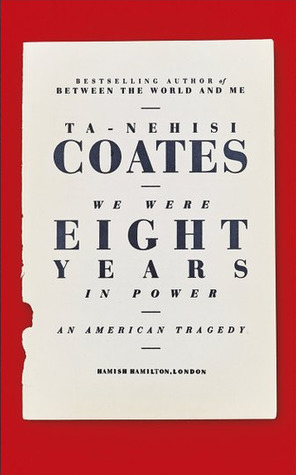 Ta-Nehisi Coates, We Were Eight Years in Power: An American Tragedy. I've read Coates's essays for years, but it was this book, which puts together some of Coates's best work for The Atlantic and, more importantly, ties them together through multiple mini-essays by which Coates himself reflects, both critically and autobiographically, on what he was trying to do in those essays and what that effort says about where he was, intellectually and politically, at the time, which truly captivated me, and made me realize what an intellectual treasure he is. Coates has been subject to a huge amount of debate and argument in the wake of Trump's election, and I have some
  Matthew Desmond, Evicted: Poverty and Profit in the American City. This is a detailed, careful, but also (I think) compulsively readable work of sociology, and that in itself is a rare enough thing that it deserves celebration. But this book deserves a wide readership not just because of the author's skill, but also his subject. Desmond's years of enthographic investigation and diligent research as produced a close, unsparing study of one rarely examined (or, at least, I hadn't ever examined it before) aspect of American poverty: the role played by substandard housing, and the whole range of laws, practices, and assumptions which make stable housing so precarious, and its loss so devastating, for the American poor. I found it a blistering, relentless work of exposure, one that anyone who cares about economic justice should read.

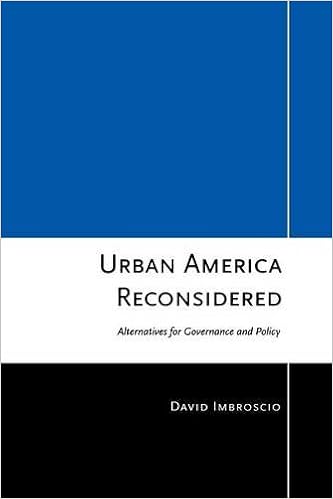 David Imbroscio, Urban American Reconsidered: Alternatives for Governance and Policy. David Imbroscio himself gave me a copy of this book around a year and a half ago, and to my shame I've only gotten around to reading it now. Why to my shame? Because it's excellent. David makes an clear, careful, and (I think entirely) persuasive argument against the liberal assumptions underlying both urban regime theory and liberal expansionism, two dominant theories in urban sociology. More importantly to my mind, he puts into the context of urbanist arguments about state-market relations, community development, and a host of other concerns the ideas of Marxist, localist, distributist, social-democratic, classical republican, and numerous other critiques of liberalism. I've been able to recognize those connections before, but I lacked the language to properly describe those connections, and that's a language David provides for me here. The fact that these connections range widely might be considered a flaw, but I don't see it that way; this is a book about asserting the plausibility of a new context for thinking about city problems, and, as the final words of the book say, starting a conversation within that context. For my part,

 Michael Pollan, Cooked: A Natural History of Transformation. I've read Pollan's work for years, but like with Coates above, I'd never sat down and read through any long, detailed argument of his before this one. I am glad I finally did! Pollan not only reminded me why he's one of the best scientific journalists writing today, but he also enabled me to see how thinking about cooking--in all its chemical, nutritional, historical, and social aspects--isn't just an side-issue to his long pre-occupations with food, health, and agriculture, but rather an essential continuation of it. We are, and have been ever since that key moment in human evolution many thousands of years ago, cooking animals, and understanding how so much of everything from our taste buds to our civilizations are wrapped up in transforming the animals, plants, earth, and air around us into bread, brisket, and beer is both deep and fascinating. A wonderful, thoughtful, and mouth-watering book.
 J.R.R. Tolkien, The Tolkien Reader. Not being satisfied with one Honors Seminar on speculative fiction, I decided to teach another, this one with a focus on Christianity and fantasy literature, particularly as represented by the Inklings, Tolkien being the most famous member of that group. As part of this class, we read a lot of Tolkien, C.S. Lewis, and Charles Williams (plus some Dorothy Sayers and Madeline L'Engle as well), much of it new to me. None of it, however, hit me as deeply as some wonderful essays and short stories by Tolkien, stuff that I've known about forever but had never taken the time to read. I'm not talking about his justly famous "On Fairy-Stories"; I mean "Farmer Giles of Ham," which I found terribly sardonic and witty, "Smith of Wootton Major," a simply delightful and thought-provoking fairy tale, and most of all "Leaf by Niggle," which is hands-down the best, most haunting and revealing, short work of Christian fiction I've ever read. Tolkien was not just the author of so many of us geeks' imaginary lives; he was a damn fine writer, and this collection proves it.


