Featured Post

WELCOME TO RUSSELL ARBEN FOX'S HOME PAGE

If you're a student looking for syllabi, click the "Academic Home Page" link on your right, and start there.

Wednesday, October 26, 2005

Has Leon Kass Seen The Corporation? (Conservatism, Part 3)

The second of Lee's posts to really get me thinking was this one, where he makes the observation that

[T]he Christian theological tradition would say that our proper attitude toward material creation is to receive it as a gift and with thanksgiving. But the consumerist attitude is similar to the attitude of the Israelites in the desert hoarding the manna that came from God. They wanted to have it at their disposal, rather than as a gift received anew each day. In a similar fashion, we want things in our possession, at our disposal, and under our control. We turn them into commodities....[We] need some way of making communal judgments about how far is too far in the realms of consumerism and technology. Can we discover something like that while still preserving the achievements of liberalism and liberal institutions?

Eric Lee, commenting on this post, suggests that what Lee is talking about is well explored in the documentary The Corporation--and he's absolutely correct. I recently gave a presentation on this film (which everyone should see--it is, I think, just about a perfect mix of careful thinking and outrageous agitprop) here at WIU, and it struck me just how fundamentally its attack on the power of corporate entities to treat practically anything human or natural as a potentially ownable commodity relates to conservative complaints about technologically-driven social transformations. It made me think--not for the first time, I'm afraid--that Leon Kass, and many social conservatives others who share his opinions, would be well served by viewing this film.

Kass came in for a lot of mockery around the blogosphere last week (see here and here), and deservedly so. I'm not sure where I saw the comment, but someone pointed out that Kass's worldview (which I think is more quaint than dangerous, but in any case I don't agree with it) basically turns on a particular Straussian--or Allan Bloomian--reading of the ancient Greeks which presents the argument that men and women can't ever really be friends; true friendship is a intra-gender phenomenon, whereas across genders the erotic force often gets confused. (Maybe I should call this a When Harry Met Sally reading of ancient learning as well.) And so, of course, when it comes to women and men associating with one another, women need to be on their guard and discipline themselves so as to be able to sexually control men and lure them into marriage, because of course, as Kass put it, "why would a man court a woman for marriage when she may be sexually enjoyed, and regularly, without it?" The possibility that the man and woman might actually be interested in one another and enjoy each others' company--that they might, in other words, be friends--is simply not likelihood in his mind.

But that's not what I wanted to talk about; what is on my mind is Kass's many strongly worded warnings about and occasional denunciations of genetic engineering, embryonic stem-cell research, cloning, and biotechnology in general. I'm enormously sympathetic to the work Kass has done on the President's Council on Bioethics (see here and here and here and here), because I share his fear that our society's needed and basic moral notions of dignity and humanity can easily be compromised by allowing technology to turn too much of what is fundamental to our nature and our everyday lives into, as Lee put it, possessions, "at our disposal, and under our control." Once again, pointing back to yesterday's post, there is an important sense in which our ability to act freely and meaningfully in the world depends upon respecting limits--denying the ability of any one person, through the supposedly neutral and empowering aegis of the market, to make their own or someone else's life utterly pliable and choice-driven. If everything is a potential possession and commodity, if everything can be bought or sold or designed or reconstructed, then nothing is permanent, and if nothing is permanent, our ability to draw moral lines, much less our ability to build our institutions and laws in reference to such, will collapse. In the end, we need to distinguish between what is human and what is merely an accoutrement of humanity, and set the former beyond the reach of profit and pleasure-minded choice.

What bothers me about Kass and many other such conservatives is that, so far as I can tell, they have not identified the real driving force behind these choices: corporations, these legal fictions which we have created that our law grants the legal standing of persons, and yet are fundamentally unable to include within the logic of their actions any kind of human value or moral concern. Yes, individual persons are the ones who make the decisions which corporations then act upon, but no individual, on their own, is so powerful or so removed from the real world of everyday moral concern to be able to do something so horrendous as, say, patent a life form. Yet that is exactly which many powerful corporations have done. The modern corporate form is wonderful for harnessing the potential of capitalism; they can, through legal mechanisms, take money from investors and rapidly buy property and move into markets and innovate the production of goods to a degree single actors never could. But it is exactly that speed, that impetus towards constant growth and exploitation, which has allowed corporate powers to generate structures within which technology escapes human control: you just have one genetic engineer here, and one lawyer over there, and each of them are doing their job, and if, in the end, you're suddenly placing patents on goods which makes the basic stuff of life--genes, seeds, DNA codes, etc.--nothing more than objects of speculation and profit...well, who is to blame? The Corporation lays out all this expertly, and entertainingly as well.

I've been reading Norman Pollack's The Just Polity, an intellectual exploration of Populism in American history, and he has much to say about the populist critique of corporations and consumerism. Much of what he has to say about "property" just as clearly applies to matters of "technology" as well, so much so that you could easily replace the former with the latter, and the basic argument would hold: "[Technology]," he writes regarding the 19th-century Populists, "was only regarded as a threat when it became integrated with the mechanisms of domination....When [technology] was concentrated, Populists viewed it as taking on a politicized form" (pg. 6). This this puts it very well--the concentration of technological power, and economic power, in the hands of corporation is hardly a neutral event, an unavoidable and harmless byproduct of the functions of the market, but one which impinges upon politics. The makers of The Corporation (which, despite its occasional rabble-rousing goofiness and its heavy use of Noam Chomsky and Michael Moore, is a lucid and insightful film) do not argue against capitalism itself or urge an agrarian-Luddite revolution; what they do is ask how, and to what degree, we can continue to justify essentially outsourcing such transformative issues to a bunch of centralized, strictly speaking inhuman, acquisitive entities. I do not expect Kass to become a Luddite--I'm not myself. But I would expect him to recognize that what is primarily driving the kind of technological danger and commodification which he fears is to a great degree the one economic agent operative in our present socio-economic world that is almost completely structurally immune to the sort of democratic "communal judgments" which Lee mentioned. If he can't do that, especially in regards to these most pressing of issues, then really, what could he possibly be "conserving" anyway?

Tuesday, October 25, 2005

The Populist Farmer (Conservatism, Part 2)

Let me pick up on a point Lee made in the first of these Verbum Ipsum posts I mentioned, where he reflects upon the arguments of one of my favorite thinkers, Christopher Lasch:

Lasch favored what he called 'populism'....Lasch's populism valorizes what he considered to be lower-middle-class or 'petit bourgeois' values of local community, solidarity, dedication to craft, loyalty and self-denial. In essence, it is an ethic of limits that doesn't expect ever-expanding wealth and opportunity, but finds satisfaction in concrete attachments to family, neighborhood, honest work, and civic participation. Lasch's vision combined a desire for a certain level of economic egalitarianism with a distrust of the state and a commitment to what we might call "traditional values." But it's not entirely clear that such a state of affairs is possible (assuming that it's desirable). Is it possible to ensure a measure of economic independence for working people without an expansive welfare state? Is it, as some have suggested, that it's the state that makes the concentration of wealth possible through the various subsidies and supports it provides to big business? Is a kind of Jeffersonian agrarianism/populism feasible in the 21st century, or is that just nostalgia?

Lee--and Lasch, for that matter--aren't really explicitly talking about farmers here; their invocation of agrarian populism has more to do with the Jeffersonian ideal of a democracy of small property owners, of producers and workers that can stand independent of large commercial machines, than with an actual celebration of farm life. Still, Lee's comment got me thinking about farming, partly because my family is involved in it, but even more because through that involvement, I think I can grasp some of the practical problems and possibilities that might go into answering Lee's question, and thus make for a better conservatism than what passes for such today.

Farming is an economy of limits, and teaches one an ethic of limits. You cannot retool a plot of land the way you can a factory; you cannot redesign or alter a crop the way you can a production line or menu or novel or any other material thing that someone might produce through their labor. Of course, over time--through working with the land, judging the seasons, experimenting with different hybrids, developing new planting and harvesting procedures--the sort of agriculture any given person or community is involved with can change; and by the same token, it's not as though any non-agricultural business or practice can just turn on a dime: there are machines and investments that need tending to, there is training that has to take place, etc. Still, broadly speaking, the essential distinction between an act of creative labor that involves oneself, or an organization, or a factory, and the labor which involves the land, holds firm: farming is--must be--careful, slow, patient, conservative work. In short, working on a farm teaches you about time, teaches you your own limits and thus turns you to others, teaches you value, as Wendell Berry put it in his essay "Going to Work," "the nature of the place itself and what is naturally there, the local ecosystem and watershed, the local landscape and its productivity, the local human neighborhood, the local memory." (This is in contrast, according to Berry, to "much modern work" which takes place in "academic or professional or industrial or electronic enclosures," and thus encourages a "separation between the workers and the effects of their work...permit[ting] the workers to think that they are working nowhere or anywhere.")

So there is a reason why Lasch--who once wrote that it was simply "common sense" that (here he quotes Raymond Williams) in the future, "work on the land will have to become more rather than less important and central"--focused on farming along with so many other lower-middle-class or "petit bourgeois" forms of work as the key to his conservative but also egalitarian, humble but also hopeful world. But does any of this have any connection to farming today? Setting aside the full-bore agrarian vision, and assuming that every person will just have to find, if we so choose, a way to recover a little bit of Jeffersonian social and economic independence (an independence which exists in the context of a defined community, not an open and uncaring market) in whatever vocation or lifestyle we live, can contemporary agriculture offer anything from which we can learn?

I think so, though perceiving it isn't easy. The terrible burden of farming in America today, and for several decades now, is that of bigness--between the technology of the Green Revolution in the 1960s, and the machinations of political and corporate leaders in the 1970s, the principle of limits, while still an undeniable aspect of farming, was officially denigrated: the goal of every farmer was to increase yields, to "get big or get out," to plant, as Richard Nixon's Secretary of Agriculture Earl Butz put it, "fence row to fence row" (and, of course, that meant trying to get more land within those fence rows as well). Of course, this didn't happen over night; in many ways, due to the enormous amount of arable land available in the United States, combined with a free-market ideology that has always encouraged farmers to think about growth rather than conservation, the lure of limitlessness has long been with us. Today, corn is so overproduced in the U.S. that massive subsidies--more than twice as much as any other crop receives--are necessary to keep it profitable, with the result that the corn economy spills over into such ridiculous and environmentally destructive endeavors as ethanol, corn-fed beef, and--worst of all in our household--the omnipresence of corn syrup as a sweetener. But to a degree this is simply a replay of the 19th century, when the overproduction of corn made possible the near-universal consumption of cheap corn whiskey and rampant alcoholism. Wise farmers and managers of farms have long been sensitive to the lure of bigness, and the crises it can cause; but such wisdom is difficult to hold onto when agriculture has become captive to obsession with growth and "feeding the world." (As Amartya Sen demonstrated years ago, famines are rarely caused by a lack of food, but rather by poorly developed or managed local economies that prevent people from finding the kind of work and wealth needed so that they can afford food.)

Today in the U.S., 90% of farms are still technically family-owned and "small"--but they account for an increasingly small percentage of total farm production. Over one-third of all agricultural output in the U.S. is now determined by corporate contracts, and two-thirds of American farms are obliged to specialize in only one or two commodities. The raw number of farms in the U.S. have been falling for decades; but what is far more worrisome is the collapse of the mid-sized farm economy, the "agriculture of the middle," as one report puts it. Small farm operations, especially those nearby urban markets, can often deliver their goods directly to consumers and stores, especially as the interest in organic food and farmers markets has grown. Huge corporate farm operations, of course, increasing dominate the agricultural scene (helped along enormously by subsidies which are tied entirely to sustaining price despite overproduction). The farmers who are falling through the cracks are the ones who are working perhaps 200, perhaps 500, perhaps 1000 acres, who still sell their crops on the open market and still make decisions about what to plant and how to manage the soil and when to harvest themselves, who still can manage the land and pass down that knowledge directly, frequently within their families. This is a grave concern: while the major agricultural conglomerates (some scholars suggest that we will soon see economic pressures and incentives force or lure most non-boutique farmers into joining massive, 225,000-acre "industrial" farm complexes) will always be able to produce food (though whether it's good to eat or not is a different story...), it is these mid-sized farms which are most able to produce unique, highly differentiated commodities in sufficient quantities to be able to participate in economies of scale. More relevant to this discussion, it is farms like these that are at the outside edge of the sort of consciousness of limits, and the virtues which follow from the same, that farming at its best represents. If we lose them, then farming's connection with Jeffersonian hopes, with a model of populist empowerment and discipline so important if we wish to prevent the free market from descending into pure anarcho-capitalism, will mostly disappear. Fortunately, things may be turning slowly around.

My family owns a farm--in two parcels, one 400 acres and the other 1400 acres, of which about 1100 acres are tillable--in the Kootenai River valley in northern Idaho. (See here for some more personal information and reflections on our farm.) We grow mostly wheat, with the occasional excursions into lentils or barley. We're lucky in a lot of ways: our land is tended for us by a family of Mennonite farmers, the Amoths, that have been associates of the Fox family for going on four generations now. Moreover, the arable land in our part of the Inland Empire is some of the finest wheat-growing land in America, with no need for irrigation and a climate well-suited for a variety of strains (we grow both soft white and hard red varieties, including the comparatively rare and valuable dark northern spring). And wheat itself is a fairly high-demand and stable crop. Still, it isn't at all impossible to imagine losing our toe-hold in the market, especially when confronted with the huge subsidies and contracts pulled in by the major operations out there. Fortunately, there are programs which have been designed to help, in particular the Conservation Security Program. This program, which has only recently become available in the Kootenai River watershed area, is a quantum leap forward in the relationship between the federal government and farmers. Rather than simply paying them the difference between their costs and the market price of their goods (thereby warping the latter), or paying them to destroy their goods outright so to keep them off the market, it treats farmers as stewards, subsidizing them in their efforts to transform--and, thereby, limit--their land in accordance with good environmental principles. Individual plans are developed in consultation with those who actually work the farm, and the result in a more natural farm, but one that is still productive, still producing marketable goods, and still ultimately in the hands of their knowledgeable, local owners and operators. As my father put it, "Someone in Washington finally figured out that people who spend their lives on the land are better environmentalists than those who visit it for a weekend." This sort of trust--call it populist empowerment--strengthens the mid-sized farm and those who, in their own independent way, make the land and their work upon it part of the American scene, thereby making it and them that much more like to endure in a world characterized by the colliding demands of environmentalism, efficiency, and economic centralization.

The CSP is just one program, and it alone can't make much difference across the country; but then, it is just an example of some of the ways in which farming's contribution to the fabric (as well as the feeding) of America can nonetheless still be drawn out. The legacy of the New Deal--which always was far more about building economic security and solidarity than simply cutting welfare checks--included several programs that built upon the expected ability (and obligation!) of farmers to make wise use of their land, assuming the market would pay for and respect the kind of limited, disciplined work they were doing. The Burley Tobacco Program is a good example of such; this is how one farmer and writer described the effects of that program (which Wendell Berry has also praised):

The Burley Tobacco program, for example, has sustained more small- and moderate-sized family farmers than has any other agricultural program in any other state in the US. When I was raising 3-4 acres of tobacco on my 155-acre dairy farm in Kentucky in the 1970s, I was making enough money from tobacco to take care of my mortgage and loan payments on the whole farm. I never got a subsidy check. The companies were required to pay a fair price, or they didn't get the tobacco. Tens of thousands of small farmers making a living meant that church and school events were always packed with people. There was a healthy, lively rural economy and social fabric....Some of my economist friends didn't like the tobacco program because they said it "retarded efficiency." They explained to me that tobacco-farming methods were antiquated, that more tobacco could be produced more cheaply if the production weren't required to be disbursed among so many "inefficient" little farms. They were right, of course, but when farm leaders talked to me about the importance of the program, the never talked solely about efficiency—they always talked about the really good farmers whose income from tobacco enabled them to be livestock and grass farmers, thereby stewarding the land. They also always talked about how many kids were sent to college with tobacco checks. This was a stark example to me of two different paradigms about economic systems. One considers financial efficiency primary and all other goals derivative. The other considers social and environmental goals as important as financial ones.

I neither smoke nor care much for people who do, and I'm anything but a fan of the tobacco industry. But you have to recognize and applaud sincere efforts, wherever you may find them, to make farming work in today's open-ended social and economic environment in the egalitarian and empowering way that agrarians from Jefferson on down have insisted that it can and should. The American government spends billions of dollars on agriculture, flooding world markets while protecting our own, propping up bloated agribusinesses that soak up the corporate welfare and use their wealth to patent crops and micromanage farming like any profit-minded corporation would, and all the while fails to do the basic things which France--which is hardly free of such abuses themselves--has successfully done with far less overall spending: identify limited niche markets where agricultural commodities, produced in conservative and limited--and therefore all the more personalized and enriching--ways continue to shape an overall way of life.

I don't imagine that the majority of the Illinois corn fields surrounding our house will be transformed into numerous small or mid-sized, locally productive and managed farms anytime soon. Still, one can hope: hope that the CSP and programs like it receives more funding and is extended to more areas of the country, hope that more people will key into the way in which farming can help to sustain a populist public good. The state must play an important role here: not simply as a provider of welfare per se, but because--absent, as I said above, a complete agrarian revolution--it alone has the democratic power to structure and thus shape the way in which modern technologies and markets interact with farmers and farming communities. Without such structuring, the best--most communitarian, most Laschian, most egalitarian, most local, most conservative--aspects of American farm work will be hard-pressed to survive. But if they do survive, or even flourish, farmers like the Amoths might well endure to be popular examples of the kind of good life which workers the country over might someday be clamoring to conserve.

Monday, October 24, 2005

Conservatism on Trial in St. Louis

Well, it seems that once again I've managed to let nearly month go by without much serious blogging. I guess I'll have to do something about that.

I just got back from a conference in St. Louis--it was the annual meeting of the Association for Political Theory, a relatively new and growing professional academic group--and I was on a roundtable discussing "Prospects for American Conservatism." It was an excellent panel, with some great discussion afterwards--in some ways, a replay of the panel I was on with some of my fellow bloggers at APSA, but in some ways going in a very different direction. For one thing, it was much more personal, reflecting the efforts of four people thinking very hard about how to place themselves and their interests, hopes and fears in relation to what passes for "conservatism" in America today. I can't do justice here to the energized discussion which followed afterwards; suffice to say it was an excellent exchange all around. And there was a lot of material presented worth arguing about: Steve Millies used Burke to thoughtfully explore and critique the highly imprudent and anything-but-traditional Bush Doctrine ; I did my usual Christopher Lasch-inspired social conservative-Christian socialist shtick (our panel chair, the sharp and funny Daniel Pellerin, said after listening to me that he was surprised to find an old-fashioned Red Tory living in the U.S.); Gus Dizerega discussed his break with libertarianism and his suspicion of a totalitarianism lurking within the soul of the Christian right; and Ed Wingenbach reminded us of the danger of getting caught up in a merely "nominalist" argument when the conservative movement in America today, whatever it actually consists of, has been so successful in positioning itself as the party of power.

Ed's comments were particularly relevant given the arguments which emerged in the discussion period, most having to do with the apparent intentions of contemporary imperialists and certain neoconservatives. Does talking about "conservatism" do anyone any good in diagnosing this phenomenon at all? You link this wholesale revision of much of what has long been assumed to be "conservative" (realism, prudence, community, tradition, localism, etc.) with the ambitions of certain religious activists, and what you find is the acknowledgement that the word itself simply doesn't describe the existing movement; as Joseph Bottum himself admitted in a prominent essay in First Things, "this isn't conservatism....But so what? Call it the new moralism, if you like. Call it a masked liberalism or a kind of radicalism that has bizarrely seized the American scene." Daniel's observation that, if Hartz's thesis about the liberal tradition in America has any truth to it at all, then there is every reason to properly read Bush's adventures as a somewhat radicalized iteration of American Whiggery, the liberal imperialist mindset which has always lurked below the surface of America's civic creed and which now, post-Roe, post-9/11, has found a new outlet. I think there's a great deal of truth to that. But, for my own sake, I also think it's important to point out the enduring, oft-misunderstood presence of at least one authentically conservative strand of thought in the current Republican party.

As the discussion turned to the war on terrorism, I confessed that I had drank the Kool-Aid: back in 2003, as most of you know, I was a worried but nonetheless emphatic supporter of the Iraq War. I have long struggled, against my better judgment, with the problem that there is much that someone of my views can plausibly admire about President Bush, and a great deal of that is caught up the way he and those around him intentionally or unintentionally tapped into a deep idea--an idea that, as I put when I finally admitted that I needed to eat some crow, "appealed to me: [one that] made sense, [that] matched what I thought ought and could be possible in a world of danger and oppression where the meaning of sovereignty had changed but the role of national power hadn't." When one member of the audience suggested framing the present condition of conservatism and liberalism in the U.S. explicitly in post-9/11 terms, this is what I came up with--

In the aftermath of 9/11, and reaching all the way to the invasion of Iraq, Bush's and the neoconservatives call to war has ideologically caught up three distinct groups of Americans. The first and largest group responded to the attack on the U.S. and its interests with a straightforward patriotism, the sort of civic and religious pride in America that united many diverse factions all throughout the Cold War when Soviet communism was presented as a legitimate and dangerous threat to the American way of life. Despite the way in which, post-Vietnam, self-described "conservatives" were able to claim this mantle for themselves, there was never anything coherently conservative about it; in fact, to the extent that the "American way of life" is basically a liberal one, than this patriotic reaction is similarly "liberal" in a rather fundamental way. The second group, smaller but highly influential, were the liberal nationalists and internationalists, who resonated to the call to war for reasons of human rights and idealism and the promise of uniting democracy promotion with imperial might. So much has been written about this group (and so much of which, I must admit, I still cannot help but be sympathetic to) that there's no point in elaborating it further, except to note that, whether they called themselves liberal hawks or neoconservatives, this too, at bottom, was just another iteration of liberal reformism and humanitarian imperialism, Gladstonian-style.

The line dividing the second group from the third is thin and hard to discern, but important to speaking clearly about conservatism today. For this third, I think very small group, what happened as we watched the World Trade Center come down on September 11th was the realization, for the first time in a very long time, that one could actually see a boundary, a limit: there really was this place called "America," and it had a culture and a way of life and a meaning, and there was something outside of it, something that wasn't a function of, or susceptible to, the abstract forces o globalization, but instead took the corporate Americanization of the world and shoved it all back into national, historically embedded terms. In other words, all of sudden we could see ourselves as a community, not just a site of media and market exchanges, and a community worth loving as well. And to the extent which the struggle with Islamic fascism and terrorism proceededd on those terms, terms which presumed (and, we fancifully imagined, even encouraged the growth of, despite Bush's refusal to ever talk about any real kind of sacrifice) a solidarity with and commitment to one's own....well, the neocons and liberal hawks ended up leading a number of us national communitarians and Christian socialists around by the nose.

When I was making my remarks, Steve told me later, he scribbled down on his pad "Christopher Hitchens conservatism!"--and that nails it, absolutely. There is something subtly yet authentically conservative about the present Republican party, and it draws on that portion of the left which knows that social egalitarianism, or indeed any social ideal, will never be enough--you need an socially engaged community, a socialist and egalitarian culture, and for that you need a common morality and collective goods. A very small yet real part of the progressive left has, I think, rightly decided that we're the only one's left actually defending the authority of community and tradition, and we'll take any ally we can find in this battle, with the result that religious and communalistic progressives often end up with odd bedfellows. Too bad a lot of us for a long time couldn't see (as some of us, like Hitchens, still can't) that Bush's "traditionalism" appears to involve far more cronyism that communalism, which means that--arguably unlike the more honest imperialists of 19th-century Britain, or even the liberal-yet-still-culturally-traditional architects of America's transformative occupations of Germany and Japan after WWII--he is unwilling to acknowledge, or more likely is entirely ignorant of, what respecting and encouraging a decent culture actually means.

Anyway, since I'm now thinking about all this stuff, I might as well try to get down a couple of other recent, more theoretical ideas I've had related to conservatism, both inspired by a series of wonderful posts written by Lee at Verbum Ipsum a few weeks back. In those posts, he touched a bunch of important and interrelated issues--populism, agrarianism, technology, and the role of the state and the market--all in the context of exploring conservatism. I'll see if I can't them both up over the next day or two.

Tuesday, October 04, 2005

Happy 5766!

It's Rosh Hashanah, the Jewish New Year. Last year I wrote a long piece, weaving my thoughts about the importance of this holiday with some reflections on seasons and holidays in general; I doubt I could do any better this time around, so I'll just link to that old post, which you can read if you're so inclined. You might also be interested in a post with some links to Jewish-related matters over at Times and Seasons, where I also blog. In the meantime, if there’s a synagogue here in Macomb, IL, I’m unaware of it, so there will be cultural dimension missing from our family celebrations tonight. Still, Melissa will make her chicken soup and challah bread, and we’ll share stories from the Old Testament with our children. Shana Tova, everyone!

Wednesday, September 28, 2005

What Deterring Abortion Means

Hugo Schwyzer is talking about Proposition 73 out in California, the referendum that would require that parents be notified if an underage child of their's seeks an abortion. Hugo plans to vote no on the proposition. His reasoning for doing so is heartfelt, thoughtful, and completely respectable. And also wrong. He writes:

"Do I want to see an end to abortion in this country? Yes. Am I willing to advocate for laws to restrict access to abortion to adults or minors? No. Despite my own history, I've flirted in the past with supporting anti-abortion regulation. My faith informs me that all life is equally precious, including life in the womb. But with great heaviness of heart, I've come to agree that it's destructive and pointless to try and end abortion legislatively....If my daughter were pregnant, I would want to know. Perhaps I would want her to keep the child, or choose adoption--though those would not be my decisions to make. But even greater than my desire to know, I would want her to be safe. Ultimately, it wouldn't be about me, but about her and her needs. And if for some reason she felt she couldn't tell me or her mother, I would want her to be able to turn to medical professionals."

I added the final emphasis there, because Hugo's comment touches on the delicate, difficult heart of what deterring abortion--assuming one wants to deter abortion, which Hugo surely does--plausibly may sometimes mean. Not that I fault him for pulling back from this aspect of the debate; I actually tend to think that parental notification laws, and similar laws which have nothing to do with the procedure itself (like the partial-birth abortion rigamorale, which--however disturbing the surgical act itself may be--I think to be a distraction that generates legislative grandstanding mostly irrelevant to the real issues at hand), but which rather concentrate on the actual choice of abortion, are the most difficult parts of the pro-life agenda to get past. Unfortunately, I also think they are the most important; if we can't agree on this, then the widespread practice of abortion is never going to go anywhere. (This, of course, assumes I'm speaking to other opponents of abortion; in other words, this is an intra-faction argument.)

One commenter on Hugo's site observes that "the fact that not all parents are 'good' enough to allow their kids to go through with [abortions] without objection is a feature, not a bug." He puts it crudely, but correctly. The reason parental notification laws are even debated is because they presume the legitimacy of the interference of others (particularly parents) in a choice that is nominally guaranteed but regarded by many as morally wrong. To require notification (not consent, mind you; the proposition only mentions notification, and it allows for legal alternatives for those who come from abusive or dysfunctional homes) means the state is officially saying to those under the age of 18: "We are not going to let choosing abortion be easy. We will make it, possibly, burdensome. We will make it other peoples' problem, not just your own."

The question must be asked of those of us in agreement that abortion is often wicked and always tragic: is it an evil that is nonetheless so thoroughly tied up in complicated facts of embodiment and gender and power that any attempt to interfere with the ability of anyone, including (or especially!) a minor, to choose it is unwarranted? Or can we make our way through that tangle, and attempt to at least instantiate some sort of deterrence of abortion? For many opponents of abortion, apparently including Hugo, the integrity of the individual's choice (even if their choice is a poor one) is a fundamental that must be protected at all costs, because otherwise the risks are just too painful to imagine (foolish teen-agers with mean parents clearly being the absolute least of it). So the only alternative available to those who come to such a conclusion is persuasion, example, and taking positive steps--economically and otherwise--to try to make abortion every bit as "rare" as Bill Clinton said he wanted it to be. This is a legitimate pro-life position, I think, and I respect people who hold it--indeed, I wish more social conservatives would acknowledge it and copy from it, because the dominant "conservative" pro-life position in this country all too rarely thinks about all the positive financial and educational steps that could be taken to help women choose otherwise than many of them currently do.

Nonetheless, it's not my position. I recognize that a whole lot of people--and specifically, young women--out there face terrible, unjust, ugly choices. But I do not understand how the problem that their choices pose to society are made any easier by refusing to allow any kind of social consensus, any kind of deterrence, any kind of interference, to present itself in between the individual and their choice. If you think abortion is a bad choice, and if you agree that majorities of one's neighbors also think it is a bad choice (and there is scads of polling data which backs up that second claim), then I am at a loss as to why one would think that abortion cannot be a focus of social expression through law. Not any law, to be sure: Roe v. Wade and Planned Parenthood v. Casey are still the law of the land, meaning their are constitutional concerns that must be satisfied. (And I'm not just dodging the issue by saying that; I have plenty of complaints with both Roe and Casey, but neither do I think that the constitutional interpretations--specifically about the limits of moral consensus in a liberal society--they laid down can or should be easily dismissed.) Moreover, whatever majorities may exist that are troubled by and support discouraging abortion, such support certainly does not exist at present (except perhaps in a few small regions of the country) for laws that would actually make the choice of abortion, in practice, impossible. Abortion is widely accepted as legitimate alternative. But does that also mean that nothing can or should be done to communicate that it is a disapproved of alternative? That you don't think any person, or any two people, ought to be allowed to make this choice entirely on their own? That the weightiness of the decision ought to be prolonged and made more tangible and pressing? If, I suppose, you think that the pain and harm and burden of abortion is ultimately, and solely, the province of the person having the abortion--that is, if your baseline reading of the situation is, "Who's the chooser here?"--then of course you musn't attempt to complicate or interfere with her choice; that would be oppression. But if, on the other hand, your basic framing of the problem is one that denies that abortion is wholly within the realm of the private, then the (limited, carefully legislated, intelligently enforced) expression of mild public concern--and compared to the actual disciplinary powers of the state, what could be more mild for 99% of those minors who seek abortion then to oblige parental involvement?--is a no brainer, assuming support for such exists.

So why is it so hard to accept, then, even for those opposed to abortion rights? Because we're individualists at heart, and we have a terrible time getting free from the feeling that when someone--especially someone whose situation is sympathetic, someone who we want to protect--feels no alternative but to do something that we rightly consider shameful and sad, perhaps we ought to support them in their (unwarranted but understandable) wish to tell the rest of the world to get lost for a while and leave them alone. Moreover, and more importantly, we worry about that 1%, or maybe it'll be more than 1%--the young women (often just girls) who have been raped, perhaps even by a family member, or more likely are simply (but no less tragically) so fearful of their parents, or so distraught by their situation, that they'll seek whatever unclean, unskilled abortion services they can find when confronted by the formal demands and interference of society. Yes, those cases exist, and in all likelihood more of them (probably not very many, but likely at least a few) will be brought into existence by a parental notification law. Hugo says that above all else, he wants the girls and young women of California to be safe. He doesn't trust this law will be enforced as it ought, and even if it is, the fact that it just may be that someone's choice will be made less secure, less smooth, and less safe by it is, he thinks, reason enough for him, an opponent of abortion, to nonetheless oppose it.

It's not. It's not because to hold to such a position is to claim that one's opposition to abortion is every bit as private as the choice one attributes to the person in the sad state of needing or wanting or being compelled (sometimes by one's boyfriend, or father, or friends, or peers) to seek an abortion. It is, other words, to say that one's opposition to abortion arises from a personal squeamishness, a distaste. (Which for a lot of pro-lifers is, unfortunately, quite accurate: again, one of the reasons that I think so much time and energy has been lavished on the partial-birth abortion debate is because, fundamentally, talking about how one socially discourages a choice is hard, while showing off terrifying bloody photographs is easy. It's the difference between those principled abolitionists who spoke of the ruined dignity of the slaves, versus those who just went around telling scandalous, disturbing stories about whips and leg chains, and who opposed slavery because Harriet Beecher Stowe's Uncle Tom's Cabin kept them up at night.) If opponents of abortion cannot engage the idea that there is a collective concern here--call it a moral principle, a natural law, a religious imperative, whatever--then the ability to articulate that truth is going to be forever held hostage to the undeniable, unavoidable reality of every single real of hypothetical tragedy out there. In which case, politics really must be just about the management of incidentals, with all the serious questions safely privatized away.

This isn't a call for hard-heartedness or realism, much less extreme disregard for costs. We have to be consciously engaged in trying to work out the best and most responsible and humane ways to formulate this expression of concern, this relatively minimal but still vital insistence that those who are still legally their parents' children not be able to act otherwise when confronted with such awful choice. And let me be forthright--it's not like I've followed all the ins and outs of the debate over Proposition 73. Maybe it's a lousy law; maybe it doesn't seem likely to even be able to do what its proponents claim. That would be one reason to oppose it. Or maybe an abortion foe could oppose it by arguing that, before parental notification become mandatory, the possible exceptions be better supported and more widely distributed; interference would therefore have to wait on changing society so that the costs of interference would be even less than they might otherwise be. Again, a reasonable argument, and within limits a responsible and necessary one (though if relied on too often, it begins to sound like an argument that Martin Luther King responded to, in essence, when he insisted that the moral cause of civil rights ought not be forced to "be patient" while the white power structure slowly "moderated" itself). But Hugo doesn't make those arguments; instead, he mournfully allows that, given the world we do have, it's just too destructive to presume to implicate the choices of individuals (or at least this special, terrible, particular kind of choice) in our morally worried social reality. I respect Hugo tremendously, and have enjoyed reading his ruminations for a long time now; but for a pacifist who presumable believes that Christians can and should, in fact, as a people, proclaim peace despite "the way the world is," I can't help but think that the decision this opponent of abortion has come to on Proposition 73 is a damn odd one, to say the least.

Monday, September 26, 2005

My Wife Hates Keira Knightly (or, Definitive Versions)

Well, she doesn't really hate her. But she's not going to go see her latest movie, coming out in November: a new adaptation of Pride and Prejudice. (Here's the trailer.) Why not?, I ask her. You love Jane Austen. Because it'll be travesty!, is her response. Two hours to tell the story of Pride and Prejudice?! They'll have to hack scenes and characters and dialogue right and left! They'll ignore subplots and subtlety! That's no way to treat a masterpiece! "Elizabeth Bennet is a modern woman..." (so the trailer says)--baloney! They've plainly no idea what the story is really all about! How cheap! And so on, and so forth.

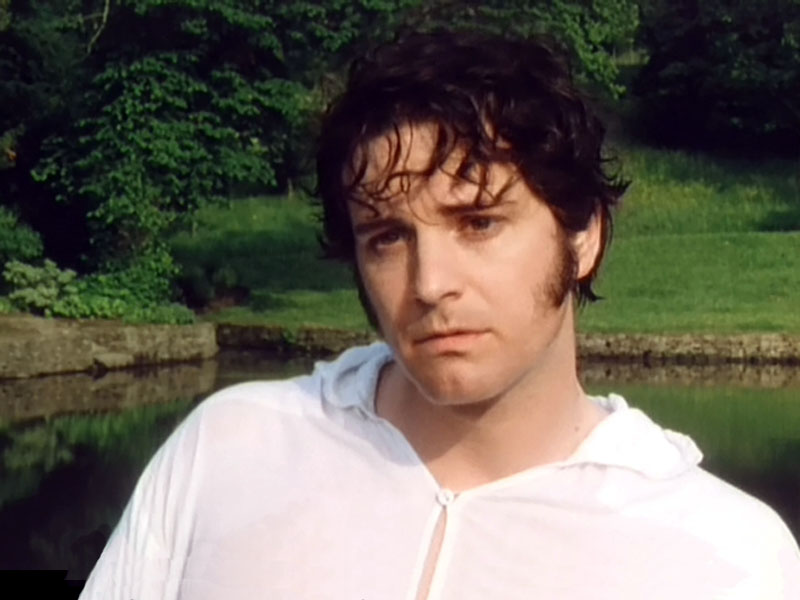
As you might be able to guess, Melissa is a massive fan of the classic BBC Pride and Prejudice miniseries. Is she simply ticked that the new version will not feature the smoldering, tousled good looks of Colin Firth? Admittedly, that may be part of it. But I suspect there is something more at work in her ferocious reaction. What it comes down to is this--as far as my wife is concerned (and clearly she's not alone) Pride and Prejudice has already been done. The miniseries was practically flawless; who could possibly want to watch--or be responsible for exposing a loved one to--an inferior adaptation when such an excellent treatment is still available? In short, we already have the definitive version of Pride and Prejudice; that's what people should be watching. For movie studios to waste their time creating another, likely bad adaptation of a such a classic piece of literature is not just foolish....it is, in a sense, disrespectful of what the BBC achieved.

I'm not a fan of Jane Austen the way Melissa is, but I can see where she's coming from. I'm only going to compare the new version to the old, and I'm confident the new version will come up short, so why bother? Yes, yes, of course--copying and adapting and transforming old stories into new is what art is all about, right? I don't disagree, particularly when it comes to film, theater, and song. But even if I grant the importance of innovation and recreation, can't I also insist that some works of art are just so excellent, so complete, so full on their own terms, that one can be forgiven for wondering is there's anything besides the lure of a fast buck behind those who insist on continuing to rework these stories and songs and images even further? (Case in point: Madonna's atrocious cover of the classic "American Pie." Another case in point: Jonathan Demme's The Truth About Charlie, an insulting remake of the flawlessly smart Charade.) I think Melissa is right when she says, in essence: there's no reason to offer me another Pride and Prejudice; Keira Knightly and Co. can't offer me a take (at least not a "realistic" take, which is what the BBC version and this new one both presume to be) on the story that's already been done about as well as can be done. So just don't bother.

Of course, not everyone will see it that way, as not everyone recognizes the same definitive versions of particular works of art. Some people insist that the original production is always definitive (I would argue this is almost always the case with the Beatles; I have only rarely heard a Beatles cover that is even comparable to the original), whereas in other cases a song or book or film fairly begs for more definitive treatment (I would argue this is the case with most of Bob Dylan--while his oeuvre has suffered from hundreds of crappy covers, more often than not it is other performers who really nail the spirit of his own songs: think Hendrix's "All Along the Watchtower"). Sometimes an adaptation utterly transforms what came before (Bobby Darin's cover of "Mack the Knife"), thus setting the stage for a whole new raft of interpretations. And sometimes an artist will cover himself, thus putting an interesting spin on what constitutes a definitive version (which is the superior version of Hitchcock's The Man Who Knew Too Much--the 1934 with Peter Lorre, or the 1956 with Jimmy Stewart?).

I can think of a handful of movies and songs that I consider definitive, basically unsurpassable--I'd rather listen or watch them over again than anything else that might come down the pike: Robyn Hitchcock's "Robyn Sings" (a complete cover of Bob Dylan's Royal Albert Hall concert); the 1959 Julie Andrews/Rex Harrison London recording of My Fair Lady; Harry Connick Jr.'s covers of "Pure Imagination," "Maybe" and other standards on "Songs I Heard"; the whole movie Singin in the Rain (every song in the film is a remake from the 1920s and 30s); Ray Charles's "Georgia on My Mind" and "It's Not Easy Being Green" (what, you thought that was a children's ditty? guess again!); Kenneth Branaugh's Henry V. I treasure them all, just like Melissa treasures her BBC Pride and Prejudice. What are your definitive versions? Do you have any?

Friday, September 23, 2005

Liberalism and Antiliberalism in Fast Food Nation

As promised, here are my thoughts about Eric Schlosser's Fast Food Nation: The Dark Side of the All-American Meal. It's been out for a few years now, obviously, but the data and arguments it presents aren't any less relevant, and it remains a great read--you can engage the book from the perspective of economics, sociology, agriculture, cultural history, or any number of other viewpoints. That's probably one of the reasons WIU chose FFN to build this year's "First Year Experience" around--every freshman was given a copy of the book, and there have been a variety of activities and seminars to give students and teachers an opportunity to talk about the book and its arguments further. I gave one of the first faculty presentations on the book, a couple of weeks back, so I figured I might as well recycle my comments into a post, especially considering that, on my reading, FFN exemplifies the need to think about how one frames the debate about consumption before (or at least while) engaging in it.

FFN is divided into two parts: "The American Way" and "Meat and Potatoes." The second section is appropriately named, since that is where Schlosser digs into the real mechanics of fast food production in America and around the world: the potato farms, the chemically designed tastes, the feedlots and slaughterhouses (and the appalling health and safety conditions within), the health hazards of modern meat production, and so forth. It is also in this section where Schlosser's attack on the "all-American meal" is clearest and most powerful. The details are often disturbing, sometimes disgusting, and always fascinating. He talks about how the meatpacking industry has systematically lied about the environmental damage wrought by its huge slaughterhouses; how it purposefully relies upon the most vulnerable of all labor pools, illegal immigrants (and digs up an incredible exchange from a federal investigation into slaughterhouse practices, in which the head counsel for one of the largest meatpacking conglomerates openly admits that they want conditions to be primitive enough that they have a lot of turnover in the plants, because short-term employees don't receive health insurance, to say nothing of vacation time); and just how dangerous certain jobs in the meatpacking industry today really are. And, of course, he is anything but reticent about the health costs of such huge, sloppy, risky, bloody, unregulated meta-production practices: there is, quite simply, an awful lot of shit in our meat. Schlosser's investigative work here echoes great exposes of the past, of course, like Upton Sinclair's The Jungle; but he goes beyond them by examining the ins and outs of the labor struggles, corporate duplicity, real estate shenanigans and business monopolization which produces the food which then gets served to us with such regularity all across the globe. It's a great, scary, persuasive attack on a system that regularly eludes both presumed health and economic norms and explicit government standards.

Schlosser's conclusions, then, should not be surprising: there needs to be a stricter enforcement of labor laws, OSHA regulations, and the minimum wage (fast food chains, both along their production line and at the service end, routinely churn through workers with the aim of keeping job training costs to a minimum, all the while benefiting from government subsidies which reward them for taking "risks" on new workers); inspectors from the USDA and FDA need to be given sufficient centralized authority and manpower to demand investigations and keep their own records (current laws allow meatpacking plants to essentially set their own schedules for investigations); antitrust laws need to be turned against major agribusiness conglomerates (there are today, amazingly enough, only about 1000 potato farmers in all of Idaho, a relatively weak and disorganized group in the face of big fry companies that dominate the market); and so on. He takes, in short, what would be widely recognized as a liberal stance, or at least a liberal egalitarian or a positive liberal stance: that it is the responsibility of the government to work to create conditions wherein people choices and lives are empowered and improved. Through the regulation of worker safety and insurance, health standards and procedures, and labor and corporate relations, the industry can be made cleaner, safer, less economically exploitive and dangerous, and more secure--and it can be done, Schlosser persuasively argues, pointing to several instances in which McDonald's and other large fast food chains quickly and radically changed some of their basic practices when under popular pressure, at very little ultimate cost to the consumer. Reform liberalism at its best, you might say.

The problem with such a reading of FFN, however, is that it doesn't do justice to want Schlosser is attempting, with (unfortunately) much less success I think, to do in the first part of the book. In those chapters, he spends his time talking about the emergence of the fast food industry and the social and economic developments which made it possible (including the huge economic push to Southern California, the home of the first true fast food chains, provided by the military-industrial complex, and a wonderful and terrible story about how General Motors, with the assistance of other automobile companies and various oil interests, managed to secretly purchase and bankrupt trolley and rail companies across the country, thereby enabling the dominance of car travel in 20th-century America). He tries to get inside the heads of those who pioneered fast food, and those who work at it today. And again and again, he makes clear his deep dissatisfaction with our reigning commitment to speedy, homogenized, cheap service, no matter what its consequences to our lifestyle. Unfortunately, that dissatisfaction is not very easily articulated in the context of his reportage, because few of those he profiles feel it themselves. And so, Schlosser has to make that point for them, sometimes condescendingly. A highlight comes early in the book, as part of an interview with Carl Karcher, one of few surviving pioneers of fast food's early days:

"I looked out the window and asked how he felt driving through Anaheim today, with its fast food restaurants, subdivisions, and strip malls. 'Well, to be frank about it,' he said, 'I couldn't be happier.' Thinking that he'd misunderstood the question, I rephrased it, asking if he ever missed the old Anaheim, the ranches and citrus groves.
"'No,' he answered. 'I believe in Progress.'
"Carl grew up on a farm without running water or electricity. He'd escaped a hard rural life. The view outside his office window was not disturbing to him, I realized. It was a mark of success."

That Schlosser is disturbed by all that he sees--the obsession with growth and profit, lowering costs and increasing speed, reducing everything to its most simple, reliable and repeatable common denominator--is quite apparent; it comes through all the time in the text, particularly in the first part of the book. He profiles a Little Caesar's Pizza franchise owner in Pueblo, CO, and recognizes him as a pretty hard-working, decent, and caring fellow; yet when this restaurant owner chooses to do something nice for his employees, Schlosser can't help but be appalled at what he does: buy them all tickets to a "Success Seminar" where they get exposed to celebrities touting this or that nostrum for personal wealth and fulfillment, an event which Schlosser thoroughly ridicules, except for the moment following a powerful address by Christopher Reeve, at which point he writes that "[e]everybody in the arena, not matter how greedy or eager for promotion...know deep in their hearts that what Reeve has just said is true...[t]heir latest schemes, their plans to market and subdivide and franchise their way up, whatever the cost...vanish in an instant. Men and women up and down the aisles wipe away tears, touched...by a sudden awareness of something hollow about their own lives, something gnawing and unfulfilled." And then, predictably, this moment of awareness is followed by a crass pitch from a New Age dietician.

His point is clear: the spirit of growth is morally bankrupt and intellectually worthless; the ability to parlay every choice into an opportunity, the central promise of the hyped-up, globalized, speedy service American way of life, isn't worth it. Schlosser lays his cards on the table at the end of his Afterword, when he writes: "Whatever replaces the fast food industry should be regional, diverse, authentic, unpredictable, sustainable, profitable--and humble. It should know its limits....This new century may bring an impatience with conformity, a refusal to be kept in the dark, less greed, more compassion, less speed, more common sense, a sense of humor about brand essences and loyalties, a view of food as more than just fuel. This don't have to be the way they are." It's a powerful ending. The problem is, it's not really a liberal one. On the contrary, all that talk of regionality, authenticity, limits, humility, compassion, and common sense, sounds like the sort of think a conservative like Edmund Burke might say (and probably would, were he alive today and being shuttled through some soulless American suburb on a quest to find a Burger King).

Of course, plenty of liberals do talk like that, about how "the people" (Americans, the middle class, whatever) have foolishly bought into an overconsumptive way of life that divorces them from simpler, more authentic pleasures, and which along the way is making them less healthy and less happy. Strictly speaking, however, when someone starts actually attacking our whole culture of consumption and growth and speed as Schlosser does, they are not longer engaging in liberalism reformism: this is no longer about using the government or education to improve the quality of extent choices (making for cleaner slaughterhouses, purer meat, less exploitive restaurants, etc.) and thus increasing, in a positive way, the liberty of persons; no, this is about actually judging, and perhaps limiting, the sort of choices people can make. A good liberal egalitarian wants McDonald's to operate in a more equitable and enlightened manner, but only an antiliberal actually thinks we would be better off without the sort of "liberties" (namely, being able to eat a cheap meal pretty much anytime that will taste the same pretty much anywhere in the world) which McDonald's makes possible. Perhaps it isn't strictly conservative, or communitarian, or socialist--but it definitely moves in that direction. (Perhaps if Schlosser had leavened his book with ideas drawn from real critics of liberalism, thinkers like Christopher Lasch, Roger Scruton, or Immanuel Wallerstein, then we'd know if we was more populist, traditionalist, Marxist, or what.)

This is most obvious when Schlosser talks about advertising. Like a great many self-described liberals, he thinks (and I agree with him) that great damage is being done to the diets, health, and material expectations of children by the incessant and often misleading advertising which fast food chains engage in, especially insofar as tie-ins to popular culture goes. (Schlosser takes several tired but still pertinent shots at Walt Disney, and how his empire both anticipated and enabled the fast food mentality.) His solution is to demand that all television advertisements aimed at children that promote food high in fat and sugar be immediately banned. And, of course, this solution puts him square in the middle of that uncomfortable intra-liberal debate over just how legitimate it is for the government to control the "speech" of advertisers--who are, after all, simply making known and encouraging a particular choice. I don't want to argue that point out here--my position, to anyone who has read this far, is probably obvious, and the opposite position, which refuses to grant any greater persuasive power (and thus acknowledge any greater need for regulation) to the market than to ordinary political speech, is pretty well laid out by my friend Nick on his new blog here. I just want to observe that if you truly believe that our ability to make choices is being warped in unhealthy and environmentally unsustainable ways by economic conditions and powerful interests, then you must not believe that individual choice is all that inviolable in the first place. Which probably means that you think choice is of limited valuable unless people are in a condition to make the right (cultural and social) choices. Schlosser's investigative work, and his clear if implicit conviction that much that is wrong with the fast food industry goes back to our having been placed on a conveyer belt that has conditioned us to expect regular delivers of ever more food, ever more cheaply and ever more reliably, shows him to be thinking about fast food in structural and moral terms. And those are terms which demand a critique of liberalism, not a repair of it.

In practice, of course, such liberalism and antiliberalism are somewhat reconcilable. Schlosser speaks admiringly about a few fast food chains that don't play by these rules, and thus break out of the culture he condemns (and, not coincidentally, therefore serve high quality, good tasting food). These places--Conway's Red Top restaurants of Colorado Springs, or the In-and-Out Burger chain in California and Nevada--are owned by families, not corporations; they reject the franchise model; they pay their employees a good wage with benefits (and thus keep employees for a long time); they buy and make their food fresh (no prefabricated syrup for the shakes, no microwaves for the burgers, no pre-pealed, cut, and frozen potatoes for the fries); and--perhaps most tellingly--they are highly idiosyncratic, with their respective companies replete with old family mottos and scriptural injunctions. That's a populism that can't be called into existence by more or better government regulations. But at the same time, one can easily imagine a reformist, regulative response to the fast food industry which was aimed explicitly at preserving and extending such local ownership and variety. A good example which was brought up during my presentation was Germany's approach to beer: the country has tight regulations in place, refusing to allow any drink that is made with more than a few key ingredients, or prepared in a manner that doesn't involve a significant amount of hands-on work, to be labeled "pure beer." (Until 1987, the restrictions were even stronger; such drinks could rarely be sold anywhere in West Germany.) One could, of course, point to the actual history of the Reinheitsgebot and snicker at how it originally was more about Bavarian protectionism than Deutsch authenticity, but that doesn't change it's practical effect today: it has helped create a beer culture that insists that there are some things that really ought to be left as they are, not speeded up, or watered down, or shipped everywhere hither and yon. A regulation which is premised upon a purity and health requirement has helped shape much more than the range of (liberal) choices available to consumers; it has helped conserve and socialize an authentic, limited, local set of consumptive practices, practices not at all dissimilar to those Schlosser is plainly hoping for. (Another example of such a compromise are some policies which my own family's has benefited from; a topic for yet another post on these interrelated themes.)

So perhaps, in the end, FFN is one of those many works that wish, whether in an informed or a merely naive or unconscious way, to make use of liberal state to reform conditions so that at least partially non-liberal, localist forms of life might be preserved. Of course, this leaves unasked the question of whether such is even coherent: can liberal empowerment do anything more than just generate, intentionally or otherwise, ever more liberal bureaucracies and expectations? A hard theoretical question, and not one Schlosser is in a position to help us with. But if nothing else, he does a superb in helping us deal with the question of whether we should eat at McDonald's, and thus endorse the exploitations of powerful agribusinesses, the abusive labor practices of meatpacking firms, the terrible health standards of the meat they serve us, the disruptive economic impact of chain proliferation, not to mention exposing ourselves to E Coli, mad-cow disease, and any number of other hamburger-born pathogens that arise from this country's depraved and foul meat-production procedures. Can you guess what his answer is? I knew you could.

Thursday, September 22, 2005

The Fat of the Land

Well, it's the first day of autumn, 2005. A good time for another long, meandering post, don't you think?

I was up early this morning, and went for a short bike ride in the pre-dawn light; a deer, a fox, and a couple of raccoons crossed my path, as the sky slowly turned a lighter and lighter shade of blue and pink. This is a great time of year: it gets me thinking about the harvest, good food on the table, a sense of the land wrapping things up for another season. All that, plus fat. Unfortunately, it's hard not to think about that when I'm out sweating on my bike. I'm 6'2", and I'm tipping the scales at just under 230 lbs. For years after I reached my full height, I was fairly slim--I stayed at 185 lbs. for most of my undergraduate career, maybe maxing out around 195. Then came marriage and graduate school and the dissertation, and suddenly I'd put on twenty pounds. And despite numerous half-hearted plans to reverse the trend, there's been a slow but steady increase ever since. No, I'm not particularly overweight or out of shape, but I've definitely grown a gut.

I've never really been tempted to hit the gym, submit to a fierce diet regime, and turn myself into a physical Adonis (assuming I even could)--I don't want to work that hard. (Not to dismiss the example of those who do--like an old friend of mine who has gone in just a few years from being heavier than I to being a competitive marathon-runner.) Plus, I suspect that many of the pressures which get brought to bear on those who aspire to "fitness" are, as Hugo Schwyzer smartly put it, "less about health and more about attempting to conform to an unrealistic beauty standard." Still, I don't like how I look, mainly because it is manifestly the case that I'm not living as lightly (literally) as I could be. And that's become increasingly important to me over the last few years: living simply and ethically, which among other things puts a big question mark over many of our activities and life choices (including how one uses or abuses one's body, as well as what one puts into it).

This probably sounds like just more of my usual leftist communitarian shtick, and it is partly that: I'm hardly immune to all the condemnations of fast food, SUVs, mini-mansions, suburban sprawl, capitalism, or America itself out there which frame themselves as attacks upon the costs and crudities of bigness and overconsumption. (I recently gave a favorable presentation to a faculty group here at WIU on Eric Schlosser's Fast Food Nation; I'll try to get a post about that up in a day or two.) And let's be honest--a lot of those sorts of critiques are driven by an elitist disdain, or the mad desire to be one of those wealthy, informed, superior, beautiful people who get to look down all the rest of the McDonald's-patronizing proles out there. Many ugly or at least wholly irrelevant sentiments can get wrapped up in the criticism of fatness, sentiments that Daniel Ben-Ami does a good job exposing in this article. Not that I agree with his rejection of the anti-overconsumption line of thought, not the least reason for which being his failure to actually engage any of the more serious arguments out there attacking how so many of eat, buy, and live. Instead, Ben-Ami is content to simply affirm that, well, of course all consumption is good, because all consumption reflects the desire to improve oneself materially and enjoy the benefits thereof, and who could possibly be against an increase of material wealth in the world, especially amongst the world's poor? That, dare I say, doesn't come close to touching on the real issue....which is what makes all the more interesting that he does get to the heart of the matter in a casual aside that deserves a lot more thought than he gives it:

"[A] key part of the reason [for the popularity of the anti-overconsumption argument] is the institutionalisation of the idea that there is no alternative to the market. Capitalism, in one form or another, is seen as the only realistic way of organising society. In terms of political debate there is what Thomas Frank, a liberal social commentator, describes as 'the systematic erasure of the economic.' In other words, cultural matters are open for debate but fundamental economic questions are not....Matters related to the sphere of consumption are [thus] open to debate. This includes not just the literal act of consumption itself but related questions such as brands and identity....In contrast, the productive sphere is seen as fixed. This is not just a technical question of the manufacturing process for, say, semiconductors or plasma screen televisions. It means that the possibility of developing a qualitatively better economy is denied. Humanity's creative potential, including the possibility of transcending the limits of the market, is banished from discussion."

For Ben-Ami, this just means that we need to shake off our doldrums and get fascinated again with the "productive" side of the equation again. Bring back supply-side economics--we need to concentrate on growth, on making everyone just as fat as Americans are! But what it suggests to me is the possibility that the argument about "fatness" often gets weighed down with condescending and unwarranted judgments exactly because those who criticize consumption are themselves committed to fixed economic perspective: they can only think of themselves as consumers, and so all there is to do is complain about all those other (lousy, low-class, overweight, irresponsible, trashy) consumers out there who haven't figured out the right way to spend their money or time, the right foods to put into their bodies so to maximize bodily outputs. As long as that is the only frame of reference available, then of course the debate won't go anywhere: if the protesters outside the McDonald's restaurant are nothing but (upper-class, well-educated, oh-so-enlightened) consumers themselves, trying to get the patrons inside to get with the program, well, it won't surprise me to see the Big Mac win every time.

Fortunately, that's not the only frame of reference available. If one turns away from the idea that one is expected to be contributing to the "right" parts of the economy by making the "right" choices, and instead reconsiders the economic sphere in light of entirely different, not necessarily consumptive and choice-driven priorities, then it becomes possible to makes certain critiques without necessarily falling into exclusive or condescending language. A friend of mine recently returned from France, and like so many who visit that country, was impressed at how healthy and fit the people he met were, how there seemed to be an inverse relationship between how little the French obsessed about food and looks, and how well they ate and appeared. Sure, his observations are just anecdotal, but they're also quite common, and the explanations behind those observations are probably not any less true for being commonplace: the stereotypical Frenchman or Frenchwoman eats more slowly and walks more; it takes longer to get things done, and the things done take up more time than most Americans are willing to accept. Put in more theoretical terms, one might say that they move bodily through a more circumscribed world, where more foods are local, more daily routines and circumscribed, and diets and habits have an organic connection (or, at least, far more organic than is the case for the average American city-dweller) to the natural limits of things. They see something else beyond the food and the road, that's all. The French may be among the world's foremost "fat American"-bashers, but it's quite possible that, when one gets down to fundamentals, most of them aren't doing so just because they think we all ought to change our diets: perhaps it has more to do with an amazement at the narrow, locked-in way (more food, faster food, more diets, faster diets, etc.) in which we approach the whole matter of consumption in the first place.

This needn't be cast in American/anti-American terms. Might it not be the case that, at least on some level, those all around who live healthily aren't doing so solely because they want to make themselves into a certain sort of person (with the tight stomach and firm abs), but because they genuinely find a certain kind of joy and empowerment in constraining and disciplining themselves? Of course it is--just listen to any long-distance runner or biker talk about the groove they fall into, how they find a deep reward in being able to relate to and feel their body in a way that has nothing to do with consumptive inputs and productive outputs. And, if you listen carefully enough, you'll find the same sort of language coming from fine chefs and fans of good food all across the country. For them, the point is to get away from the one-meal-follows-another-routine: by tuning (and therefore limiting) their minds and bodies to meals and ingredients that can't be reduced to quick, mass-produced fuel, they can consume (often luxuriously!) without losing sight of everything else food can be. I don't mean to collapse all this to a single theoretical observation, but I think it's compelling nonetheless: in my experience, people who are really close to, really appreciate, and loving indulge in the bounty of the world around us are rarely poster children for gluttony; similarly, the truly healthy people are rarely those who viciously hit the gym after every (thoughtless) lunch meal, trying to cut themselves a perfect body before rushing back to work. Good food and good health require a much simpler submission to the rhythms of the world, at least to some degree; I don't know if you could really get away with calling that an "economic" question, but I do suspect that refusing to acknowledge the pace of one's own personal economy is a sure way to fail to enjoy all that one's body allows. And as one's personal economy is at least partly a function of the larger, public one....well, I guess this comes back to the "American way of life" (or at least the rather hyped-up version of which that has dominated the public imagination for many decades now) after all. In the abstract, it seems so hard to imagine that we can and should re-assess how we manage our pace and presence in the world; when confronted with distant examples--like the French--the tendency is to insist (like the good "realists" we imagine ourselves to be) that those who resist the lure of the cheap and compact and quick are fooling themselves: that the traditional French diet (which is arguably in decline anyway!) is nothing more than "trick[ing oneself] into experiencing what is actually self-denial as a kind of pleasure." Heavy word there, "trick." It assumes that there's some falsehood lurking around. But doesn't that beg the question? Why is the pleasure that one can find in such alternative construals of the modern world necessarily false?

Last weekend we went out to visit a small Amish community near Macomb. They're farmers and carpenters; they run a local grocery store and sell some baked goods. Nothing special. But we've been lucky enough to find, through them and other local organic farmers, suppliers for a lot of our meat and vegetables; we're taking baby steps towards becoming more sensitive consumers. (Part of this is a return to something I grew up with, a topic I also need to blog about soon.) The Amish and other small farmers we've met around here are hardly svelte; they probably don't work out much. Some of them have guts that put mine to shame. But they look pretty fit too. And why shouldn't they be? The harvest is coming in; they're enjoying the fruits of their labors (literally, in some cases). They work hard, and eat pretty well, and live a life which, as any economist could tell them, they probably ought to have abandoned long ago--that is, assuming they want to get ahead in life. Thankfully, not many of them do: or at least, they don't accept that such "getting" ought to involve getting away from a more landed (in every sense) way of life which provides with them with more than enough to get fat on. That's a fatness, one might say, that you could be proud of.

(More here, if you're actually still interested.)

Tuesday, September 06, 2005

A Week of Ideas and Anguish

Last Wednesday I flew to Washington D.C. for a busy APSA meeting--I presented a paper (one version of which you can find here), chaired the aforementioned discussion about conservatism with fellow bloggers Henry, Scott, and John (we hope to get their papers, plus our discussant's comments, up on Crooked Timber fairly soon), and served as a discussant myself on a panel on early 20th-century Chinese liberalism, which I probably sweated more about than any other event from the whole four days. (I don't think I've so much as thought about Sun Yat-sen, much less read anything about him, since I was getting my M.A., over a decade ago.) Plus interviews, plus meetings, etc. It was a very busy and engaging few days, as APSA always is for me. I know academics who get burned out on conferences, and perhaps someday I will as well, but so far I still crave them--they're where I get my batteries recharged, where I get jazzed on the latest argument or insight or publication. I'm lucky that I've been able to attend as often as I have.

Lucky--now there's an understatement. There I was, along with a few thousand of my professional peers, hanging around a couple of hotels in D.C., buying books, swapping stories, arguing over papers and drinks, going out to dinner. But not just that--because whenever there was a free moment, in the mornings or evenings or during the day, people were talking about Katrina and New Orleans, crowding around the TVs to watch the latest horrifying footage. Flooding, starvation, fires, chaos, violence, despair, disease, and massive, massive incompetence. It was the topic of almost every non-profession-related conversation I overheard or participated in; and in fact became the topic, either explicitly or implicitly, of more than a few of those discussions as well.

Two of such stand out. On Thursday I got together with Damon Linker, an old friend and our discussant for the conservatism panel on Friday. He told me about the David Brooks column from that morning, with its invocations of terrible, catastrophic floods from America's past (the Johnston, PA, flood in 1889; the hurricane which destroyed Galveston, TX, in 1900; and most importantly the awesome Mississippi flood of 1927), and the huge, and hugely unpredictable, consequences they have had on the socio-economic fabric--and the political leadership--of the country. He ended that column writing:

"[F]loods are also civic examinations. Amid all the stories that recur with every disaster--tales of sudden death and miraculous survival, the displacement and the disease--there is also the testing. Civic arrangements work or they fail. Leaders are found worthy or wanting. What's happening in New Orleans and Mississippi today is a human tragedy. But take a close look at the people you see wandering, devastated, around New Orleans: they are predominantly black and poor. The political disturbances are still to come."

While talking about this over our snacks, watching CNN out of the corner of our eyes, my friend predicted the end of Bush. His approval ratings will be at 35% or lower within two weeks, and won't recover. The Democrats will be able to hang so much on him that it'll take a massive blunder on their part for Bush's record not to create a huge opening for them in 2008.

I was thinking about that discussion when, Saturday morning, I checked out a panel discussion on progressive politics in the U.S., with presentations by Rogers Smith and Bill Galston, and comments from Jeffrey Isaac. Each presented some fascinating information and controversial opinions; a great discussion overall. But what really stood out to me was Isaac's apparent lack of confidence in any of these devastating events to actually translate into reform or any kind of progressive political action at all. He said he certainly hoped heads would roll, that the voting public would respond productively to these terrible visuals of poverty, disarray, and finger-pointing . . . but he doubted it would happen. Instead he feared, he said, that the majority of American citizens have become so convinced of their isolation from, or so settled in their opinions about, public life that they simply couldn't be roused, much less led to demand accountability from, their (mostly Republican) leaders. President Bush will hug people and try to come up with money he's directed to be spent elsewhere, FEMA Director Michael Brown will talk about how hard he's trying, the libertarians will tell you that the government couldn't possibly have done any better anyway, and soon the masses will be led on to the next media event. (Katrina? That's old news. Yes, yes, all the refugees are starving in the Houston Astrodome, we know. But hey, Rehnquist died! Hit the Senate lights; it's confirmation time.)

I don't know which it'll be. Brooks's latest suggests that we are at the "bursting point," and that even Republicans are "mad as hell" at an administration which has systematically, if unintentionally, underfunded and misdirected the federal government's ability to fulfill its most basic responsibility: collectively providing security and aid at a time of crisis. Laura thinks that David is right: that no one "can seriously talk about small government now"; that "perhaps this will lead to more consciousness of the poor in their own backyard"; that seeing as how "one of the major accusations of the relief effort was that troops couldn't be sent in to Jefferson Parish, because they were in Falluja," we can be certain that popular support for the war in Iraq has probably ended overnight. I hope she's right. Certainly Brooks's columns are exactly the sort of thing which Timothy Burke ("I do honestly beg your pardon for saying so to those of you who are regular Republican voters, because I know you're not necessarily at all the same as the people who now represent your party on the national stage . . . [but if] you can't be bothered to draw the line between your decency and the screaming indecency of your leadership, then what's the point?") and Henry Farrell ("Bush and his friends and supporters tell us that they're conservatives. Conservatism, if it has any moral content at all, is supposed to be a political philosophy of values, of taking responsibility for one's actions and inactions. Not press conference spin, blame shifting and Potemkin relief efforts.") have been eloquently pleading for over the past few days. But does Bush read Brooks? More pertinently, do Republican voters? I think Damon was probably right at least insofar as that there's probably a couple of weeks worth of a window open, at most, for such anger to coalesce and have consequences. If his prediction isn't born out in that time, I fear Jeffrey's may be the more accurate one after all.

Thursday, August 25, 2005

Still Here

Yes, we survived the move. The day of the move itself--our anniversary, August 13th, as it happens--was pretty terrible: a U-Haul truck without air conditioning, and then a rainstorm to give us a respite from the heat just when we arrived in Macomb and needed to unload the truck. It was a long, sweaty, dirty, damp, miserable day. But did we really expect anything different? It's a rather humbling and sad thing to see all one's worldly possessions--all the clothes, furniture, books and boxes--shoved, like a jigsaw puzzle, into the back of a moving truck. You keep thinking it won't possibly fit, that you've got too much, that life has grown too complicated....but since you've got no alternative you just keep at it, twisting things this way and that, throwing stuff out at the last minute, and then suddenly it's done: your whole material existence has been reduced to a 24' by 11' by 9' space. And then, of course, you get to drive it somewhere, open up the truck, and let it all tumble out again, in a (hopefully unbroken) mess. Even under the best possible driving and weather conditions, I don't see how moving yourself could ever be a joy--and the larger your family, the less joyful it becomes. I don't have any deeper desire at the moment than for the job here at WIU to work out, and that is solely because the idea of moving again next summer gives me a headache.

I love WIU so far--the faculty and staff have been friendly, outgoing, and involving. I even liked orientation, if you can believe that; I just sat back, inundated with handouts and schedules, impressed that a regional university like this could have so much energy (and, not unrelatedly, sufficient money and organizational know-how to put that energy to productive use). I really can't say anything about my classes so far, except that I need to re-acquaint myself with teaching large sections, of which I have several. We also like Macomb, so far; as we'd hoped, we've obviously learned a few tricks over the years, and so acclimating ourselves and the kids to life in a small city, even smaller than Jonesboro, hasn't been hard so far. There's a lot of fun little things to discover around town, and we've been busy discovering them. (While there aren't any bike paths, there is also sufficiently light traffic that quite a few people ride their bikes everywhere, and I'm anxious to get mine back on the road after having been in storage for most of the last three years.) The girls are enjoying school so far, and our local church has been very welcoming. All in all, if we can blot out the memory of the move itself and ignore the unfinished and bothersome remnants of such all around us (the boxes that we really ought to unpack, but just don't have the desire to; the long list of things we probably should complain to the landlord about, but instead will probably just live with), we should be fine.

As always, there's a lot on my mind, and a lot I could write about. But don't expect anything here until after Labor Day--still too much work to do at home and the office, plus the upcoming APSA conference I need to prepare for. (I've organized a panel on conservatism which will feature Henry Farrell, John Holbo, and Scott McLemee, so I'm sure I'll want to say something about that on the blog afterwards.) A shout out to William Polley, an economist and fellow blogger who also began a new position at WIU this year, and has been kind enough to share his knowledge of the Midwest with me on a couple of occasions as we've made out transitions. I've been here less than two weeks, of course, so what do I know? Still, I think WIU and Macomb is going to bring some good opportunities our way.