Featured Post

WELCOME TO RUSSELL ARBEN FOX'S HOME PAGE

If you're a student looking for syllabi, click the "Academic Home Page" link on your right, and start there.

Sunday, March 06, 2022

On Simplicity, Transparency, and Educational Trust in Topeka
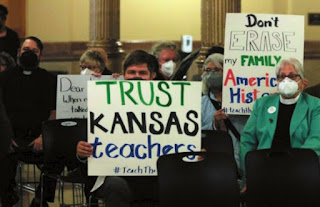
[A shorter version of this essay appeared in the Wichita Eagle here.]

There are several different ways to talk about the "Parent's Bill of Rights and Academic Transparency Act" being debated in the Kansas legislature. One obvious way is to look at the role of ALEC and conservative and Republican-leaning groups and activists in flooding state legislatures across the country with bills challenging what their advocates see as the unpatriotic curriculum often taught in public schools (usually associated with the "Critical Race Theory" bogeyman), employing the same claims which helped elect Greg Youngkin to the governorship in Virginia. But that perspective, though obviously correct, focuses only on the ideological and partisan actors at work in the promotion of this legislation. However polarized American voters have become, I also suspect that bills like this can ultimately only enjoy whatever popular success they do because they also appeal in part to a frustration and confusion, and certain kind of a longing for simplicity and trust, which is all but universal--because it seems to so often compromised-- in our modern lives. So as politically naive as it may be, I want to set aside the dark money accusations for the moment, and focus on that appeal.

That the ordinary lives lived by you and I and anyone else who may read this in the United States today--as in almost every other industrialized and post-industrialized economy--are regularly shaped by all sorts of complicated corporate, governmental, and bureaucratic systems is hardly a new insight (paging Rousseau, Weber, Berry, or my own pretentious writings about "simplicity" from the early days of this blog, more than a decade and a half ago). Almost no one like this, and almost everyone complains about it, but relatively few people--maybe entirely home-schooling parents, maybe off-the-grid Amish farmers, etc.--are both willing or able to reject the many goods (in terms of time, convenience, and specialized services, many of which are life-saving, but may others of which are, I'd like to believe most people would admit, merely distracting fun) which these complex, usually out-sourced systems provide. In the midst of this complexity and tension, how to hold onto the ideal of ordinary citizens being able to access the information to truly governing themselves? For some, like this bill's authors--or, probably more accurately, the audience for whom the ideologically disposed authors of this bill intended it--the answer is “transparency.”

That “transparency” is a key component of modern democracy is undeniable. If the decision-making of those whom we elect stays invisible, it invites corruption and poisons our civic health. But like “democracy” itself, the concept of “transparency” can sometimes become a totem, a term used to advance a cause rather than a standard to assess what is actually taking place. And that is, unfortunately, what I think has happened with this proposed educational reform. When a couple of Kansas legislators recently defended the bill, they only passingly mentioned the “unhealthy ideas” and “harmful ideologies” which they believed could find their way into the public schools. Instead, they focused upon how parents “have a right to know what their children are being taught,” claiming that the bill simply aims to guarantee “easy access to curricular materials that already should be available today,” and concluded by writing that there are no enemies in transparency. And on a certain level, they’re completely correct. 

Who, after all, likes to be kept in the dark, however unintentionally, by the specialized bureaucracies were are obliged to negotiate? When these two Republican legislators--both of whom, for whatever it's worth, are mothers and former educators themselves--point out that for “busy parents” the process of finding out just what exactly is happening in their children’s classrooms may be “unclear, unfamiliar, and tedious,” I would imagine that anyone who has ever had to negotiate the complex systems around us (think about trying to find a human being to talk to when calling to file an insurance claim or fix a problem your wireless plan) can relate.

But all the same, I wonder about their perspective on their former careers. The great majority of public school teachers I have known regularly bend over backwards to involve parents in their curriculum, and to help them through the process of understanding that curriculum, with frequent parent-teacher conferences, open houses, book fairs, and so much more. The history of our four daughters moving through Kansas's public schools haven't been conflict-free by any means (I can remember one rather tense meeting when we and several other parents confronted the principal of Wilbur Middle School over a division action a teacher had taken), but overwhelmingly, when have sacrificed sufficient time so to become fully familiar with and thus committed to the specialized work being done by the neighborhood schools our daughters have attended, the results have been pretty wonderful, and as close to collective, slowly built, long-term educational experience with pursuing the public good as I've ever known.

Weigh that reality--which I am sure I am not alone in having experienced--against what is actually in the proposed bill. It woulds require school districts to set up “transparency portals” to give parents online access to “each test, questionnaire, survey, or examination,” as well as explanations of the rationale behind each assignment and accounts of how any of the data collected from any of those assignments will be used in the evaluating the student, plus links to all the library materials used in any of the aforementioned assignments, and much more. In light of all that, it’s not unreasonable that many here in Kansas see bills like this as using the cry of “transparency” to express, instead, a simple distrust in educators themselves.

The bill won’t pass right now, thanks to strong Democratic opposition and dissents from some Republicans concerned about the intrusive governmental mandates it involves. But whether it dies, or sneaks through as part of an appropriations bill, or comes back again next year, the problem inherent to employing a valuable concept like transparency to justify creating more work and reporting for teachers whom parents should be talking to regularly anyway will remain. 

Outside of a complete embrace of home schooling, the classic small-r republican ideal of parents and teachers working together in local schools for the “the common good of the child”—as these legislators put it—will probably always face at least a little difficulty, since their roles and responsibilities of parents and teachers are different. Public schooling in America has always involved a balance between providing a private service to parents--providing their children with the skills and knowledge that will presumably benefit them in their adult lives--and a public good to society at large--introducing to minors civic concepts and a degree of cultural literacy which is judged to be appropriate to the responsibilities of adult democratic citizenship. That balancing act, in practice, will likely disappoint and frustrate as often as it succeeds; that’s what life in a complex, specialized society unavoidably brings us. Technological transparency may smooth over some of these frustrations, but considering its costs, maybe resisting the temptation to demand that the internet to be used to survey everything happening in one's children's classrooms at all times, and instead making the time to respectfully talk and listen, thereby showing trust in each others’ areas of concern and expertise, would surely be the better path.

Thursday, January 13, 2022

The Potential of, and the Problems with, Wichita’s (More) Partisan Future

[Cross-posted to Wichita Story]

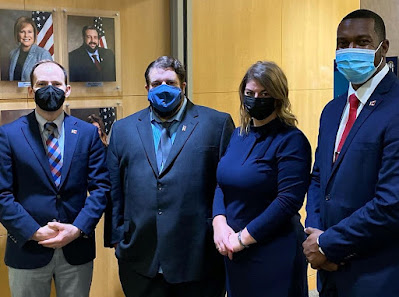
 (From left to right: Mayor Brandon Whipple; Mike Hoheisel, councilmember for Wichita District 3; Maggie Ballard, councilmember for Wichita District 6; Brandon Johnson, councilmember for Wichita District 6. Photo credit: Chris Pumpelly)

There’s been a lot of talk about the “new Democratic majority” on the city council that officially took power on Monday night. WSU professor Chase Billingham, in particular, observed last August what the consequences of the November elections might mean should they go the way Mayor Whipple wanted them to (which they did), and in a long Facebook post on Monday, Billingham considered a relatively small-stakes fight during last week’s council agenda review meeting in ways that makes his observations from last year seem pretty prescient: namely, that with three--presumably reliable--Democratic votes on the council, Mayor Whipple appears both capable and willing to pursue agenda items that he previously knew he wouldn’t have the votes to push forward. And he wants the Republicans on the council–who have long enjoyed an unstated and basically uncontested majority on the council but are now in the minority–to know it.

So is the business of the city council, or the way it conducts business, about to radically change, and if so, how should the people of Wichita feel about that? Answering those questions aren’t easy, because it obliges one to figure out just what the business of our, or any, city council, actually is--or ought to be.

Is the business of a city council the sort of thing which even ought to be construed in partisan terms, much less one where talking about having a “Democratic majority” on a council is meaningful? There’s plenty of reason to think “no,” and a lot of those reasons are echoed by the members of this Democratic cohort themselves. In a long article on partisanship in municipal elections published in the Kansas Leadership Center Journal last November, Ballard affirmed “local elections should stay nonpartisan in nature and focused on local issues,” while Johnson claimed that keeping city council elections and candidates “focused on the issues” makes it “harder to simply paint candidates with broad partisan brushes.” These views are reflective of a perspective that is more than a century old: the presumption that partisan groupings, being more national and ideological, have nothing to do with figuring out how to keep potholes filled and otherwise managing the rules and resources necessary for living and working together in a city, and hence that municipal elections shouldn’t involve candidates identifying themselves by a party label, much less running with the support of party organizations. Hoheisel echoed these presumptions in an interview after his election, stating that his “political leanings are irrelevant” to the business of the city council.

One problem with all these assumptions, however, is that they are not actually grounded in complaints over partisan identification or political beliefs. Rather, they really turn on the voting and funding practices which partisanship activity is usually seen as connected to, and the fact that many of those activities are seen as corrupting. To be sure, that’s a legitimate concern. However, there isn’t a lot of evidence that making municipal elections non-partisan actually evades any of those practices or activities (which, of course, shouldn’t be a surprise to anyone who remembers the mayoral election of 2019, where the lack of partisan labels certainly didn’t prevent corrupt actions and accusations from dominating the campaign).  In fact, the evidence mostly indicates that Democrats and Republicans elected to municipal positions tend to act—despite the constraints which our system imposes upon city governments–pretty similar to other Democrats and Republicans elected to all other political positions. And voters pick up on that similarity pretty quickly, with Democratic and Republican voters casting their ballots (and making their donations) accordingly.

This doesn’t mean Democratic or Republican voters are any less likely to hold Democratic or Republican officeholders accountable for failing to keep potholes filled, absent other considerations. Nor does it mean that national partisan positions will always be a good predictor of local partisan ones (for example, promoting bike paths, farmers markets, and alternative transportation and environmental sustainability generally are usually seen as liberal or progressive causes in the United States, yet Councilmembers Becky Tuttle and Bryan Frye, both Republicans, have been smart and consistent supporters of both). But it does mean that those “other considerations”—which reflect the wide variety of ways in which most of us identify our interests and respond to public concerns in an electoral way—are always going to be present. Going to extra lengths to prevent cultural or socio-economic or racial or any other considerations from “polluting” municipal elections by connecting them to partisan positions beyond those of pure municipal management is, I think, a fool’s errand (not to mention, given the way our system, for better or worse, strongly supports the freedom of speech and association, potentially unconstitutional). Allowing people to organize and run for office with those considerations—and those partisan connections—explicitly present would make possible a wider (and, I think, a more responsible) engagement with the diverse interests present throughout Wichita’s city council districts. Hence my belief that our city council elections should be partisan, as I’ve argued again and again and again.

But whatever your opinion on bringing partisanship to the forefront or hoping to keep it subdued when it comes to Wichita’s city council, the fact is that in 2019 Wichita elected a mayor who—as he put it in the same article which quoted Ballard and Johnson—has a “different viewpoint” when it comes to partisanship, seeing it as “less scary and dirty” than many may make it out to be. Whipple’s belief that partisanship is a valid—perhaps even unavoidable—tool when it comes to leadership is, I think, correct. That’s not a defense of the many ways in which partisan thinking makes compromise--which the fundamental, ambition-vs-ambition, Madisonian logic of our constitutional system accepts as essential—more difficult. The worries expressed by Lynn Rogers, Kansas’s state treasurer, former lieutenant governor, and a Wichita resident, about the rising partisanship in Wichita’s (and other Kansas) municipal elections, especially when it comes to rules about candidate eligibility, can’t be easily dismissed.

But it is also valid to note that parties and their members—both those who run for office and those who vote for them—don’t exist in a vacuum; they’re shaped by their electoral environment, and those shapings change as the wider environment does. Insofar as the state of Kansas and the city of Wichita are concerned, it is reasonable to see both of them as going through, however slowly, the same demographic and ideological transformations, particularly in regards to both urbanism and liberalism, as the nation as a whole has over the past 30 years. It’s also worth noting that Whipple and all three of the other Democratic members of city council members are young enough (clockwise from top left: Ballard—39; Hoheisel—38; Johnson—35; Whipple--39) to have been shaped by those same transformations.

None of this means, of course, that any of these folks are clones of Representative Alexandria Ocasio-Cortez or other youthful progressive darlings of the moment; they are all their own people, with their own roots and histories here in Wichita, Kansas, which is very much not New York City. (Whipple’s record as a rather moderate Democratic state legislator before he ran for mayor ought to conclusively prove that.) And yet…Wichita nonetheless is an American city, one that is, like other American cities, becoming more diverse than it was before, more progressive than it was before, and thus more Democratic than it was before. (Wichita may not ever be blue, but it went for Biden nonetheless.) And moreover, it’s not like the Kansas Republican party which those who identify as Democrats—like Ballard, Hoheisel, and Johnson--define themselves against hasn’t greatly changed over the same time period. So overall, I think it’s fair to wonder just how much of the angst some feel about Whipple’s willingness to bring partisanship, especially Democratic party partisanship, into Wichita’s municipal elections is a function of either 1) the way it potentially gives effective electoral expression to newly emergent—if hardly dominant--progressive interests in our city, or 2) the way it challenges the (admittedly often successful!) strategies which previous generations of Kansas Democrats developed to deal with Republican dominance, as opposed to solely because it presents a challenge to municipal norms and expectations. If nothing else, it is a question that serious political observers should keep in mind: that Mayor Whipple, by approaching city elections here in Wichita with an unapologetically partisan eye, may have made himself and the city of Wichita into a significant part of the story of party development in the Sunflower State.

I need to emphasize that “may,” however. Successfully building a partisan majority in a nominally non-partisan context will only ever be of interest to political nerds like myself if it isn’t conjoined with partisan direction that can be successfully pursued and will make a difference in the perception of voters; otherwise, that electoral achievement will be remembered by everyone who isn’t a partisan themselves as a lot of conflict which didn’t necessarily change the status quo. Hence, Whipple and the three other Democrats on the council need to be able to show voters that, now that they have a majority, they can do something that wasn’t done before, or do what’s been done before better. Given the heavy policy limitations which city governments operate under, that’s easier said than done. The recent struggle to pass a non-discrimination ordinance in the city, despite the sturm und drang which surrounded its writing and passage, might in retrospect be seen as low-hanging fruit in terms of distinguish votes on the council, at least in comparison to other municipal matters before them.

Among those issues that are most obviously within the legal grasp of the city council—including land use, business subsidies, and law enforcement--it’s not clear that these four Democrats will be sufficiently united as to make their majority position as effective as it might be. For example, Johnson has strongly advocated for expansive (and expensive) redesigns of our downtown core, and pushed against the idea of the council being wholly bound by public referendums on Century II and other historic buildings; Hoheisel, by contrast, has criticized new major downtown projects as inappropriate, spoke fondly of restoring Century II, and defended the idea of conducting a “binding vote” on its fate. Similarly Hoheisel, during his campaign, expressed significant doubts about retaining Robert Layton as Wichita’s city manager; whereas last week, both Whipple and Johnson gave Layton a strong show of support by voting to give him a raise. And while Johnson has long been engaged in efforts to change the Wichita’s overly violent police culture, the police union was crucial to Whipple’s election as mayor, and it is reasonable to presume that he wants to retain their support.

None of these facts suggest policy orientations that might not change or involve a significant rethinking or compromise once people get down to the nitty-gritty, of course—but by the same token they demonstrate, I think, some of the obstacles to declaring some immediately obvious common agenda which this Democratic majority shares. Which leaves this particular electoral accomplishment, at the moment, resting primarily on its members being young and new(ish) and thus, presumably, a breath of fresh air. In politics, where the ability to deal with others from a position of knowledge and influence is often key to getting things done, such freshness can only take you so far. Still, this is their first week, with everyone still getting used to the new arrangements; maybe only now, with these new members officially on the council, will we see some new unifying initiatives emerge that weren’t on anyone’s radar screen before.

Do I happen to have any recommendations for what those unifying initiatives might be? Why yes, I do...